Project Management for Small Projects shows you how to tailor bureaucratic planning processes to a sleek minimum while still keeping your project running like a well-oiled machine. The Project Management Body of Knowledge (PMBOK) recommends tailoring the planning processes to fit the size of your project, but it doesn't always fully explain how. Using too much process can be as detrimental to a project as not using a process at all. For years, this book has helped managers of small projects design processes that are neither too big nor too small but "just right." It provides simplified but compliant tools for immediate use in managing small projects. And since most small projects tend to be similar in structure or outcome, a template for one project can be used for future projects. This new edition of Project Management for Small Projects has been updated to align with the latest PMBOK. In addition, there is new material on Agile project management and on the essential leadership skills for small project managers.
Most organizations rely on a variety of projects, both large and small. Although small projects have unique challenges that are not present in large projects, small projects can still benefit from a defined project management methodology. To achieve maximum benefits, the processes, tools, and techniques must be scalable and adaptable. The more successful you are with managing small projects, the more opportunities you will have to obtain larger projects. Almost everyone, to some degree, is involved with projects and should be prepared to manage them effectively. Project Management for Small Projects suggests an approach that allows the project manager to apply structure and discipline to managing small projects while balancing the needs of the project with the project management methodology.
As we discuss project management practices, I will use definitions from the Project Management Institute’s (PMI) publications and other sources.
Project Management Best Practices
A best practice is an activity that has proven to be successful over time. Some project management best practices include:
• Using a project management approach that captures the intent of the project business case
• Developing a project charter
• Documenting project requirements
• Identifying what is in and out of scope
• Using a project schedule to plan and monitor project activities
• Developing a project budget to control project costs
• Managing project risks
• Communicating to project stakeholders
• Using project management tools, techniques, and templates
• Tailoring a methodology to fit the specific needs of the small project to address the competing constraints of scope, schedule, cost, resources, quality, and risk
PMI defines the project management body of knowledge (PMBOK) as a term that describes the knowledge within the profession of project management. The project management body of knowledge includes proven traditional practices that are widely applied as well as innovative practices that are emerging in the profession.1
Therefore, the PMBOK® Guide provides a foundation which I used to build the techniques for small projects.
Project Overview
Projects are a more important part of business now than they ever have been. They exist at all levels of every organization and must be managed proactively, regardless of size. Normally when we think of projects, we think of large initiatives such as developing a new product or service, developing a new information system or enhancing an existing one, constructing a building, or preparing for a major sports event. Small projects are not always viewed as projects and therefore are not always treated as projects—especially smaller, more informal projects, which are often called assignments.
Definition of a Project
“A project is a temporary endeavor undertaken to create a unique product, service, or result.”2 A project can create:
• A product that can be a component of another item, an enhanced item, or an end item in itself
• A service or a capability to perform a service
• A result, such as an outcome or document
• A unique combination of one or more products, services, or results
A project has three distinct characteristics.
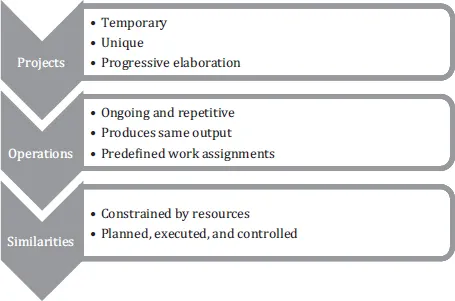
1. A project is temporary in that it has a beginning and an end. A project always has a defined start and end date. The project begins with a statement of work or some form of description of the product, service, or result to be supplied by the project, and it ends when the objectives are complete or it is determined that the objectives cannot be met and the project is canceled.
2. A project is unique in that the product, service, or result created as a result of the project is different in some distinguishing way from all similar products, services, or results. Unique also indicates that although a project might appear to be similar to another project because you are producing the same type of deliverable, it really is not. In both projects you are creating something that did not exist before. Even a revision to an existing deliverable is considered unique because the revised product is something that did not exist before.
3. A project is characterized by progressive elaboration. This means the project develops in steps and grows in detail. Progressive elaboration allows you to continually improve your plan by adding more detailed and specific information as more accurate estimates become available. When you are first given a project, you have limited information to work with, usually in the form of a high-level project description, the project objective, and some assumptions and constraints. The scope might be further defined, and the work activities for the project will have to be planned in detail as more specific information becomes available. Progressive elaboration allows you to manage to a greater amount of detail as the project evolves.
Projects also drive change in organizations. A project is used to move an organization from its current state to a defined future state.
Finally, projects enable business value creation. There is value derived from doing the work. Business value is the benefit that the results of a project provides to the project stakeholders and can be tangible, intangible, or both.
Another way to view a project is to see a project as something we do one time, as opposed to operational work, which is continuous and repetitive and is undertaken to sustain the business. Operational activities have no real completion date; they are ongoing. An example of a project would be to develop or enhance an accounting system. The operational activity would be to process biweekly payroll or pay monthly expenses. Both operational activities and projects are constrained by resources and are planned, executed, and controlled (figure 1.1). However, projects, due to their temporary nature, are initiated and closed.
Projects can intersect with operations in several ways:
• When developing a new product or result for an existing system
• While developing new or enhancing existing procedures
• When a project is completed and transferred to operations
Figure 1.1: Projects and operations comparison
Why Use Project Management on Small Projects?
Imagine being assigned a project to revise an existing process. You have a team of three subject matter experts to assist with the design and implementation. Where do you begin? What are you planning to deliver? When will this project be completed? How much will this project cost? What are the team members’ roles and responsibilities? The use of project management provides the discipline and tools for answering these questions.
Definition of a Small Project
Small projects are perceived to be relatively easy, but other than this there is no one way to define when a project is a small project. In some cases small could be defined on the basis of cost, such as costing less than $1 million. Cost is relative, however, and depends on the in...
Table of contents
Cover
Title Page
Copyright Page
Dedication
Contents
Preface
PART ONE. Project Management Discipline
PART TWO. Project Management Process for Small Projects
PART THREE. Additional Discipline
PART FOUR. Agile
Notes
Glossary
Acknowledgments
Index
About the Author
Trusted by 375,005 students
Access to over 1.5 million titles for a fair monthly price.
Study more efficiently using our study tools.
Frequently asked questions
Yes, you can cancel anytime from the Subscription tab in your account settings on the Perlego website. Your subscription will stay active until the end of your current billing period. Learn how to cancel your subscription
No, books cannot be downloaded as external files, such as PDFs, for use outside of Perlego. However, you can download books within the Perlego app for offline reading on mobile or tablet. Learn how to download books offline
We are an online textbook subscription service, where you can get access to an entire online library for less than the price of a single book per month. With over 1.5 million books across 990+ topics, we’ve got you covered! Learn about our mission
Look out for the read-aloud symbol on your next book to see if you can listen to it. The read-aloud tool reads text aloud for you, highlighting the text as it is being read. You can pause it, speed it up and slow it down. Learn more about Read Aloud
Yes! You can use the Perlego app on both iOS and Android devices to read anytime, anywhere — even offline. Perfect for commutes or when you’re on the go. Please note we cannot support devices running on iOS 13 and Android 7 or earlier. Learn more about using the app
Yes, you can access Project Management for Small Projects, Third Edition by Sandra F. Rowe in PDF and/or ePUB format, as well as other popular books in Business & Food Industry. We have over 1.5 million books available in our catalogue for you to explore.