- 256 pages
- English
- ePUB (mobile friendly)
- Available on iOS & Android
eBook - ePub
About this book
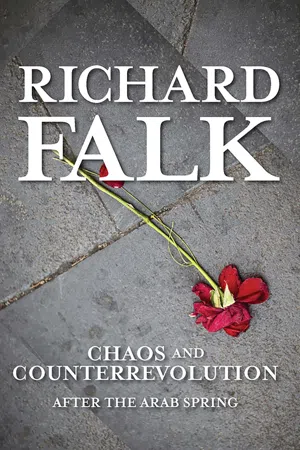
In Chaos and Counterrevolution, international law scholar Richard Falk explores the wave of popular protests that swept North Africa and the Middle East in 2011—and the rapid demise (or reversal) the protest movement suffered in most countries, soon thereafter. The protests of 2011 inspired a new generation to imagine a future without authoritarianism. Yet, this sense of hope soon gave way to pessimism, counterrevolution, and sectarian strife.
In this unique collection of blog posts and essays, Falk explores these developments in key countries like Egypt, Libya, Syria, Turkey, Iran, and Iraq, pairing his reflections on developments as they unfolded with his later analysis of the events.
This is a companion volume to Falk's Palestine: The Legitimacy of Hope (Just World Books, 2014.)
In this unique collection of blog posts and essays, Falk explores these developments in key countries like Egypt, Libya, Syria, Turkey, Iran, and Iraq, pairing his reflections on developments as they unfolded with his later analysis of the events.
This is a companion volume to Falk's Palestine: The Legitimacy of Hope (Just World Books, 2014.)
Frequently asked questions
Yes, you can cancel anytime from the Subscription tab in your account settings on the Perlego website. Your subscription will stay active until the end of your current billing period. Learn how to cancel your subscription.
No, books cannot be downloaded as external files, such as PDFs, for use outside of Perlego. However, you can download books within the Perlego app for offline reading on mobile or tablet. Learn more here.
Perlego offers two plans: Essential and Complete
- Essential is ideal for learners and professionals who enjoy exploring a wide range of subjects. Access the Essential Library with 800,000+ trusted titles and best-sellers across business, personal growth, and the humanities. Includes unlimited reading time and Standard Read Aloud voice.
- Complete: Perfect for advanced learners and researchers needing full, unrestricted access. Unlock 1.4M+ books across hundreds of subjects, including academic and specialized titles. The Complete Plan also includes advanced features like Premium Read Aloud and Research Assistant.
We are an online textbook subscription service, where you can get access to an entire online library for less than the price of a single book per month. With over 1 million books across 1000+ topics, we’ve got you covered! Learn more here.
Look out for the read-aloud symbol on your next book to see if you can listen to it. The read-aloud tool reads text aloud for you, highlighting the text as it is being read. You can pause it, speed it up and slow it down. Learn more here.
Yes! You can use the Perlego app on both iOS or Android devices to read anytime, anywhere — even offline. Perfect for commutes or when you’re on the go.
Please note we cannot support devices running on iOS 13 and Android 7 or earlier. Learn more about using the app.
Please note we cannot support devices running on iOS 13 and Android 7 or earlier. Learn more about using the app.
Yes, you can access Chaos and Counterrevolution by Richard Falk in PDF and/or ePUB format, as well as other popular books in Geschichte & Geschichte des Nahen Ostens. We have over one million books available in our catalogue for you to explore.
Information
1
Regional Perspectives
The general introduction is oriented around regional developments during the period covered by the blog posts in this section, and those broader issues will not be again addressed here. The themes emphasized can be briefly identified. They include a reminder of the unpredictability that exists throughout the region, and gives rise to a series of ‘black swans,’ that is, transformative events that are unanticipated until they happen, and then are laboriously explained by “the experts.” The complexity of the region has become apparent in recent years. More than other parts of the world the Greater Middle East (Arab world + Iran + Turkey + North Africa) is crosscut by a series of transnational conflicts and ideological passions that are additionally complicated as a result of their linkages to extraregional global patterns of intervention and rivalry.
Attention is also given to the Arab Spring as a regional phenomenon, and as an expression of distinctive challenges to the established order in each of the countries in the Greater Middle East. As we now know, the democratic promise unleashed by the extraordinary developments in early 2011 generated a phase two that mingled promises of democratic reform with authoritarian pushback, producing a variety of coopting and counterrevolutionary reactions that have caused the further hardening of authoritarian regimes, instances of persisting civil strife, and some cosmetic reforms.
Among the situational factors that has proved so significant has been various types of political polarization, perhaps most starkly observed in Egypt, but also evident in Turkey, Tunisia, and elsewhere. Several of the posts published here try to comprehend the specific contours and toxic effects of polarization, and how it diminishes prospects for democratization and respect for human rights. From the outset of the Arab Spring, reinforced by my several visits in recent years to the Middle East, I became more and more aware of the intensity of polarization, and its effect of delegitimizing opposing views whether it takes the form of majoritarian democracy that is contemptuous of the outlook of the opposition or the form of a discontented citizenry that withdraws legitimacy from the political leadership, whether or not it has been elected.
In addition to polarization are problems of sectarianism within Islam, the tensions that exist between Sunni and Shi’a Islam, as politicized through the patronage of their principal rival proponents in Riyadh and Tehran. There are intensifying interactions between political polarization, sectarianism, and dynastic anxieties about grassroots political Islam, best exhibited by extreme hostility toward the various country branches of the Muslim Brotherhood. The United States played the sectarian card during its decade of occupation of Iraq with disastrous results, and then belatedly has tried to urge the Shi’a leadership in Baghdad to be more inclusive.
Finally, the emergence of dreaded forms of political extremism are examined as consequences of external intervention and occupation, most especially the ramifications of the U.S.-led 2003 invasion and occupation of Iraq and the ongoing civil war raging in Syria since 2011. The challenges posed by these outbreaks of extremism prompt yet another cycle of extraregional intervention justified on counter-terrorist and humanitarian grounds, being addressed militarily with no willingness to explore diplomatic paths to regional stability. The U.S. government is particularly responsible for this dysfunctional reliance on military intervention implemented mainly by way of air strikes. The picture of the Greater Middle East that emerges from these posts is not encouraging, but as is stressed, the turbulence in the region is likely to cause unexpected eruptions in the years ahead that might bring more positive tendencies to the surface in more durable forms than what emerged in 2011. What lies ahead is obscure, but likely to alter dramatically our present expectations for political developments in the region and how these relate to world politics.
The posts in this section exhibit my early concerns as to whether the upheavals in the region, especially Egypt and Tunisia, could attain their democratizing goals, given the fact that only the rulers and immediate entourage were removed from power. The entrenched bureaucracy remained the core of the governing regime whether they approved of the upheaval or not. Furthermore, trusting the armed forces to manage a transition to a more democratic governing process seemed naïve, given their privileged role and material interest in stabilizing the former authoritarian regime.

Can Humanitarian Intervention Ever Be Humanitarian?
August 4, 20111
Not since the debate about the Kosovo war of 1999 has there been such widespread discussion of humanitarian intervention, including the semantics of coupling “humanitarian” with the word “intervention.” At one extreme of this debate about language stands Gareth Evans, former foreign minister of Australia and a staunch advocate of displacing the discourse on “humanitarian intervention” by relying on the concept of “responsibility to protect” (R2P). Evans was, in fact, co-chair of the International Commission on Intervention and State Sovereignty, which came up with the idea of R2P a decade ago. This approach to intervention was skillfully marketed to the international community, including the United Nations. Evans writes that they made the conceptual case for R2P “by changing the focus from the ‘right’ to ‘responsibility,’ and from ‘intervene’ to ‘protect,’ by making clear that there needed to be as much attention paid to prevention as to reaction and non-coercive measures, and by emphasizing that military coercion—which needed to be mandated by the UN Security Council—was an absolute last resort in civilian protection cases.”2
Insisting that the coercive actions in the Ivory Coast and Libya show the benefits of this approach, as contrasted with the supposed failures in the 1990s to take action in Rwanda, Bosnia, and Kosovo, Evans feels so vindicated by recent events as to plead that we “please lay ‘humanitarian intervention’ language to rest once and for all.” This raises three questions: Should we? Will we? And does it really matter? My answer to the first two is “no,” and to the third, “not much.” My basic problem with the R2P approach is that it downplays the role of geopolitics in the diplomacy of decisions both to intervene and not to intervene. By hiding this fundamental element in the decision process behind a screen of moralizing language, talking of R2P rather than humanitarian intervention invites misunderstanding as well as encouraging imperial ambitions.
At the other semantic extreme is Michael Walzer, who, writing in Foreign Affairs, insists that the idea of humanitarianism has become a central feature of world politics in the early twenty-first century. He starts his article with some hyperbolic language to this effect: “Humanitarianism is probably the most important ‘ism’ in the world today, given the collapse of communism, the discrediting of neoliberalism, and general distrust of large-scale ideologies.”3 I find this sentiment so exaggerated as to defy reasoned discussion; one wonders how such an incredible sentence escaped the scrutiny of the eagle-eyed editors of Foreign Affairs. Walzer appears to be suggesting that humanitarianism now eclipses realism and nationalism as an influential global force in the world of ideas and statecraft, which is not only farfetched and wrong but especially surprising considering that Walzer is, without question, one of the world’s most respected and influential thinkers on the ethical dimensions of relations among sovereign states. His overall effort in the article is to demonstrate that this humanitarian impulse is a matter of duty for governments and should not be treated as a species of charity. This is a potentially valuable distinction that becomes clear when he comes to discuss humanitarian intervention without even mentioning the R2P approach, presumably because it obscures rather than illuminates the underlying issues of choice.
Walzer looks behind the semantics of intervention to appraise the responses to situations where populations are genuinely at risk. He faults the UN Security Council as having a dismal record due to its failures “to rescue those in need of rescuing,” giving Rwanda and Bosnia as examples. Walzer goes on to conclude that the “UN Security Council rarely acts effectively in crises, not only because of the veto power of its leading members but also because its members do not have a strong sense of responsibility for global security, for the survival of minority peoples, for public health and environmental safety, or for general well-being. They pursue their own national interests while the world burns.”4 This passage sounds to me like an old-fashioned reaffirmation, after all, of realism and nationalism and is far more descriptively credible than Walzer’s assertion that humanitarianism is the recently emergent dominant ideology.
Coming to specifics, Walzer understandably turns his attention to Libya as having generated a new debate about humanitarian intervention. He summarily dismisses leftist suspicions about Western recourse to hard-power solutions to international conflict situations, but also acknowledges that this NATO intervention does not seem to be succeeding in making good on its initial humanitarian claim. Nevertheless, he gives the interveners a surprising clean bill of health as far as their intentions are concerned: “Their motives were and are humanitarian, but not sufficiently shaped by considerations of prudence and justice.”5 Walzer is alive to the complexity of international political life, which makes him skeptical about endorsing generalized solutions to such general problems as what to do about a menaced civilian population. Instead he advocates a situational approach to gross civilian vulnerability. He argues that any state can serve as a humanitarian agent, even without necessarily receiving permission from the international community for a use of nondefensive force. In Walzer’s words, “[t] here is no established procedure that will tell us the proper name of the agent.” He gives approval to several non-Western examples of humanitarian intervention: Vietnam in 1978 against the Khmer Rouge in Cambodia; India in 1971 against Pakistan in what was then East Pakistan and is now Bangladesh; and Tanzania in 1979 against the bloody tyranny of Idi Amin in Uganda. These uses of force are endorsed as serving humanitarian ends even though they failed to receive any mandate to act from the Security Council and even though in each instance, despite rescuing a vulnerable population, the predominant motivation to intervene seemed clearly non-humanitarian in character. In contrast, Walzer pushing to the outer limit his central thesis as to the rise of humanitarian diplomacy, writes, “In these circumstances, decisions about intervention and aid will often have to be made unilaterally.... The governing principle is, Whoever can, should”6—which is the second extraordinary statement made in his article.
Such a volitional framework governing interventionary initiatives negates, without even an explanatory comment, the essential effort of contemporary international law to prohibit all international uses of force that are neither instances of self-defense (as defined by the UN Charter in Article 51) nor authorized by the UN Security Council. In this respect, Walzer seems to be endorsing a kind of ethical anarchism as the best available means for achieving global justice in these situations. At this point he veers back to his confidence in the purity of geopolitical motives by contending that “what drives” these uses of force “is not only humanitarian benevolence but also a strong sense of what justice requires.”7 This is written as if imperial ambitions, even if packaged as “grand strategy,” should not be a concern. What about the protection of vulnerable states that are victimized by geopolitical maneuvers associated with resources, markets, and congenial ideology? It might be well to recall that it was a notorious tactic of Hitler’s expansionist foreign policy to intervene, or threaten to do so, for the sake of protecting German minorities allegedly being abused in neighboring countries.
Returning to a comparison of perspectives, Evans sets forth a series of guidelines that he believes will make it more likely that uses of force in these interventionary settings will respect international law while at the same time recognizing sensitivities in the postcolonial world about giving approval to military encroachments upon sovereign space, which are invariably of a North/South character if acted upon by the United Nations (that is, the North as agent of intervention, the South as the site where force is used). His five criteria, which are law-oriented and deferential to the authority vested in the Security Council, are: (1) the seriousness of the risk; (2) the purposeful and discriminate use of force to end a threat of harm; (3) force as a last resort; (4) the proportionality of the military means authorized with respect to the humanitarian goals of the mission; (5) the likely benefit of the contemplated use of force to those being protected. While Walzer seems willing to live with unilateralism, Evans seeks a consensual foundation for such uses of force, so he insists that the final mandate for an R2P operation must be shaped within this five-part framework and based on formal Security Council authorization. Walzer argues—more opportunistically and geopolitically naively—that states should be empowered to act even without proper authorization if they have the will and means to do so. His examples of humanitarian interventions by non-Western states (Vietnam, India, Tanzania) were all neighbors of the target state and were at the time contested to varying degrees due to the play of geopolitical forces, not as a reflection of different levels of humanitarian urgency. In this regard, the strongest humanitarian argument was undoubtedly present in support of the Vietnam intervention in Cambodia to stop a massive genocide, but this was also the most controversial, as it contravened the American policy of placating China to increase pressure on the Soviet Union. Acting under the umbrella of R2P is most likely to generate intense controversy when the United States acts with or without European backing (Iraq, Afghanistan, Kosovo, Libya), especially if the humanitarian claim seems marginal or functions as a cloak hiding strategic and imperial goals. Only in the Libyan debate did R2P figure prominently; it seems to have led several members of the Security Council, including China and Russia, to abstain rather than vote against the resolution that gave NATO the green light to commence its military campaign.
In this sense Evans’s claims need to be taken seriously: not because they represent a step forward, but rather because they weaken the overall effort of the UN and international law to minimize war and military options in international political life.
What makes these discussions serious is their bearing on life-and-death issues for vulnerable peoples and their supposed benefactors. On the one side, Noam Chomsky is right to worry about “military humanism,” which he depicts as cleverly disguising the grand strategies of hegemonic political actors as global public-works projects. In effect, humanitarianism is the pathetic fig leaf selected to hide the emperor’s nudity. Chomsky points to “double standards” as proof positive that, whatever the explanation given for a particular intervention by the United States or NATO, the claimed humanitarian motivation is window dressing, not the primary consideration. He treats Western silence about decades of brutal Turkish suppression of the Kurdish movement for human rights as an illuminating example of geopolitical blinkering whenever it seems inconvenient to take action on behalf of a victimized minority. In my view, the most extreme instance of double standards involves the failure of the UN System or “a coalition of the willing” to take any action to protect a Palestinian population that has endured an oppressive occupation for more than forty-four years, despite the direct responsibility of the UN and colonialists for the Palestinians’ ordeal.
On the other side of this debate among progressives is Mary Kaldor, who worries that without the intervention option, dreadful atrocities would take place with even greater frequency. She supported intervention to protect the endangered Albanian population of Kosovo, fearing that, otherwise, the genocidal horrors of Bosnia would likely have been repeated, including even the grisly massacre of Srebrenica. At the same time, Kaldor was not indifferent to the risks of abuse by the great powers and tried, in the manner of Gareth Evans, to condition her endorsement of intervention with a framework of guidelines that (if followed) would apply the restraints of international humanitarian law and minimize exploitative opportunities for intervening powers. This framework was embodied in the report of the Independent International Commission on Kosovo, of which Kaldor was an influential member. That report also took account of the inability of the interveners to win UN Security Council approval (in this instance, because of the expectation of Russian and Chinese vetoes). The report took the position that, in situations of imminent humanitarian catastrophe, it would be legitimate to intervene if the capabilities were available to exercise effective proportionate force, although unlawful given the UN Charter’s prohibition on all nondefensive claims to use force. It is, of course, not generally desirable to create exceptions to restraints that enjoy the status of fundamental rules of international law, but it can seem even more discrediting for the role of law in world affairs to be paralyzed in humanitarian emergencies by rigid rules and procedures that produce inaction and expose vulnerable peoples to genocide or severe crimes against humanity.
There is no right and wrong in such a debate. Both orientations are in touch with relevant realities; there is no principled way to choose between such contradictory concerns beyond assessing the risks, costs, and likely effects of intervention or inaction in each instance. Judgment here is necessarily operating in a domain of radical uncertainty: that is, nobody knows! This raises the crucial question of what to do when nobody knows. It is this unavoidable responsibility for a decision when the consequences are great and available knowledge is of only limited help that points to the difficulties of the human condition, even putting to one side the distorting effects of greed, ambition, civilizational bias, and the maneuvers of geopolitics. The late, great French philosophical presence, Jacques Derrida, explored this dilemma in many discourses that related freedom to responsibility, with some collateral damage to Enlightenment confidence in the role of reason in human affairs. For Derrida, making such decisions is an unavoidable ordeal that is embedded in what it means to be human, combining helplessness with urgency.
I would suggest two lines of response. First, there are degrees of uncertainty, which makes some decisions more prudent and principled, althoug...
Table of contents
- Front Cover
- Back Cover
- Title Page
- Copyright Page
- Dedication
- Contents
- Map
- Introduction
- 1. Regional Perspectives
- 2. Egypt
- 3. Libya
- 4. Syria
- 5. Turkey
- 6. Iran
- 7. Iraq
- Appendix: The Ghent Charter in Defense of Iraqi Academia
- Acknowledgments
- Notes