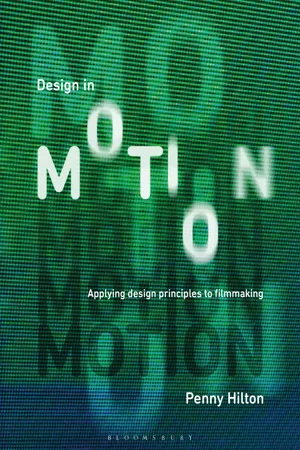
With an abundance of information on how to create motion graphics already available, Design in Motion focuses on the why of moving image and less about the how. By unpacking the reasons behind screen designer's production choices, each chapter deconstructs examples of motion graphics by drawing on case studies of both familiar examples from contemporary cinema and unseen work from postgraduate motion graphic designers. It examines the value of image, text, motion, camera and transitions, explaining in detail why some methods work, while others fail.
Whether you work in info-graphics, documentary or design, this book is structured to follow the production process and, together with its multimedia companion website, will be a by-your-side companion to guide you through your next project.
- 280 pages
- English
- ePUB (mobile friendly)
- Available on iOS & Android
eBook - ePub
About this book
Trusted by 375,005 students
Access to over 1.5 million titles for a fair monthly price.
Study more efficiently using our study tools.
Information

Part 1
Setting It All Up

1
Foundations
Chapter Overview
This first chapter aims to give you a few pointers on how you can begin an idea. It puts some of the essential building blocks in place to ensure you can follow it through, from the initial concept for a new film, to setting up an efficient workflow system, including planning, research and organizing your time to keeping your development on track.
In this chapter, you will learn to do the following:
•Kick off an idea by looking at some ways to approach brainstorming. Take a methodical approach to your initial experiments and slowly build up ideas for a new project.
•Consider how this early work forms part of your primary research. Look at the intrinsic value of secondary research and the importance of looking around you. Exploring and drawing inspiration from experts in the field is crucial to your development.
•Value the different stages of storyboarding to help you organize ideas for your film and be realistic about production.
•Keep development on track; timetable and schedule the production in a way that allows for change by remaining flexible to adapt to any revisions or developmental changes during production.
•Turn feedback into feedforward by taking it as constructive criticism to help you stay focused and perfect the film you originally intended to make. Apply a strategy of constructive self-appraisal that allows for design development. Be open to comment and value professional feedback to aid project development.
•Outline the benefits of constant reflection and critical self-assessment and develop ways of documentation to enable you to share your process and methodology.
Brainstorming
So you are at the start of a new project. Great. Often it is the best bit, full of promise and speculation about what your new production could be. You could begin by asking yourself what am I interested in, what generates an emotion in me? What could provide an opportunity to visually articulate something I feel motivated by and work out exactly what I want to say. Do I want to develop some new skills and find my voice through the craft of film? Any number of these things might be the impetus for starting a new film project.
On the other hand, some people find the start of a new film daunting. There are too many possibilities, and the whole prospect is so overwhelming that it is hard to know where to start.
If that is the case, this chapter is good place to begin. If you feel bogged down by uncertainties, such as ‘Will I actually be able to do what I want to do?’ or ‘Will I pull it off?’, this book will help.
Setting a new idea in motion can be the most difficult part. Many find it easier to be involved in an idea with a clear task allocated that contributes towards the whole of the production, rather than being entirely responsible for it. Film work does, after all, rely on successful collaboration.
Either way you must start somewhere, solo or in a team, and you are not going to get better unless you make a start.
We all have different interpretations of how to go about brainstorming, be it group work to capture the first things that spring to mind on a large sheet of paper or independent sketchbook work jotting down ideas as they occur. Either way if you are not a confident mark-maker, it is important to ‘stay in your sketch book’ as much as possible and not be tempted to jump onto your computer, which often ends any focused exploration as the on-hand digital tools take over the mind. Even though this manual process can initially be disappointing or lead to frustration, it is better to keep your goal in mind and start doodling, sketching, potato printing – anything to make some physical marks. Worry about presentation later, if at all. If you don’t free yourself from how it looks, you will get nowhere. In the following pages students demonstrate early, systematic idea generation using a geometric shape as a starting point.
The goal is to pull something extraordinary out of the ordinary. Nothing complex, but rather a different, systematic approach that can deliver surprising results. Once you have got some early ideas and thoughts to start you off, do anything, then do it again and ask yourself what it shows or could represent. Keep answering your enquiry, ‘Why is it interesting?’
Xi Wu develops ideas based on a circle. On her camera she recorded all the circles in her immediate environment. Surprised at the prevalence of circular shapes, she began making patterns around her and soon looked beyond her initial preconceptions of the inherent properties of the circle. She notes an affiliation with feelings of attraction and radiation. She began to ask herself if it was possible to c...
Table of contents
- Cover
- Title Page
- Dedication
- Contents
- Preface
- Introduction
- Part I: Setting It All Up
- Part II: Creating the Elements
- Part III: Putting It All Together
- Glossary
- Image Credits
- Index
- Acknowledgements
- eCopyright
Frequently asked questions
Yes, you can cancel anytime from the Subscription tab in your account settings on the Perlego website. Your subscription will stay active until the end of your current billing period. Learn how to cancel your subscription
No, books cannot be downloaded as external files, such as PDFs, for use outside of Perlego. However, you can download books within the Perlego app for offline reading on mobile or tablet. Learn how to download books offline
Perlego offers two plans: Essential and Complete
- Essential is ideal for learners and professionals who enjoy exploring a wide range of subjects. Access the Essential Library with 800,000+ trusted titles and best-sellers across business, personal growth, and the humanities. Includes unlimited reading time and Standard Read Aloud voice.
- Complete: Perfect for advanced learners and researchers needing full, unrestricted access. Unlock 1.5M+ books across hundreds of subjects, including academic and specialized titles. The Complete Plan also includes advanced features like Premium Read Aloud and Research Assistant.
We are an online textbook subscription service, where you can get access to an entire online library for less than the price of a single book per month. With over 1.5 million books across 990+ topics, we’ve got you covered! Learn about our mission
Look out for the read-aloud symbol on your next book to see if you can listen to it. The read-aloud tool reads text aloud for you, highlighting the text as it is being read. You can pause it, speed it up and slow it down. Learn more about Read Aloud
Yes! You can use the Perlego app on both iOS and Android devices to read anytime, anywhere — even offline. Perfect for commutes or when you’re on the go.
Please note we cannot support devices running on iOS 13 and Android 7 or earlier. Learn more about using the app
Please note we cannot support devices running on iOS 13 and Android 7 or earlier. Learn more about using the app
Yes, you can access Design in Motion by Penny Hilton in PDF and/or ePUB format, as well as other popular books in Médias et arts de la scène & Applications de bureau. We have over 1.5 million books available in our catalogue for you to explore.