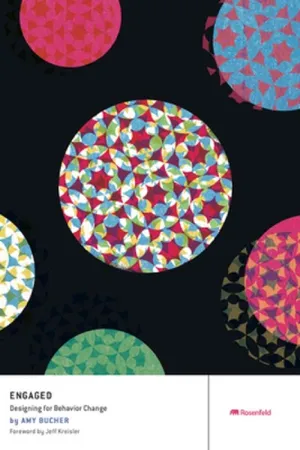
Behavior change design creates entrancing—and effective—products and experiences. Whether you've studied psychology or are new to the field, you can incorporate behavior change principles into your designs to help people achieve meaningful goals, learn and grow, and connect with one another. Engaged offers practical tips for design professionals to apply the psychology of engagement to their work.
- 320 pages
- English
- ePUB (mobile friendly)
- Available on iOS & Android
eBook - ePub
About this book
Information
CHAPTER 1

A Kind of Magic
Psychology and Design Belong Together
What Types of Products Benefit from Behavior Change?
Where Does Behavior Change Happen?
Some Core Tenets
Terminology
All About Motivation
The Behavior Change Design Process
The Upshot: You Can Do Behavior Change Design
PERSPECTIVE
Heather Cole-Lewis and Building Toward Value
In 2018, a team of researchers made headlines with the findings in their study of workplace wellness initiatives. The story that got me to click was titled “Study Finds Virtually Zero Benefit from Workplace Wellness Program in 1st Year.”
This headline is alarming on its face. Workplace wellness is a multibillion dollar industry in the United States. If it doesn’t work, that’s a lot of money and time wasted. More alarming for me personally, it’s where much of my professional work has focused in the past fifteen years. Was I tilting at windmills the whole time?
My nerd powers on alert, I downloaded the original research study that prompted the headlines. The Illinois Workplace Wellness Study is a multiyear examination of wellness programs for employees of the University of Illinois at Urbana-Champaign. At the end of the first two years of the study, the researchers found that although more people did health screenings once the program was put in place, it didn’t seem to have any effect on medical spending, health behaviors, productivity at work, or health status. Unfortunately, those non-outcomes are exactly what most workplace wellness programs are supposed to improve, so these results do look pretty bad for workplace wellness.
But here’s the thing. As I read the description of what the workplace wellness program at the University of Illinois actually consisted of, it became clear that of course it wasn’t having its intended effects. The program, called iThrive, consisted of annual biometric screenings, an annual survey called a Health Risk Assessment (HRA), and weekly wellness activities. Employees were given financial incentives for completing the screenings and HRA each year, and given paid time off to do the weekly activities, most of which were in-person classes. There was also an “online, self-paced wellness challenge”; however, no description was offered of how it was designed or what it included. Employees were encouraged to choose activities related to their HRA results. All of these features were pretty standard for workplace wellness programs, based on the information given, but none of them were designed for engagement.
If the program designers had adopted a behavior change design perspective, similar to the process this book lays out, iThrive probably would have looked a little different. For starters, most HRAs don’t provide feedback that would help people choose the right behavior change programs; a program built on behavior change would provide more structured guidance to match people to goals.
Then there was a lack of variety in the programs offered, with an emphasis on group classes. People who hate group activities were highly unlikely to enroll in one, even for a reward. And about those rewards: research suggests that linking repeated behaviors, like new health habits, to financial rewards is a great way to make sure that people don’t develop an intrinsic interest in doing them. Also, participation in the iThrive program was tethered to the workplace, which made it hard for people who valued keeping their health private from colleagues to participate without feeling uncomfortable. Finally, I don’t even know what was in the digital component of the program, but chances are, it represented lots of missed opportunities to engage users in a wellness process.
It’s not that workplace wellness programs can’t change behavior. It’s that workplace wellness programs are designed and implemented without a firm basis in psychology, so they don’t work effectively for the way that human beings actually behave.
Behavior change design as a discipline can help prevent headlines like the ones about the Illinois Workplace Wellness Program by helping designers create more engaging, effective programs. Behavior change design offers a toolkit to build products that actually work, while also supplying the evidence to prove it. Specifically, behavior change design includes:
• A process for designing and building products that incorporate research and evidence
• Access to frameworks and theories to help leverage proven techniques within products
• Tools to define and track product success metrics
Working within a discipline like behavior change design helps ward off huge investments in programs that don’t engage users or produce results for customers. The common language and process it offers sets expectations for potential investors and buyers that helps them assess whether a product is worth paying attention to. It also helps the product team do their work with rigor, detect and address potential problems early, and collect the evidence to either prove their worth or send them back to the drawing board. It’s not a panacea, but having a well-defined method sure helps keep people honest.
So what is this method? Behavior change design is the application of psychological methods and research to the development of products, services, or experiences. Almost everything designers make has some behavior change built into it. Any time you expect a person to interact with your product, you’re asking them to change their behavior from what it would be if the product didn’t exist. The complexity, longevity, and significance of those behaviors can vary widely. As each of those dimensions increases, the need to include formal behavior change considerations in your design does too.
What Types of Products Benefit from Behavior Change?
Some products, services, or experiences are intended to change people’s behaviors in the real world. Behavior change designers call those products interventions. That sounds very clinical, but an intervention doesn’t have to be dry or complicated. Some of the behavior change interventions you’ve probably heard of include MyFitnessPal, Runkeeper, and Duolingo, none of which feels like a heavy experience. But all three of them get people to do something differently on purpose: MyFitnessPal encourages users to be mindful of their eating and movement; Runkeeper helps people train to run longer or faster; and Duolingo teaches new ways of communicating.
Behavior change interventions are more common in certain subject areas. In this book, you’ll find a lot of health examples, because that’s the domain I know best from my career and one where behavior change has been embraced. Health interventions may help people along a spectrum of functioning—from coping with acute illness or injury to managing chronic conditions, supporting wellness, or reaching sports and performance goals. And they can target a range of behaviors, including eating, exercise, taking medication, going to doctor’s appointments, or deep breathing through stressful situations.
Behavior change interventions in financial services may center on major life goals like going to college (and paying off the associated loans), buying a home, or saving for retirement. Some successful financial behavior change interventions include changes to tax notices to prompt timely payment and changing 401(k) enrollment processes so that more people sign up.
Education is a natural outlet for behavior change; if people are building deep knowledge or new skills, they’ll need to engage in practice behaviors. Some types of education manifest through behavior, like speaking a new language, writing code, or repairing an automobile.
The performance management tools that big companies use to review employees and manage bonuses are a type of behavior change intervention.
Environmental science organizations practice behavior change, too, whether it’s getting people to consume fewer plastics or choose more sustainable fish to eat. As people realize the impact that their individual behaviors might have on the global climate, more digital interventions are being developed to support them in changing their efforts.
Behavior change design can also be used to make consumer products and experiences more engaging—while sometimes having the positive side effect of helping users develop new habits or skills. Pokémon Go! is an example. It was designed as a game, but users report boosts in their daily step counts as a result of their quests to capture Pokémon. Even products without much potential for positively changing people’s behavior, like shopping websites or music apps, could be made stickier using the strategies you’ll learn about in this book. In fact, many of the most “addicting” digital experiences borrow heavily from psychology in their design.
But just because you can do something doesn’t mean you should. It’s easy to creep into dark patterns and manipulative design choices, if your goal in applying psychology is to keep someone within your product as long as possible without it being beneficial to them.1 Behavior change design is about helping people achieve their goals, not yours.
In this book, I focus on digital products—apps, websites, connected devices, and the ways in which they intersect. Many behavior change endeavors today include a digital component or are entirely digital; technology makes interventions scalable, so they can be delivered quickly and cheaply to large groups of people no matter where they live. And digital offers opportunities to reach people in or near moments where they’re taking actions that matter. It’s a channel with enormous promise for affecting outcomes.
Like it or not, people are going to use tactics from psychology to make their digital products more engaging. They might as well learn to do it right.
Where Does Behavior Change Happen?
Behavior change design works at two levels. For products that are intended to change people’s behaviors, there is often a protocol built into the product itself. These protocols are step-by-step processes that outline the correct way to change a behavior based on previous research. For example, research on smoking cessation clearly indicates that setting a quit date in advance makes people much more successful at quitting, so most smoking cessation programs include steps around setting a quit date. Behavior change designers may be responsible for developing the protocol within a product, often in partnership with subject matter experts like physicians or researchers. Or, they may need to translate a protocol that exists in a nondigital format to a digital one; you’ll see examples in this book where techniques like cognitive behavioral therapy (CBT), typically used in counseling, are brought into a digital experience. Creating or translating these sorts of protocols requires understanding their active ingredients and being able to make sound judgments about how to represent them accurately through digital experiences.
The second level at which behavior change design works is making the digital product itself engaging by aligning it with people’s motivational needs. It is this second level of behavior change design that can be applied to nonbehavior change products, and where most of the material in this book is focused.
Although I’ll primarily talk about using behavior change within the guts of a digital product to make it engaging, effective engagement also requires you to pay attention to the context in which the product is being used. That includes how your product is marketed and distributed, any reminders or messages users might receive from the product, and how data is collected about users’ experiences. Some digital products include an onboarding exp...
Table of contents
- Cover Page
- Title Page
- Copyright Page
- Dedication Page
- Contents
- How to Use This Book
- Frequently Asked Questions
- Foreword
- Introduction
- CHAPTER 1. A Kind of Magic: Psychology and Design Belong Together
- CHAPTER 2. Pictures of Success: Measurement and Monitoring
- CHAPTER 3. It’s My Life: Making Meaningful Choices
- CHAPTER 4. Weapon of Choice: Make Decisions Easier
- CHAPTER 5. Something in the Way: Diagnosing Ability Blockers
- CHAPTER 6. Fix You: Solving Ability Blockers
- CHAPTER 7. Harder, Better, Faster, Stronger: Designing for Growth
- CHAPTER 8. Come Together: Design for Connection
- CHAPTER 9. Mr. Roboto: Connecting with Technology
- CHAPTER 10. A Matter of Trust: Design Users Can Believe In
- CHAPTER 11. Someday Never Comes: Design for the Future Self
- CHAPTER 12. Nothing’s Gonna Stop Us Now: Go Forth and Engage
- Index
- Acknowledgments
- About the Author
- Footnotes
Trusted by 375,005 students
Access to over 1.5 million titles for a fair monthly price.
Study more efficiently using our study tools.
Frequently asked questions
Yes, you can cancel anytime from the Subscription tab in your account settings on the Perlego website. Your subscription will stay active until the end of your current billing period. Learn how to cancel your subscription
No, books cannot be downloaded as external files, such as PDFs, for use outside of Perlego. However, you can download books within the Perlego app for offline reading on mobile or tablet. Learn how to download books offline
We are an online textbook subscription service, where you can get access to an entire online library for less than the price of a single book per month. With over 1.5 million books across 990+ topics, we’ve got you covered! Learn about our mission
Look out for the read-aloud symbol on your next book to see if you can listen to it. The read-aloud tool reads text aloud for you, highlighting the text as it is being read. You can pause it, speed it up and slow it down. Learn more about Read Aloud
Yes! You can use the Perlego app on both iOS and Android devices to read anytime, anywhere — even offline. Perfect for commutes or when you’re on the go.
Please note we cannot support devices running on iOS 13 and Android 7 or earlier. Learn more about using the app
Please note we cannot support devices running on iOS 13 and Android 7 or earlier. Learn more about using the app
Yes, you can access Engaged by Amy Bucher in PDF and/or ePUB format, as well as other popular books in Design & Consumer Behaviour. We have over 1.5 million books available in our catalogue for you to explore.