Despite the common association between authenticity and motivation in language learning, there does not currently exist a single volume exploring these connections. This book looks at the relationship between authenticity and motivation by specifically viewing the process of mutually validating the act of learning as social authentication, which in turn can often lead to positive motivational synergy between students and teacher(s). The study at the centre of this book uses autoethnography and practitioner research to examine the complex relationship between authenticity and motivation in the foreign language learning classroom. In particular, it traces the links between student and teacher motivation, and proposes that authenticity can act as a bridge to connect learners to the classroom environment and engage with the activity of learning.
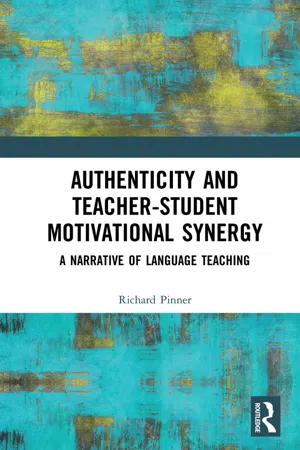
eBook - ePub
Authenticity and Teacher-Student Motivational Synergy
A Narrative of Language Teaching
- 310 pages
- English
- ePUB (mobile friendly)
- Available on iOS & Android
eBook - ePub
Authenticity and Teacher-Student Motivational Synergy
A Narrative of Language Teaching
About this book
Information
1Introduction
If you seek authenticity for authenticity’s sake, you are no longer authentic.Jean-Paul Sartre (1992, p. 4)
This book examines the connections between authenticity and motivation in language teaching and learning, two often cited yet highly elusive constructs. Despite this elusiveness, authenticity and motivation are high-frequency collocates in discussions around language teaching, and both are seen as having an important position in the process of second-language acquisition (SLA) (Dörnyei & Ushioda, 2011; Gilmore, 2011; Mishan, 2005). For example, in the collection of papers entitled International Perspectives on Motivation edited by Ushioda (2013c), authenticity is mentioned almost as frequently as autonomy, as can be confirmed with reference to the index. In a typical example, Banegas (2013, p. 86) directly equates authentic content with increased student and teacher motivation. In the same volume, Henry (2013) dedicates an entire chapter to bridging the authenticity gap between students’ personal lives and the type of instruction they receive. Mishan (2005) points out that the ‘motivation factor is one of the key justifications for the use of authentic texts for language learning’ (p. 26), and Gilmore (2007a, 2011) has also examined the links between authenticity and motivation in some detail.
The most pervasive definition of authenticity usually refers to materials, and is often reduced to some kind of inherent trait based largely on the original intention of the materials not having been for language teaching. In other words, authenticity in language teaching tends to mean materials designed for anything but language teaching, which somehow implies that the very act of language teaching is also somehow inauthentic. I refer to this as the ‘classic’ definition of authenticity. However, authenticity is not necessarily something merely attributed to learning materials and content, and is more usefully seen as something connected with identity, society, and Self.
Despite being a central and familiar concept in the field of applied linguistics, the theme of authenticity is one which is fraught with much debate and confusion. This is perhaps because authenticity is a deeply personal concept, unique to each individual and yet relevant to the way she or he interacts in society. It is also perhaps due to the way the concept of ‘authentic language’ is tied up with other issues, such as native-speakerism, linguistic imperialism, social class, and academic gatekeeping. Textbook publishers, language test makers, academic institutions, teachers, and students all regularly interact with the concept of authenticity in language at both the personal and the professional level, yet because of the complexity and controversy surrounding this theme, its importance is rarely discussed head-on. Instead, the outdated ‘classic’ definitions of authenticity are still implicit in many of the materials which are branded ‘authentic’, and either feature an embedded culturism or tend to gravitate unfairly towards so-called ‘standard’ or ‘native-speaker’ varieties of the target language (Lowe & Pinner, 2016; Pinner, 2016b). These definitions approach authenticity as a static or inherent trait rather than as a dynamic process. Researching the issue of authenticity is not merely marred by these problems but also has more or less been ground to a halt by them. In the past 20 years there have been very few papers which feature an inquiry into authenticity as their main focus. Those papers which have attempted to research the issue of authenticity in language teaching have tended to fall short by defaulting back to the aforementioned ‘classic’ definitions which do not reflect the reality of English as an international language. Widdowson (1978) wrote about the inherent fallacy of what I refer to as the ‘classic’ definition of authenticity when he discussed the difference between genuineness and authenticity.
We read what is relevant to our affairs or what appeals to our interests; and what is remote from our particular world we do not bother to read at all. To present someone with a set of extracts and to require him to read them not in order to learn something interesting and relevant about the world but in order to learn something about the language being used is to misrepresent normal language use to some degree. The extracts are, by definition, genuine instances of language use, but if the learner is required to deal with them in a way which does not correspond to his normal communicative activities, then they cannot be said to be authentic instances of use. Genuineness is a characteristic of the passage itself and is an absolute quality. Authenticity is a characteristic of the relationship between the passage and the reader and it has to do with appropriate response.(p. 80)
In other words, authenticity is created through interactions. Authenticity is something socially constructed, in the moment, and to label a text as inherently authentic is to oversimplify the construct.
Language is centrally tied up with identity, not just because language is how we construct our social identities but also because language is how we make sense of and codify our experience of the world. One of the main ways we do this is by telling stories, and narratives are ‘considered by many to be the prototypical or core genre’ of discourse (McCarthy & Carter, 1994, p. 33; original emphasis). Language can be viewed as not only what makes us innately human but also what makes us ourselves. However, it is rather unusual for a person to know only a single language (Fabbro, 2001), and many education systems around the world require learners to practise and undertake high-stakes tests in foreign language proficiency. For others living in multicultural societies, the second language is even more integrated, and in such cases just as much a part of a person’s social and individual Self as is their first language. As the world moves towards super-diversity (Blommaert & Rampton, 2012; Blommaert & Varis, 2011; Vertovec, 2007) and a period of ‘transnational connectedness, which scholars have labelled modernist globalisation’ (Canagarajah, 2013, p. 25; emphasis in original), more and more emphasis is being put on the social aspects of SLA (Atkinson, 2011; Block, 2003).
However, even if the foreign language is merely something learned at school or university, as Williams and Burden (1997) point out, ‘it involves an alteration in self-image, the adoption of new social and cultural behaviours and ways of being, and therefore has a significant impact on the social nature of the learner’ (p. 115). Even though Williams and Burden do not use the word directly, essentially they could be talking about the authentic self here, in the existentialist sense, as it relates to identity. By extension, this means that as language teachers one of our jobs is perhaps to enable our students to learn how to express their authentic self through the target language. Therefore, finding authenticity may also entail the creation of a foreign language (L2) identity, and this L2 identity may or may not be the same as the first language (L1) identity (Block, 2007). Identity in the language classroom is strongly connected to motivation, and recent theories of L2 motivation have begun to draw heavily on self-concepts (Csizér & Magid, 2014; Dörnyei, 2009; Dörnyei & Ushioda, 2009, 2011; Gregersen & MacIntyre, 2015; Mercer, 2015a; Nitta & Baba, 2015; Ryan & Irie, 2014). Again, the connection between authenticity and motivation is hinged on the idea that language is about expressing the authentic self, and that good teaching therefore allows learners the chance to express themselves in an authentic way.
[L]anguage is a medium of self-expression and a means of communicating, constructing and negotiating who we are and how we relate to the world around us – that is, of giving ourselves voice and identity. A foreign language is not simply something to add to our repertoire of skills, but a personalized tool that enables us to expand and express our identity or sense of self in new and interesting ways and with new kinds of people; to participate in a more diverse range of contexts and communities and so broaden our experiences and horizons; and to access and share new and alternative sources of information, entertainment or material that we need, value or enjoy.(Ushioda, 2011a, pp. 203–204)
Indirectly again, Ushioda seems to be talking about authenticity in the existential sense, and here situating the use of language as being innately authentic and individual. As Mishan (2005) points out in her seminal work on authenticity, ‘language learning is a natural – an authentic – activity’ (p. ix; emphasis in original).
However, learning a foreign language is both a face-threatening and a daunting task (van Dam, 2002). In learning to speak a foreign language, learners inevitably have to struggle through situations in which they do not have the linguistic repertoire to easily and successfully convey meaning. They may find themselves in unfamiliar cultural territory as well, even if they are learning in their own country where the target language is a foreign language. In particular, English is a very high-stakes language; proficiency in English is often linked with educational and social success, as demonstrated by Seargeant’s (2009, 2011) work which focused on Japan. Despite this, the fact that English is an international, global, or even ‘hyper-centralised’ language (de Swaan, 2001) means that it could also become a disembodied language – in other words, it is very far removed from a discernible cultural base. In other words, English is ‘divorced’ from its use contexts and ‘just another school subject’ where the learners’ true selves are often left at the classroom door (Lamb, 2013, p. 19). The hyper-centralising of English simultaneously makes it more and less real, especially for English as a foreign language (EFL) learners. This can have a very depersonalising effect on the way English is both taught and learned.
Teaching is a deeply personal endeavour. Several studies have shown that, contrary to the adage ‘those who can, do; those who can’t, teach’, most teachers become teachers because they are intrinsically motivated to do so, and usually because they are passionate about their subject and wish to communicate this to other generations (Dinham & Scott, 2000; Dörnyei & Ushioda, 2011; Richardson & Watt, 2006). Furthermore, there is a ‘synergistic’ relationship between student and teacher motivation (Deci, Kasser, & Ryan, 1997, p. 68; Dörnyei & Ushioda, 2011), and so this seems to be a matter of central importance to language learning and teaching.
This book presents a narrative of my attempt to make sense of these elusive yet vital components of language learning. At the heart of this book is a narrative of my own practitioner research, which was conducted at a Japanese university in Tokyo, with a group of first-year non-English majors taking compulsory courses as part of their Bachelor’s degree. Because I have come to approach authenticity as a deeply personal, contextually dependent, and socially constructed phenomenon, I have adopted an exploratory and reflective approach to this inquiry. The methodology I have adopted has grown out of the puzzle at the heart of the inquiry, which is an investigation of the nature of authenticity and motivation in language teaching, specifically related to English teaching in EFL contexts. This puzzle acts as the central research question, which aims to gain a deeper understanding of the process of social authentication and examines how this relates to teacher-student motivational synergy. Because this relates to my own working environment and teaching persona, the inquiry has also grown somewhat to include aspects of my own professional development as I mature as a teacher and researcher. In this way, this book charts a pivotal moment in my own development by focusing on my evolving and emergent professional identity. In order to further extend upon this narrative, I have also collected nine vignettes from other practitioning teachers from around the world. These are presented alongside certain of my own observations, in order to provide other points of view. These vignettes also have in common that they share insights into the reasons why teachers teach, and how their motivations are linked to those of their students.
This development in the inquiry, focusing on my own emerging identity, is a result of my attempt to focus in particular on the ‘synergistic’ relationship between student and teacher motivation (Deci et al., 1997). This relationship, I have come to believe, is based to a large extent on authenticity, as conceptualised as a process of validating the act of learning/teaching and shared social sense of investment in the process. When this process happens en masse within a classroom environment, I refer to it as social authentication. Through this inquiry, I have come to see authenticity as a powerful affective component of perceived validity which bridges the individual and social worlds of both learning and teaching. It is a fluid component of identity and part of the dynamic system of motivation. As such it is both essential to language learning and at the same time highly elusive and hard to define.
The only way to gain genuine insight into such a personal and internalised process was to turn myself into a research subject. Therefore, I have combined autoethnography with Exploratory Practice to attempt to unearth some of the deeper meanings behind my practice as it undergoes an important change in my developmental continuum. This study focuses on my own interpretations of my teaching practice and interactions with students. Reflecting on the way I responded to the students’ needs and navigated through the learning process is, I will argue, one of the ways in which I attempted to create a culture of authenticity in the ‘small culture’ (Holliday, 1994, 1999) of my own classroom and teaching context. This has much in common with ecological approaches to language learning, which refer to the study of organisms in relation to others and their environment (Kramsch, 2002b; Tudor, 2003; van Lier, 1998). Such a view also fits within the paradigm of language as a complex dynamic system (de Bot & Larsen-Freeman, 2011; King, 2016c; Larsen-Freeman, 1997; Larsen-Freeman & Cameron, 2008a; Verspoor, de Bot, & Lowie, 2011).
In order to make sense of this inquiry, I present it as a chronological narrative structured around my observations, analysis, and academic reading on these subjects. As such, in the next section I start at the beginning and explain how I came to this inquiry and what my starting point was.
1.1 Arriving at social authentication
Teaching and learning a foreign language poses many challenges, but perhaps one of the simplest and yet most pressing issues is the question of what to teach and how to teach it, that is, the content of the lessons and the tasks used to facilitate engagement. The choice of materials to use in the foreign language classroom is fundamentally important. No single activity or text will be interesting or engaging for every single learner to the same extent (van Lier, 1996). Materials designed to inspire debate can cause offence; materials designed to be contemporary can age quickly and be expensive both to produce and to replace. Materials designed for large multinational circulation lack the localised relevance and cultural understanding required to avoid being overly generic and thus can be uninteresting for learners (Mishan, 2005). When considering materials, both content and context are of central concern (Copland & Mann, 2012; Mann & Copland, 2015). This has always been the case in my own teaching, and for a long time I have been using almost entirely my own materials, which I have written for specific classes and recycled or adapted in a continuous process of development, which a colleague of mine quite poetically termed the living textbook.
I felt these self-made materials to be ‘authentic’. Without realising it, I had rejected the materials produced by most EFL textbook publishers, and on reflection I feel that this is due in some way to what I perceived as an inherent culturism and native-speakerism which I now think is rather deeply embedded in many commercial (but not all) textbooks. This led me to question the place of global English in today’s materials and how the concept of authenticity might be related to these issues. The connection between authenticity and motivation in language classrooms is often acknowledged from a practitioner’s viewpoint (Mishan, 2005), and it seems logical that using authentic materials for language learning would be more motivating for students than ‘inauthentic’ or contrived materials because they bear a resemblance to the place where the language will actually be used (Widdowson, 1990, p. 44). However, there is a great deal of complexity surrounding this issue, especially as we move deeper into the information age. Immense changes have come over society and language due to the acceleration of information communication technology (ICT). These have long been a feature in the discussions about language teaching, and the heightened importance of the debate about English as a global language has begun to feature heavily in the reconceptualisation of motivation (Ushioda, 2013b; Ushioda & Dörnyei, 2009). However, examinations of the special status of English and its homogeneous ‘world-culture’ remain scarce in discussions about authentic materials. It is widely acknowledged (Gilmore, 2007a, 2011; Mishan, 2005; Richards, 2001) and even empirically tested (Peacock, 1997) that authentic materials are more motivating for students and expose them to ‘real’ language. A very common assertion, which Widdowson (1990) labels the means/ends equation, is that authentic language is necessary. It is a means to an end because ‘real’ language is what learners will need to be able to use and understand since very few learners wish to become unnatural speakers or to learn English in a way which is only adequate for the classroom or to pass exams. However, definitions based around the notion of a single target language culture are problematic. Just as the global position of English has started to change how applied linguists conceptualise motivation, in the same way the traditional or culturally embedded definition of authenticity is in need of reconceptualising. The ideas relating to global English are now also being acknowledged by major EFL publishers, as illustrated by textbooks such as Macmillan’s Global and Heinle ELT’s World English series featuring images from National Geographic. Although there are heated discussions about what kind of models teachers and materials writers...
Table of contents
- Cover
- Half Title
- Title Page
- Copyright Page
- Dedication
- Contents
- Figures
- Tables
- Ad-hoc interviews
- Acknowledgements
- Glossary of abbreviations and specialist terms
- 1 Introduction
- 2 Theoretical framework: Stepping stones
- 3 Research methods: The evolution of my design
- 4 Spring semester
- 5 Autumn semester
- 6 Bridging the gap: Synergies into praxis
- 7 Vignettes
- 8 Conclusions
- Afterword
- Appendix 1: Spring semester syllabus
- Appendix 2: Autumn semester syllabus
- Appendix 3: Transcription conventions
- Appendix 4: CaLabo transcript
- Appendix 5: Digital appendix
- References
- Index
Trusted by 375,005 students
Access to over 1.5 million titles for a fair monthly price.
Study more efficiently using our study tools.
Frequently asked questions
Yes, you can cancel anytime from the Subscription tab in your account settings on the Perlego website. Your subscription will stay active until the end of your current billing period. Learn how to cancel your subscription
No, books cannot be downloaded as external files, such as PDFs, for use outside of Perlego. However, you can download books within the Perlego app for offline reading on mobile or tablet. Learn how to download books offline
Perlego offers two plans: Essential and Complete
- Essential is ideal for learners and professionals who enjoy exploring a wide range of subjects. Access the Essential Library with 800,000+ trusted titles and best-sellers across business, personal growth, and the humanities. Includes unlimited reading time and Standard Read Aloud voice.
- Complete: Perfect for advanced learners and researchers needing full, unrestricted access. Unlock 1.5M+ books across hundreds of subjects, including academic and specialized titles. The Complete Plan also includes advanced features like Premium Read Aloud and Research Assistant.
We are an online textbook subscription service, where you can get access to an entire online library for less than the price of a single book per month. With over 1.5 million books across 990+ topics, we’ve got you covered! Learn about our mission
Look out for the read-aloud symbol on your next book to see if you can listen to it. The read-aloud tool reads text aloud for you, highlighting the text as it is being read. You can pause it, speed it up and slow it down. Learn more about Read Aloud
Yes! You can use the Perlego app on both iOS and Android devices to read anytime, anywhere — even offline. Perfect for commutes or when you’re on the go.
Please note we cannot support devices running on iOS 13 and Android 7 or earlier. Learn more about using the app
Please note we cannot support devices running on iOS 13 and Android 7 or earlier. Learn more about using the app
Yes, you can access Authenticity and Teacher-Student Motivational Synergy by Richard Pinner in PDF and/or ePUB format, as well as other popular books in Lingue e linguistica & Didattica delle lingue. We have over 1.5 million books available in our catalogue for you to explore.