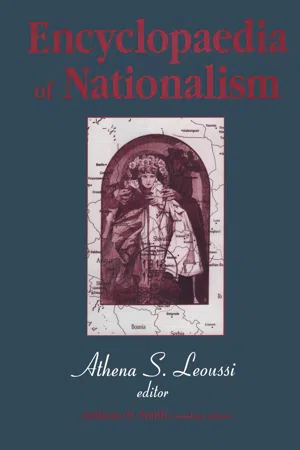
Since the end of the internationalist Soviet experiment in 1989, nationalism is now recognized as a positive, vital force in modern political, cultural, and social life-if kept in check from excess. As a result of the explosion of nationalism, there has been a veritable resurgence of nationalism studies. This proliferation calls for a survey of instruments which have been developed by scholars for the study of nationalism. The Encyclopaedia of Nationalism brings together leading scholars in nationalism studies to survey this complex phenomenon.With over one hundred entries the Encyclopaedia of Nationalism offers a complete and concise set of tools for the study of nationalism in a single volume. The focus throughout is theoretical, and for this reason particular nationalist movements and individual leaders are treated only as illustrative historical and contemporary cases in numerous entries. The Encyclopaedia is organized in an alphabetical sequence of entries, each of which includes a short bibliography for further reading. The reader will find in-depth discussions of the work of modern theoreticians of nationalism.The defining figures of the eighteenth and nineteenth centuries including Herder, Rousseau, Fichte, Marx, and Renan. Conceptual entries, are treated historically and sociologically. Crucial influential ideas and phenomena that continually redefine themselves with changing historical circumstances, among them, anti-Semitism, art and nationalism, assimilation, class and nation, decolonization, ethnic competition, genocide, language and nation, multiculturalism, religion and nation, state and nation, and xenophobia are treated in depth. A special attraction of this volume is its essay-long entries, many of which have been written by the scholars who developed them.The Encyclopaedia of Nationalism discusses in lucid terms, from an interdisciplinary perspective, the central issues, debates, concepts, and theories available to students and scholars of nationalism. As such it is the most comprehensive and authoritative guide to the subject in all its varied manifestations and implications. It will be an essential tool for historians, political scientists, sociologists, and scholars of the history of ideas.
- 314 pages
- English
- ePUB (mobile friendly)
- Available on iOS & Android
eBook - ePub
Encyclopaedia of Nationalism
About this book
Information
A
Anti-Semitism
The term “anti-Semitism” (“Antisemitismus”) was popularized by Wilhelm Marr in 1879 in order to differentiate modern, scientific attitudes towards the Jews from hatred of the Jews derived from old-fashioned religious prejudice. In popular usage, the term has come to mean any hatred or prejudice directed against Jews, irrespective of time or place. The assumption that it has always existed (“Eternal anti-Semitism”), implies that there is something innate in the Jews—be it vice or virtue—which produces a negative response from non-Jews. This is a fundamental proposition of the Zionist analysis of Jewish history which identifies the Jews’ decisive shortcoming as lack of a homeland. This homelessness inevitably produced an abnormal relationship between Jews and Gentiles. The uncritical use of the term “anti-Semitism” has often led to a lack of proper differentiation between varieties of hostility towards the Jews.
Scholarly efforts to prove the “eternal” quality of anti-Semitism have cited hostility to the Jews in the classical world, before the emergence of Christianity. Episodes of hostility (the story of Haman in the Book of Esther, anti-Jewish riots in Alexandria in 38 A.D., hostile descriptions of Jews by the Roman historian Tacitus) are in fact typical of the interethnic, intercommunal and religious struggles of the day. It is noteworthy that the Romans gave Jews the privileged status of a politeuma, a community governed by its own practices and traditions. Some Roman pagan writers decried the “impiety” of the Jews, but military repression, featuring the destruction of the Second Temple and the expulsion of the Jews from Palestine in the aftermath of the Bar Kokhba Revolt (132-35 A.D.) was the inevitable Roman response to political opposition and revolt. Diaspora Jews developed practices, institutions and myths which allowed them to survive, as a self-aware community, under disparate forms of alien rule.
While the relations of Jews with the followers of the other Abrahamic religions were always problematic, those between Jews and Christians were especially fraught because both lay claim to an identical spiritual inheritance. The sacred writings of the Jews, “the Tanakh” (the Hebrew Bible) serve also as Christian prophetic texts: the “Old Testament” bears witness to and is fulfilled by the “New Testament.” As Christianity evolved from a Jewish sect into a separate, universalized religion, the two religions remained locked in a fundamental debate over proof texts. Christians read Jewish texts to show that Jesus Christ was not only the Jewish Messiah (itself a much debated concept) but also the Son of God. Jews rejected both these claims. It was thus necessary for Christians to deny the Jewish interpretation of their own texts, and to lay claim to the status of God-elected or chosen people which the texts clearly attributed to the Jews. Christians became the “New Israel.” The Christian scriptures, especially the Gospel of John which equated Jews with the Devil, and the letters of Paul the Apostle to emergent Christian communities, created a climate of hostility between devotees of the two faiths. There was an element of rivalry as well, in the form of Christian fear of Jewish proselytism, especially “Judaizing” among new Christian converts. Modern scholars tend to view skeptically the claim that Jewish instigation lay behind some Roman persecution of the Christians.
This essentially theological debate between pagans, Christians and Jews was transformed by the establishment of Christianity as the state religion of the later Roman Empire. Coercion became the handmaiden of religious polemic. In the ensuing Christian debate over the status of the Jews, two traditions emerged. That associated with the foremost father of the Eastern Church, John Chrysostom (c. 347-407), associated the Jews with Satan’s anti-Christian work. This link justified their expulsion or total exclusion from interaction with Christians. The tradition which emerged from the writings of the Western theologian, Augustine of Hippo (354-430), proved more influential and accommodating. Augustine offered an exegesis on the Genesis story of Cain and Abel. Just as Cain’s treachery verified and exalted Abel’s faith, so the skepticism of the Jews and their fall from divine favour, exemplified by the destruction of the Temple and their exile, reinforced the truth of Christianity. Jews, like Cain, were not to be killed, but to wander the world as proof of their rejected status. They could be tolerated, but they were never to have domination over Christians. Augustine also awarded Jews a vital role in Christian apocalyptic thought: the second coming of Christ would be accompanied by the conversion of the Jews and the end of their exile. This tradition inspired the caveat—often honored in the breech—that Jews were not to be forcibly converted.
Some scholars have argued that the period of the Church Fathers played a decisive role in assigning to Jews the mythic role of “Other,” a status which forever objectified them in the Christian and post-Christian consciousness. Others have identified this moment in the thirteenth and fourteenth centuries when a number of grotesque and occult charges against the Jews gained wide acceptance. The Jews underwent a process of demonization, whereby they were directly equated with the Devil and his anti-Christian conspiracies. Demonic characteristics were attributed to the Jews—horns and a tail, a particular stench (the feotor judaicus), cloven feet, and swine’s teeth. Jews were linked to anti-human activity in general—the poisoning of wells, black magic, and sorcery—as well as anti-Christian outrages in particular—ritual murder of Christian children and desecration of the sacramental bread. Gavin Langmuir contends that these motifs were a clear reflection of the insecurities of Christian society which transformed the Jews into a “chimera,” a level of fantasy which projected all the insecurities of Christian society onto a powerless and subordinate out-group. The demonization of the Jews was accompanied by efforts to exclude Jews by special clothing or symbols, special places of residence (such as the Italian ghetto), or physical expulsion (England and southern Italy, 1290; France, 1306, 1394; the German lands, 1350; Spain, 1492; Portugal, 1497). The aftermath of forced conversions in the Iberian lands promoted the activities of the Holy Office, better known as the Inquisition, which acquired a sinister reputation for its efforts to identify and punish crypto-Jews. The Protestant Reformation forced a rethinking of the theological position of the Jews but, as the example of Martin Luther reveals, not always to the Jews’ advantage. Luther’s 1523 pamphlet, “That Jesus Christ Was Bom a Jew,” expressed sympathy for the Jews as a target of Christian persecution. Towards the end of Luther’s life, disappointed in his hopes for the conversion of the Jews and fearing “Judaizing” among Protestants, he wrote crude and vulgar polemics, exemplified by “On the Jews and Their Lies,” published in 1543.
The intellectual changes in European thought signalled by the French Enlightenment in the eighteenth century had two implications for Jews. The theory of a rationally apprehended Natural Law worked against the dogmas of revealed religion and Christian intolerance, while the Lockean concept of the tabula rasa implied the possibility of universal human improvement, Jews included. The assumptions of so-called Political Economy argued against restrictions on the Jews which conflicted with the economic interests of society. Taken together, these intellectual currents helped give rise to concepts of Jewish “emancipation” or “naturalization.” Yet, parallel lines of Enlightenment thought viewed the Jews in negative terms by denying Judaism the status of a “Natural Religion,” and seeing the Jews as a backward and obscurantist element. The Jews’ traditional economic pursuits were often viewed as a threat to the national well-being. Most thinkers, especially Voltaire, viewed the Jews as corrupt and degraded, and disagreed only as to whether or not Jews were susceptible to improvement. Many thinkers subconsciously recast traditional religious prejudices against the Jews into secular or “scientific” form.
Emergent national states offered Jews varying degrees of acceptance. In return, or as a precondition, liberal statesmen demanded Jewish acculturation or assimilation. The movement of Jews into modern society, either as an identifiable sub-culture or, even more, as an invisible element, provoked a reaction. Some responses, such as the Prussian debate in the 1840s over the role of Jews in a Christian state, bore clear vestiges of religious prejudice. Whatever their underlying origins, however, most hostility toward Jews was presented as “modern” and rational. The European Left, represented by Bruno Bauer and Karl Marx, saw Jews as a remnant of obsolete socioeconomic systems, while others on both Left and Right, depicted them as the symbol of harmful economic change, the “Gold International” or the plutocratic “Kings of the Age.”
Advances in the biological sciences were especially significant for views on the Jews. Anthropologists sought to differentiate the world’s population into “races,” to which concept a hierarchy of value was inevitably assigned. Jews were consistently seen as a distinct group or sub-group, the “Semitic race.” The evolutionary theories of Charles Darwin, especially the concept of survival of the fittest within species, were applied to human beings. Social Darwinism had a special appeal for the ideologues of European imperialism, eugenics, and militarism. Racial mixing, warned pessimistic thinkers such as ARTHUR DE GOBINEAU, was a retrograde process, whereby the “higher” races were swamped by the “lower,” a category which invariably included the Semitic Jews. This negative influence was not only biological, but cultural as well. Jews were denounced by authors like Richard Wagner as uncreative parasites, capable only of corrupting higher cultures.
Nineteenth-century anti-Semitism was thus a coat of many colors, albeit intimately linked to all the ideas of the “century of -isms.” Scholars have detected, as the crucial aspect of anti-Semitism, its propensity to mirror the fears and discontents of the age. While there is disagreement over the objective or psychological sources of these obsessions, there is little doubt that for many thinkers, a subjective conceptualization of “The Jews” came to represent both the negative aspects of modern civilization as well as the archetypal “Other.” For example, the Jews were linked to the spirit of revolution, despite the negligible role that they played in 1789, 1830, and 1848. In this way, they also became associated with the Freemasons who had been one of the original targets for those who sought a conspiratorial angle in the events of the French Revolution. Jews served as a symbol of emergent capitalism, and were blamed for its failures (particularly the famous crash of 1872 in Germany, which followed a period of stock market speculation, the Gründerzeit). In France, the Dreyfus Affair (1894-1906) introduced anti-Semitism into the violent debates over the nature and future of the Third Republic.
Many students of nineteenth-century anti-Semitism have seen an objective foundation for its growth. Hannah Arendt famously linked the Court Jews of the early modern period with the modern banking system. Peter Pulzer points to the strength of the Jews in middle class activities in Germany and especially in the press in Austria-Hungary (Pulzer 1988). Albert Linderman has emphasized aspects of Jewish behavior which underlay notorious affairs such as the Dreyfus Affair and the Beilis ritual murder affair in Russia (1911-13).
On the other hand, the ease with which anti-Semitism was able to serve so many ideological masters, suggests deeper, non-objective roots. Jacob Katz, among others, has suggested that much of “modern” anti-Semitism is religious hostility transmuted into secular form (Katz 1980). Claims that Jews were objectified, demised, or made into a chimera in the premodern period, are all attempts to explain the enduring force of anti-Semitism in the nineteenth century and beyond. The ease with which mundane realities of Jewish life—the role of some Jews in the modern economy or in modern political life—were transformed into mythic forms—the international Jewish conspiracy envisioned by the Protocols of the Elders of Zion, the “Gold International,” and so on—suggests a deep psychological source for modern anti-Semitism.
Anti-Semitism was a strong ideological current in the twentieth century, exemplified by the attempted extermination of the “Jewish race” by the followers of German National Socialism. While widely spread, however, most varieties of anti-Semitism did not lead logically to mass murder. “The Jews” in the guise of “Bolsheviks” were variously blamed for the rise of Communism or, as “international bankers,” for the collapse of capitalism by a number of right-wing ideologues in Europe and the United States in the interwar period.
More substantial was anti-Semitism in the states created in the aftermath of the collapse of the Russian, Austro-Hungarian and German Empires in 1917-8 (Klier 1995). State-building societies such as Poland and Romania were faced with the challenges of integrating national minorities, such as Ukrainians and Belorussians (Poland) and Hungarians (Romania), together with substantial Jewish minorities. Trianon Hungary, on the other hand, no longer required Magyarized Jews as a counterweight to non-Hungarian minorities, as had been the case before 1918. The role of Jews as a commercial element in primarily agrarian societies also created tensions, especially with the onset of the Great Depression. The growth of chauvinism and authoritarianism in Central and Eastern Europe threatened discrimination and mistreatment of Jewish minorities, but gave no hint of the Nazi experiment in genocide.
Anti-Semitism adapted easily to a variety of ideological systems, ranging from the embattled democracy of the French Third Republic (where the Action Française employed anti-Semitism), to the military authoritarianism of Poland, and the native fascism of Romania (the Iron Guard) and Hungary (the Arrow Cross). The absence of any anti-Semitism in the archetypal fascism of Italy suggests that anti-Semitism was at least in part a product of local conditions, rather than an inevitable ingredient of the fascist corporate state.
German National Socialism remains the special case. Anti-Semitism was an integral part of its Weltanschauung (if not the source of its widespread appeal) primarily because of its importance for Adolf Hitler. There is a substantial historical debate regarding the extent to which the physical removal of the Jews, by exterminatory force if necessary, was a specific long-term objective of Hitler and his movement (Kershaw 1993). Some scholars have seen it as inherent in Mein Kampf (1925), while others have argued that the resort to genocide was the outcome of the unique conditions created by the Second World War.
New forms of hostility toward the Jews emerged with the establishment of the State of Israel in 1948. Israel’s Arab and Muslim enemies have always argued that their antipathy is directed against the “Zionist entity,” and should be considered anti-Zionism, not anti-Semitism. Whatever the truth of this claim, there is no question that elements of Western anti-Semitism (i.e., the Protocols of the Elders of Zion) have been assimilated into anti-Zionism. Scholars such as Bernard Lewis argue that this is a late ideological borrowing and an aberration, pointing to the long centuries during which Jews were accommodated by Muslim communities (Lewis 1986).
Divergent forms of anti-Semitism appeared in the second half of the twentieth century. The last years of Stalin in the Soviet Union witnessed the linking of Jews to “Western imperialism,” and anti-Soviet a...
Table of contents
- Cover
- Half Title
- Title Page
- Copyright Page
- Contents
- Introduction
- Encyclopaedia of Nationalism
- Index of Entry Titles
- Index of Subjects
- List of Entries with Contributors
Trusted by 375,005 students
Access to over 1.5 million titles for a fair monthly price.
Study more efficiently using our study tools.
Frequently asked questions
Yes, you can cancel anytime from the Subscription tab in your account settings on the Perlego website. Your subscription will stay active until the end of your current billing period. Learn how to cancel your subscription
No, books cannot be downloaded as external files, such as PDFs, for use outside of Perlego. However, you can download books within the Perlego app for offline reading on mobile or tablet. Learn how to download books offline
Perlego offers two plans: Essential and Complete
- Essential is ideal for learners and professionals who enjoy exploring a wide range of subjects. Access the Essential Library with 800,000+ trusted titles and best-sellers across business, personal growth, and the humanities. Includes unlimited reading time and Standard Read Aloud voice.
- Complete: Perfect for advanced learners and researchers needing full, unrestricted access. Unlock 1.5M+ books across hundreds of subjects, including academic and specialized titles. The Complete Plan also includes advanced features like Premium Read Aloud and Research Assistant.
We are an online textbook subscription service, where you can get access to an entire online library for less than the price of a single book per month. With over 1.5 million books across 990+ topics, we’ve got you covered! Learn about our mission
Look out for the read-aloud symbol on your next book to see if you can listen to it. The read-aloud tool reads text aloud for you, highlighting the text as it is being read. You can pause it, speed it up and slow it down. Learn more about Read Aloud
Yes! You can use the Perlego app on both iOS and Android devices to read anytime, anywhere — even offline. Perfect for commutes or when you’re on the go.
Please note we cannot support devices running on iOS 13 and Android 7 or earlier. Learn more about using the app
Please note we cannot support devices running on iOS 13 and Android 7 or earlier. Learn more about using the app
Yes, you can access Encyclopaedia of Nationalism by Athena Leoussi in PDF and/or ePUB format, as well as other popular books in Politics & International Relations & Nationalism & Patriotism. We have over 1.5 million books available in our catalogue for you to explore.