For almost four hundred years, between the fall of Constantinople in 1453 and the Greek War of Independence, the history of Greece is shrouded in mystery. What was life really like for the Greeks under Ottoman rule? Was it a period of unremitting exploitation and enslavement for the Greeks until they were finally able to rise up against their Turkish overlords, as is the traditional, Greek nationalistic view? Or did the Greeks derive some benefit from Turkish rule? How did the Greeks and Turks co-exist for so long? And why are Greek attitudes towards Venice, who also controlled much of Greece for many of these years, so different?
In this wide-ranging yet concise history David Brewer explodes many of the myths about Turkish rule of Greece. He places the Greek story in its wider, international context and casts fresh light on the dynamics of power not only between Greeks and Ottomans but also between Muslims and Christians, both Orthodox and Catholic, throughout Europe. This absorbing and riveting account of a crucial period will ensure that the history of Greece under Turkish rule is no longer hidden. It will delight anyone with an interest in Greek and Turkish history and in how the past has shaped the Greece we know today.
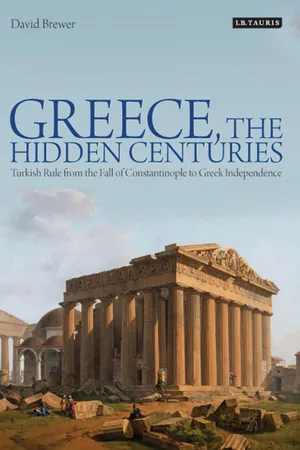
eBook - ePub
Greece, the Hidden Centuries
Turkish Rule from the Fall of Constantinople to Greek Independence
- 320 pages
- English
- ePUB (mobile friendly)
- Available on iOS & Android
eBook - ePub
Greece, the Hidden Centuries
Turkish Rule from the Fall of Constantinople to Greek Independence
About this book
Information
1
Greece Before the Turks
The Fourth Crusade, summoned in 1198 by the new Pope Innocent III, was not originally intended to go anywhere near Constantinople. The Pope called for a crusade to recapture the Holy Land, then in the hands of Saladin, and to reverse, as he put it, ‘the deplorable invasion of that land on which the feet of Christ stood’.1
Those who responded were mainly French and Italian, led by their nobility. Their plan was to travel to the Holy Land by sea, and first to establish a secure base by annexing Egypt. The keys to Jerusalem, it was said, were to be found in Cairo. So the crusaders needed a fleet and contracted with Venice to build one for them.
The fleet was huge, some 250 ships, and the cost of the ships and their supplies correspondingly enormous: 85,000 marks, about twice the annual income of the King of England or France. The Venetians also demanded that ‘so long as our association lasts we shall have one half, and you the other half, of everything that we win, either by land or sea,’ and these terms were confirmed by treaty.2
But when the fleet was ready to sail, in the summer of 1202, the crusaders could not pay – they were about a third short of the price that had been fixed. The Venetians therefore agreed to postpone full payment if the crusaders and their fleet would first recapture for Venice the town of Zara, modern Zadar, on the Dalmatian coast, which Venice had recently lost to Hungary. On 12 November 1202 Zara fell to the crusaders, and as it was too late in the season to sail on, the crusaders were stuck there until the following spring.
During this enforced wait there was another twist to the course of the crusade. Alexios was the twenty-year-old son of the recently deposed and imprisoned Byzantine Emperor, Isaac II. Alexios now arrived in Zara and made the crusaders an offer. If they would place his father on his rightful throne and ensure his own succession, he would pay them, from the riches of Constantinople, the money they owed the Venetians. This offer was satisfactory for everybody. The Venetians would get their money, the crusaders would be relieved of their debt, and Alexios would get his throne. It also had a benefit for Innocent III. A Byzantine Emperor who owed his throne to the crusade that the Pope had inspired would be more likely to support the Pope’s long-term objective: the reunification of the Western and Eastern Churches, and the reassertion of papal authority in the Byzantine Empire.
In June 1203 the crusaders reached Constantinople, and within a month had overcome Byzantine resistance by breaching the walls to the north of the city along the Golden Horn. Alexios and his father Isaac were installed as co-emperors. But Alexios was unable to raise the money to pay the crusaders. The populace resisted his new taxes, and his seizure of Church plate to be melted down infuriated the clergy, while the citizens of Constantinople loathed the often violent and drunken crusaders. By January 1204 Alexios and Isaac had been deposed, Isaac was dead and Alexios had fled the city. The new Emperor, another Alexios known as Mourtzouphlos, was committed to resisting all the crusader demands and the crusaders’ only course now was to take the city themselves.
A detailed plan was therefore drawn up for the division of offices and of territory in what was to become the Latin Byzantine Empire. A committee of six Venetians and six Frenchmen was to choose the Emperor, and the side that did not provide the Emperor would nominate the patriarch. The territory, both in Constantinople and outside, would be divided, with a quarter going to the new Latin Emperor and, as originally agreed, the remaining three quarters split equally between the Venetians and the non-Venetian crusaders. Any idea that the crusade would ever proceed to the Holy Land was abandoned.
On 12 April 1204 Constantinople fell to the crusaders and in the following three days the city was looted. The crusaders knew the value of Constantinople’s treasures, and carried away all they could. The most spectacular part of the Venetian booty was the set of four horses of gilded copper, probably already a thousand years old, that were taken back to Venice and placed over the entrance to the basilica of St Mark’s, where replicas still remain. The most significant trophies for many crusaders were the highly marketable holy relics, including two pieces of the True Cross, two of the nails that were driven through Christ’s hands and feet, and His crown ‘which was made of reeds, with thorns as sharp as the points of daggers’.3
Steven Runciman, in his classic 1950s account of the crusades, expressed the passionate feelings still harboured by many about the 1204 sack of Constantinople. ‘There was never’, he wrote, ‘a greater crime against humanity than the Fourth Crusade.’4 Later historians, however, wonder if the sack was as dreadful as it has been represented. It was natural for Byzantine writers to describe the pillaging in the worst possible terms, and it is possible that some of the more lurid details of violent and sacrilegious destruction are simply black propaganda.
Some historians believe that the diversion of the Fourth Crusade was the result of a series of accidents. Others believe that each step was planned from the beginning by the influential Doge of Venice, the 90-year-old Enrico Dandolo, in pursuit of Venetian commercial advantage. The most likely explanation, lying somewhere between these two views, is that the course of events was determined by Dandolo’s masterful administration of the unforeseen.
However it came about, the seizure of Constantinople by the Fourth Crusade was a turning point for Europe. Though the crusaders’ Latin Empire lasted only 50 years and Byzantine rulers returned to govern a diminished empire for another two centuries, Byzantium was no longer strong enough to resist the Ottoman invasion, which eventually took Constantinople in 1453. Moreover, the memory of the Fourth Crusade made any reconciliation between Catholic west and Orthodox east even more difficult. And for the Greeks the Fourth Crusade brought a radical upheaval – the division of the country between rival rulers.
Six major power centres now came to dominate the affairs of Greece, two from outside it and four within the country itself. As agreed before Constantinople fell, the committee of six Venetians and six Frenchmen elected the new Latin Emperor. Baldwin of Flanders was chosen, was crowned and anointed in a splendid ceremony in Ayía Sophía, and became the nominal overlord of all crusaders ruling in Greece. But the Byzantine ruling family, though it had lost its capital, was not finished. Theodore I Laskaris, who was related by marriage to the Angelos family, remained a rival Byzantine Emperor based in Nicaea, modern Iznik, only 60 miles south-east of Constantinople. These were the two power centres outside Greece.
There were four more, broadly speaking, in Greece itself. In the north, to the east of the Píndos mountains, was the so-called Kingdom of Thessalonika. This went to the crusader Boniface, from Montferrat in Piedmont, a disappointed candidate for the position of Latin Byzantine Emperor. Also in the north, to the west of the Píndos, was the Despotate of Ípiros. This was seized by the crusaders’ one Greek rival in Greece: Michael, illegitimate but cousin of the Alexios who brought the crusaders to Constantinople. He styled himself Michael Angelos Komnenos, emphasising his link with the family that had provided the Byzantine Emperors in the previous century. Central Greece was dominated by the Lordship of Athens, later called a duchy, which remained in the hands of the de la Roche family from Burgundy for 100 years. Lastly, the Peloponnese in the south was ruled by the Villehardouin family from Champagne, who began the construction of the magnificent buildings of Mistrás.
Besides these six there were other less extensive but significant centres of influence. Venice, which had been allotted three eighths of the whole Byzantine Empire, was little interested in acquiring large territories needing substantial armies to defend and control them, and took only places useful for trade, in particular the harbour towns of Methóni and Koróni in the south-west Peloponnese. The one large Venetian acquisition of territory was Crete, originally allocated to Boniface. But Boniface was more concerned with his Kingdom of Thessalonika than with distant Crete, and immediately sold the island to Venice for a mere 1,000 marks – a tiny fraction of the 85,000 marks that Venice had charged for building the crusader fleet. Within a few years other Venetian families were established in the islands of the Aegean.
This patchwork of possession did not last, and could hardly be expected to do so. These Franks from the western parts of Europe were not stable possessors of land in Greece as they might have been in their own countries, but became competitors in an intense and many-sided struggle for power. In 1224 the Despot of Ípiros took Thessalonika from Boniface’s son and successor Dimitrios, only to lose the city 22 years later to the Byzantine Emperor in exile at Nicaea. In 1259 at the battle of Pelagonia these Byzantines defeated and captured Guillaume de Villehardouin, the ruler of the Peloponnese. Two years later the Byzantines of Nicaea achieved their greatest success, recapturing Constantinople and bringing the tottering Latin Empire to an end.
As time passed, other competitors appeared in Greece: Catalans, Neapolitans, Genoese, the Knights of St John, as well as the Turks. How did the Greeks fare in this territorial turmoil? How strongly did they resist their new rulers, and how far were they caught up in battles between them? Did the Catholicism of the occupiers supplant the Orthodoxy of the subject Greeks? And how did the common people of Greece live, in the countryside and in the towns?
We can find some answers to these questions by following the fortunes of one of the territories of Greece established after the fall of Constantinople to the crusaders in 1204 – the Peloponnese. Its story over the next two and a half centuries falls into three phases: first, half a century of stable rule by the crusading Villehardouin family; second, a century of conflict between the crusaders’ successors and the restored Byzantine Empire; and third, a century of rule by the now enfeebled Byzantines, marked by constant attacks from outside.
The first phase began with the division of territory among the victorious crusaders. The Peloponnese, then and later known as the Morea, had originally been allocated to Venice, but a chance meeting determined otherwise. This meeting in 1205 was between two prominent crusaders, Guillaume de Champlitte and Geoffroy I de Villehardouin. De Villehardouin had already acquired some territory in the Peloponnese, and agreed with de Champlitte that together they would take over all of it. De Champlitte was to become the first Frankish overlord of the Peloponnese. Their meeting, it has been said, was to decide the history of Greece for the next two centuries.5
The crusaders had little difficulty in establishing themselves in the Peloponnese. Though the region had been allotted to Venice, the Venetians were interested only in the harbours of the Peloponnese and their commercial possibilities, and were satisfied with the southern ports of Methóni and Koróni. De Villehardouin and Champlitte fought only one major battle against the Greeks, in which it was claimed that 700 crusader troops decisively defeated 4,000 Greeks. Otherwise the crusaders were conciliatory as, being so few, they had to be. The Greeks, weary of conflicts between local warlords, which their remote Byzantine rulers had become too weak to control, readily submitted. A chronicler reports de Villehardouin addressing an assembly of Greeks as ‘archons, friends and brothers and, henceforth, comrades’. He goes on to point out to them that ‘You do not have a lord to protect you,’ and ends by saying: ‘Therefore it seems to me better for you that we come to terms whereby murders, lootings and the taking of prisoners will not occur.’ The Greek landowners could keep their domains, with the accompanying privileges and obligations, while the crusaders took state and Church land, and it was promised that ‘the peasants of the villages would remain as the crusaders had found them.’6 There was indeed little point in resisting, and the Greeks submitted to the new rulers.
The chronicler mentioned above is the writer of the so-called Chronicle of Morea. There are eight versions of the material it contains, three in prose in French, Spanish or Italian, and five in verse in Greek, of which the earliest, written in about 1388 or possibly before, is considered the most authentic and is used here. All eight versions are probably derived from a French original, now lost, which was composed about 1310.
The Chronicle of Morea was designed either to be read or to be listened to. As its author says, ‘If you know letters, start reading; if, on the other hand, you are illiterate, sit down beside me and listen.’ It opens engagingly with the sentence that stands as the epigraph to this book: ‘I am going to tell you a great tale . . .’.7 The chronicle has its weaknesses. It clearly favours the Franks. Some of its details are wrong. Its many long speeches by leaders cannot be verbatim records, but can reasonably be relied on to express the speaker’s policies. And, as a window on the actual conditions in the Peloponnese of those centuries, it is uniquely valuable.
The first half-century of crusader rule in the Peloponnese was something of a golden age. De Champlitte returned to France in 1208, where he died soon afterwards, and Geoffroy I de Villehardouin was recognised as overlord of the Peloponnese both by the Latin Emperor in Constantinople and by the Pope, with the title of Prince of Achaia. His rule lasted from 1208 to 1228, followed by those of his two sons Geoffroy II (1228–46) and Guillaume (1246–78). The conciliatory approach of Geoffroy I towards the Greeks was followed by his sons. Guillaume besieged Monemvasía, the precipitous fortress just off the south-east coast, for three years from 1245 to 1248; the town was ‘enclosed in exactly the same way as the nightingale by its cage’, says the chronicle.8 When it finally surrendered there was none of the bloody retribution common at the time and for centuries later. The people of Monemvasía were required in future only to provide boat services, for which they would be paid. Guillaume left the town’s three leading families in control, gave them a grant of land in the Mani, which may have been as rocky as their old home, and, if the chronicle is to be believed, ‘bestowed upon them gifts of horses and chargers, robes all of gold, and scarlet ones as well’.9
In the following year Guillaume began building the fortress of Mistrás, on a commanding and easily defensible hilltop three miles from Sparta; Mistrás was to remain the administrative centre of the Peloponnese under different rulers until replaced by Tripolis in 1719. Guillaume and his barons brought out from France their existing families or new noble brides, and formed a highly cultivated circle, one of whose products was the splendidly illuminated Manuscrit du Roi, now in Paris. As a contemporary Spanish chronicler put it, ‘one would say that the noblest knights of France were the knights of Morea, and the French spoken there was as fine as that of Paris.’10 But Guillaume was not a remote ruler cushioned in cultivated luxury. ‘He was wont’, wrote a contemporary, ‘to send his most confidential advisers from time to time to the courts of his vassals, to see how they lived and how they treated their subjects.’11 He also went out among his subjects himself, and as the chronicle puts it ‘he went riding with his retinue and strolled among the villages near Monemvasía and the lands in that direction; with joy he went around and passed his time.’12
For the peasants among whom Guillaume de Villehardouin strolled so benignly, life went on under a continuing feudal system much as it had before. The twin sources of wealth had been, and remained, land and the labour to work it. To convert this wealth into military power, the ruler granted portions of land as fiefs to those who owed him allegiance, who in return had to provide military service. When Geoffroy I de Villehardouin came to allocate fiefs in the Peloponnese he set up a commission to do so, which included, besides himself and other Franks, five major Greek landowners. Twelve large fiefs were granted, with varying requirements for providing mounted knights and other troops when demanded.
Though some peasants were free, most of them were tied to labour on these fiefs. There seem to have been three categories of these unfree peasants: those with some land of their own, those without such a holding, both types having certain rights, and serfs, without property or virtually any rights at all.
The free peasant paid taxes to his lord, and unfree peasants above the level of serfs were also obliged to provide labour services to him, for which they must maintain a pair of oxen and an ass, and pass over to the lord a proportion of their crops. Both these groups had certain limited rights under the law. What was called low justice was administered by the fief-holder, and concerned payment of rents and other dues, and lesser civil cases. High justice, administered only by the holders of the major fiefs, covered important civil cases and criminal cases involving the death penalty.
Serfs, on the other hand, contributed to the fief-holder all their labour and produce apart from what was needed to exist. The serf was a chattel. His lord could take away all the serf’s goods beyond the requirements of bare subsistence, a lord who killed a serf had only to replace him, a fugitive serf could be reclaimed wherever found, and a serf wronged by a lord could not take his case to any superior lord. It was a constrained and miserable existence indeed, though little different from the position of serfs in feudal societies elsewhere in Europe.
The people of Greece were Orthodox and their new rulers Catholic, so one might have expected attempts to convert the Greeks, or at least conflicts between the two Churches. In fact neither happened except in a few isolated instances. Catholic archbishops and bishops were appointed, in the Peloponnese at Pátras, Corinth, Argos and at Venice’s possessions of Methóni and Koróni, but they did little or nothing to spread Catholicism. They seem to have spent their time at their episcopal seats, and their energy on establishing their jurisdictions and keeping, or clawing back, their landholdings. They were competitors in the local power struggles rather than spiritual leaders. Meanwhile, little changed for the Greeks. Catholic priests in the countryside were virtually non-existent, and though this meant that the Greeks received little pastoral care except from an impoverished local priest, at least their religion was not under threat. The Catholic hierarchy did not regard the Greeks as heretics to be punished, but as schismatics who would one day rejoin the fold through the union of the Churches.
In the two and a half centuries of Frankish presence in Greece, territory wa...
Table of contents
- Cover
- Author biography
- Title page
- Copyright page
- Contents
- List of Maps
- List of Illustrations
- Dedication page
- Acknowledgements
- Notes on Pronunciation and Names
- Prologue – The Greek View of Turkish Rule
- 1 Greece Before the Turks
- 2 1453 – The Fall of Constantinople
- 3 Sultans and Patriarchs
- 4 The Greek Peasants
- 5 The Italians in the Aegean
- 6 Pirates and Slaves
- 7 The Fall of Cyprus
- 8 1571 – Lepanto
- 9 Mainland Greece and Town Life
- 10 The Greek Church
- 11 Venetian Crete
- 12 1669 – The Turks Take Crete
- 13 Turkish Rule in Cyprus and Crete
- 14 The Changing Ottoman Empire
- 15 Hunger and Disease
- 16 Travellers to Greece
- 17 1770 – The Orlov Revolt
- 18 Greeks Abroad
- 19 Greeks and the Enlightenment
- 20 The Enlightenment Attacked
- 21 Prelude to Revolution
- 22 1821 – The War of Independence
- 23 One Man’s War – Nikólaos Kasomoúlis
- 24 Some Conclusions
- Chronology
- Notes
- Select Bibliography
- Plates
Trusted by 375,005 students
Access to over 1.5 million titles for a fair monthly price.
Study more efficiently using our study tools.
Frequently asked questions
Yes, you can cancel anytime from the Subscription tab in your account settings on the Perlego website. Your subscription will stay active until the end of your current billing period. Learn how to cancel your subscription
No, books cannot be downloaded as external files, such as PDFs, for use outside of Perlego. However, you can download books within the Perlego app for offline reading on mobile or tablet. Learn how to download books offline
Perlego offers two plans: Essential and Complete
- Essential is ideal for learners and professionals who enjoy exploring a wide range of subjects. Access the Essential Library with 800,000+ trusted titles and best-sellers across business, personal growth, and the humanities. Includes unlimited reading time and Standard Read Aloud voice.
- Complete: Perfect for advanced learners and researchers needing full, unrestricted access. Unlock 1.5M+ books across hundreds of subjects, including academic and specialized titles. The Complete Plan also includes advanced features like Premium Read Aloud and Research Assistant.
We are an online textbook subscription service, where you can get access to an entire online library for less than the price of a single book per month. With over 1.5 million books across 990+ topics, we’ve got you covered! Learn about our mission
Look out for the read-aloud symbol on your next book to see if you can listen to it. The read-aloud tool reads text aloud for you, highlighting the text as it is being read. You can pause it, speed it up and slow it down. Learn more about Read Aloud
Yes! You can use the Perlego app on both iOS and Android devices to read anytime, anywhere — even offline. Perfect for commutes or when you’re on the go.
Please note we cannot support devices running on iOS 13 and Android 7 or earlier. Learn more about using the app
Please note we cannot support devices running on iOS 13 and Android 7 or earlier. Learn more about using the app
Yes, you can access Greece, the Hidden Centuries by David Brewer in PDF and/or ePUB format, as well as other popular books in Historia & Historia de la antigua Grecia. We have over 1.5 million books available in our catalogue for you to explore.