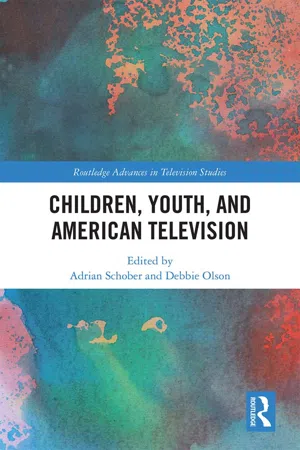
This volume explores how television has been a significant conduit for the changing ideas about children and childhood in the United States. Each chapter connects relevant events, attitudes, or anxieties in American culture to an analysis of children or childhood in select American television programs. The essays in this collection explore historical intersections of the family with expectations of childhood, particularly innocence, economic and material conditions, and emerging political and social realities that, at times, present unique challenges to America's children and the collective expectation of what childhood should be.
eBook - ePub
Children, Youth, and American Television
- 288 pages
- English
- ePUB (mobile friendly)
- Available on iOS & Android
eBook - ePub
Children, Youth, and American Television
About this book
Information
1 Recognizing the Children in Alfred Hitchcock Presents and the Alfred Hitchcock Hour
Preface
Sociologist Nick Lee observed: “In order to properly recognize children, researchers must make a firm decision not to apply the dominant framework.”1 In other words, to see children and childhood for what they really are, it is necessary to think outside the customary frame. (Lee’s point, to be taken up later, is that society hasn’t always encouraged such a liberal outlook.) What this essay calls Hitchcock’s “ecumenical” view, meaning his open-mindedness, is well-suited to such a recognition of children, and mostly that viewpoint informs the various episodes of the TV series, whether directed by Hitchcock or by someone else (such as Robert Stevens or Norman Lloyd). The essay also concerns itself with Hitchcock’s long-standing interest in the “growing up process” – including sometimes its reversal or annulment – which for him may have had its roots in English novels and plays2 and was no doubt sharpened when he began to feel himself an accomplished artist, especially of “suspense” pictures. Critic Raymond Durgnat noted the mechanics of that suspense, if not its broader implications, when he wrote of Hitchcock’s audience: “He catches us in that semi-serious, semi-infantile area where we accept innocent and wicked as real moral states, and then insists that we grow up, a little.”3 To be fair, Hitchcock’s ostensible subject-matter is often like the famous MacGuffin: the artist’s true intent may remain hidden until, with all distractions finally off the table, the characters, and the audience, face an elusive truth. A paradigm show in this respect is “The Crystal Trench” (AHP, Fifth Season), discussed shortly. But I don’t want to simplify (or moralize) and would observe that the vast majority of the shows are nuanced and shaded throughout, which can conveniently raise the matter of Hitchcock’s fascination with “pure cinema.” Something insufficiently appreciated, I believe, is how the films and TV shows are less about “content” as usually understood (domestic melodrama or celebrity biopic, say) than “situations” whose tone and general allusiveness are to be sensed and savored. A surprising number of the films and shows constitute what I would loosely call “soul-dramas”; and, significantly, children are not excluded from these – see, for instance, my several comments on “Santa Claus and the Tenth Avenue Kid” (AHP, First Season) below. Further, I hope the reader will accept my emphasis in this essay on the shows’ lead-ins and lead-outs (wraparounds), as distinct from the individual dramas themselves: the wraparounds function as an integral part of each show, in a catalytic, and even surreal, eye-opening way. A reader wanting sociological analysis of children-in-society may question such emphasis, but I think it reflects that of the shows’ producers. To come back to the word “ecumenical”: in these shows, nearly anything goes, the shocking is permitted – and at least one of the children is a killer.
J.M. Barrie’s “Eternal Childhood”
A representatively daring episode of Alfred Hitchcock Presents (AHP, 1955–1962) is “Backward, Turn Backward” (Fifth Season), in which 59-year-old widower Phil Canby is suspected of having bludgeoned to death his next-door neighbor Matt Thompson, another widower, who had objected to Canby’s romancing his daughter, Sue, aged 19. Although the actual age of the two actors was 52 and 35, a viewer quite sees the situation (the actress is especially convincing, playing a pretty, long-haired teenager); moreover, the episode proceeds to seek our sympathy for the couple, even to employing a glowing flashback, like the one in Hitchcock’s I Confess (1953), of their first kiss, in Phil’s garden, when he had realized that he indeed loved this doe-like girl and that the attraction was mutual. Further, as sheriff Andy Willetts investigates what seems an open-and-shut case of murder, it is the couple’s vindictive neighbors gathering in the street who are critiqued: the sheriff calls them “vultures,” and the District Attorney refers to them as “wolves” and “that mob.” Such content was in keeping with what the series’s associate producer, Norman Lloyd,4 disclosed in his book Stages (1990): “We maintained that unless one out of every six shows brought hate mail, because it shocked the viewers, we were not reaching our audience.”5 He added: “The television show had to reflect Hitch … We understood his storytelling style so well that we easily fell into it.”6 However, this essay will claim that more than just the director’s style was reflected in the shows, that their rich variety – typically featuring a transgressive but ultimately mysterious human psyche, including sometimes that of a child – reflected a Hitchcockian outlook that was ecumenical. “Backward, Turn Backward” ends with the revelation that it was Sue who killed her father, signaled when she suddenly breaks down and cries like a baby: that is, regresses to infancy/childhood. Fade-out on snowy-haired Phil cradling her head in his arms – the audience will recall that he had said, “She makes me feel young again” – as the sheriff comments that she probably never knew what she had done. Fade-in on Hitchcock apologizing: “We have run out of entertainment.” Then he belies those droll words by taking up a hammer and chisel and carving a block of marble that had earlier been recalcitrant. The distinctive role of the Hitchcock wraparounds, in subverting society’s “dominant framework,” is something else examined below.
Neither protagonist “grows up” in “Backward, Turn Backward,” although the future isn’t hopeless (Sue will go to hospital, Phil will help raise a baby grandson). On the other hand, in “You Can’t Be a Little Girl All Your Life” (AHP, Seventh Season), a recently married “daddy’s girl” Julie Barton, who weakly identified an innocent man in a police line-up, suddenly sees that she must grow out of her inhibitions and inform on her aberrant husband when she realizes with a shock that he was the mysterious late-night intruder who attacked her. Always, Hitchcock was intrigued by the permutations of “growing up” and especially by instances where the process appears suspended – in part, almost certainly, because he sensed an analogue with the tension in an artist to retain a child’s (alleged) “innocent eye.” In a brilliant essay on the multi-valency of Hitchcock’s comedy The Trouble With Harry (1955), which I’ll be citing further, Adrian Schober invokes Samuel Coleridge’s prescriptions for the artist, who needs to “carry on the feelings of childhood into the powers of manhood.”7 When Hitchcock was a teenager, one of his favorite novels was Oscar Wilde’s Faustian fantasy The Picture of Dorian Gray (1890), in which Dorian barters his soul to receive eternal youth. Later, Hitchcock attended the premiere season of the play Mary Rose (1920) by J.M. Barrie, already famous for Peter Pan, or, The Boy Who Would Not Grow Up (1904), and was entranced. Mary Rose moved in and out of time and resisted normal ageing; reportedly Barrie himself went to extremes to emulate the part, so that his marriage to another Mary (note: “Mary” was his mother’s name too) was never consummated. One commentator would call Barrie “the progenitor of the eternal English childhood.”8
The supposed dangers – metaphoric or actual – posed by marriage often figure in Hitchcock’s feature films, with issues of growing up a corollary. Maxim in Rebecca (1940) is so scarred by the failure of his first marriage that he instructs his new bride never to wear satin or pearls or to be thirty-six – he wants her to stay a girl. And in Shadow of a Doubt (1943), a telling moment occurs when serial murderer, and bachelor, Uncle Charlie comes to Santa Rosa and first sees his sister Emma, now married, after a period of many years. “Emma, don’t move, you’re Emma Spencer Oakley, the prettiest girl on the block.” He wants to remember her just as she was, as a girl eternally. Hitchcock chose to personally direct “The Crystal Trench” (AHP, Fifth Season),9 based on a short story (1915) by A.E.W. Mason, a friend of Barrie. Once again the story fitted Hitchcock’s fascination with suspension. In the following synopsis, I’ll use the name of the character from the TV episode. Stella Ballister loses her young husband in a freak accident on a Swiss mountain, and his body is swept into a slow-moving glacier. She resolves not to remarry but to wait loyally over the years until the body reemerges and she can be reunited, however briefly, with her loved one. But a shock awaits her. That shock, in turn, can be read as symbolic of the sudden realization that life isn’t what we thought it and has passed us by. Yet to Barrie the story had a positive aspect. A particularly close friend had been the polar explorer Captain Scott who perished in the Antarctic in 1912 after managing to leave a farewell letter for Barrie. A decade later, delivering the Rectorial Address on the subject of courage to students at St. Andrews University, Scotland, Barrie held up the letter and told how the fate of Scott reminded him of “the strange Alpine story of the youth who fell down a glacier and was lost,” but whose body was reckoned to appear again on a certain date:
Some of the survivors returned to the glacier to see if the prediction would be fulfilled; all old men now; and the body reappeared as young as on the day he left them. So Scott and his comrades emerge out of the white immensities, always young.10
Something of those “white immensities” would inform Hitchcock’s Spellbound (1945) – with an implicit nod to the poet Shelley’s “white radiance of eternity”11 – but the film’s strength is its tongue-in-cheek ambivalence. One robust criticism of Barrie was that of Edgell Rickword, who understood the one-sidedness of his vision: “only able to conceive a perfected action by an escape into fantasy.”12 Rickword added: “He has never had … the audacity to state the indifference of the universe.”
Hitchcock’s Pastoral Vision
For his part, Hitchcock could be profoundly – if paradoxically – downbeat. Nonetheless, the TV dramas constitute a rich array of human interest stories. In that respect, they are like a “pastoral,” which may both recall Hitchcock’s description of The Trouble With Harry (“a nice little pastorale”13) and conveniently introduce one more literary influence. Hitchcock’s overall vision, I suggest, is less Barrie’s relatively static one in Peter Pan or Mary Rose than that of yet another Barrie friend, author Rudyard Kipling, in a truly ecumenical tale about growing up, the picaresque Kim (1901).14 That novel’s most obvious link to Hitchcock is the fact that young Kim’s journey into the mountains to steal papers from a couple of Russian spies is the probable source of the narrative device that screenwriter Angus MacPhail called “the MacGuffin.”15 However, as at least one commentator notes, Kipling’s novel is indeed a “pastoral,”16 in which its orphan-hero learns at length about “the game of life” rather than simply play the Great Game that the British Raj offers him (his father having been an Irish soldier in India). He is called Little Friend of All the World, and Alan Sandison feels strongly that the novel transcends Kipling’s basic pessimism tha...
Table of contents
- Cover
- Half Title
- Title Page
- Copyright Page
- Table of Contents
- List of Figures
- Introduction
- 1 Recognizing the Children in Alfred Hitchcock Presents and the Alfred Hitchcock Hour
- 2 Rod Serling’s Damaged Children: The Twilight Zone
- 3 The Trouble with Teenagers and the Case of Gidget: ABC and the 1960s Youth Market
- 4 “And Then There Were Three”: Childhood, Bewitched, and 1960s America
- 5 Like It or Not: How Sesame Street Influenced European Children’s Television
- 6 Krofft Kids: Saturday Morning Innocence and Counterculture TV
- 7 “Dance Your Cares Away”: Fraggle Ethics, or Jim Henson’s Response to Reaganism
- 8 The End of Racism and the Last Family: The Cosby Show’s Fukuyaman Neo-Liberal Children
- 9 Performing Adulthood: The Adult-Child and the Child-Adult in Modern Family and Roseanne
- 10 Are You Afraid of the Dark? Children’s Horror Anthology Series in the 1990s
- 11 On the Cusp: Exploring Male Adolescence and the Underbelly of High School in Freaks and Geeks
- 12 “Be careful!”: Child Safety and Empowerment in The Legend of Korra
- 13 Bob’s Burgers: Rewriting the Rules for Girlhood in American Television
- About the Contributors
- Index
Trusted by 375,005 students
Access to over 1.5 million titles for a fair monthly price.
Study more efficiently using our study tools.
Frequently asked questions
Yes, you can cancel anytime from the Subscription tab in your account settings on the Perlego website. Your subscription will stay active until the end of your current billing period. Learn how to cancel your subscription
No, books cannot be downloaded as external files, such as PDFs, for use outside of Perlego. However, you can download books within the Perlego app for offline reading on mobile or tablet. Learn how to download books offline
Perlego offers two plans: Essential and Complete
- Essential is ideal for learners and professionals who enjoy exploring a wide range of subjects. Access the Essential Library with 800,000+ trusted titles and best-sellers across business, personal growth, and the humanities. Includes unlimited reading time and Standard Read Aloud voice.
- Complete: Perfect for advanced learners and researchers needing full, unrestricted access. Unlock 1.5M+ books across hundreds of subjects, including academic and specialized titles. The Complete Plan also includes advanced features like Premium Read Aloud and Research Assistant.
We are an online textbook subscription service, where you can get access to an entire online library for less than the price of a single book per month. With over 1.5 million books across 990+ topics, we’ve got you covered! Learn about our mission
Look out for the read-aloud symbol on your next book to see if you can listen to it. The read-aloud tool reads text aloud for you, highlighting the text as it is being read. You can pause it, speed it up and slow it down. Learn more about Read Aloud
Yes! You can use the Perlego app on both iOS and Android devices to read anytime, anywhere — even offline. Perfect for commutes or when you’re on the go.
Please note we cannot support devices running on iOS 13 and Android 7 or earlier. Learn more about using the app
Please note we cannot support devices running on iOS 13 and Android 7 or earlier. Learn more about using the app
Yes, you can access Children, Youth, and American Television by Adrian Schober, Debbie Olson, Adrian Schober,Debbie Olson in PDF and/or ePUB format, as well as other popular books in Media & Performing Arts & Television History & Criticism. We have over 1.5 million books available in our catalogue for you to explore.