- 208 pages
- English
- ePUB (mobile friendly)
- Available on iOS & Android
eBook - ePub
Catholicity and Heresy in the Early Church
About this book
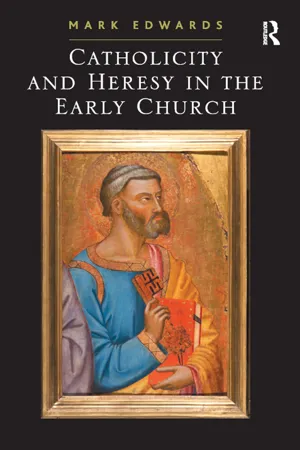
While it has often been recognised that the development of Christian orthodoxy was stimulated by the speculations of those who are now called heretics, it is still widely assumed that their contribution was merely catalytic, that they called forth the exposition of what the main church already believed but had not yet been required to formulate. This book maintains that scholars have underrated the constructive role of these "heretical" speculations in the evolution of dogma, showing that salient elements in the doctrines of the fall, the Trinity and the union of God and man in Christ derive from teachings that were initially rejected by the main church. Mark Edwards also reveals how authors who epitomised orthodoxy in their own day sometimes favoured teachings which were later considered heterodox, and that their doctrines underwent radical revision before they became a fixed element of orthodoxy. The first half of the volume discusses the role of Gnostic theologians in the formation of catholic thought; the second half will offer an unfashionable view of the controversies which gave rise to the councils of Nicaea, Ephesus and Chalcedon . Many of the theories advanced here have not been broached elsewhere, and no synthesis on this scale had been attempted by other scholars. While this book proposes a revision in the scholarly perception of early Christendom, it also demonstrates the essential unity of the tradition.
Information
Chapter 1
The Gnostic Beginnings of Orthodoxy
Notwithstanding all that chance and scholarship have brought to light in the last hundred years, it is probable that Marcion, Valentinus, Basilides and the Gnostics will continue to be known to us primarily through the philippics of Irenaeus and his younger contemporaries, who, from their own time to the present, have been regarded as the architects of catholic theology. Eulogists the heretics have in plenty today, but not among those who wish to uphold the traditions that have now become normative; they are praised instead, as they were once condemned, for the intrepidity and diversity of their experiments on the gospel. Books which follow the hegemonic line in the ‘development of doctrine’ may concede in a parenthesis that these thinkers had a catalytic role in the framing of orthodox thought, as Irenaeus would not have put any systems on paper had he not felt obliged to contradict them; but, so long as it is assumed that he arrived at his own beliefs without their counsel, it will always appear that his thought emerged from theirs like a ray from darkness rather than as sunrise after dawn.
The aim of the present chapter is to show that each of the names that I have cited can be associated with the first expression of a principle which has become an axiom of catholic doctrine. This project will require us to take account of salient differences between Gnostics, Basilideans, Valentinians and Marcionites, which have often been obscured by the broadening shadow of the term ‘Gnostic’. Once the embryonic presence of orthodox norms in one or more of these groups has been established, it will be possible, in the next chapter, to examine the survival and germination of these precepts in episcopal writers of the second century. We shall see in later chapters that the content of orthodoxy, as it is now defined, was augmented by the recrudescence of thoughts that seemed at one stage to have died of vigorous pruning, while, on the other hand, some tenets advanced at first by catholic writers either in deference or in opposition to ‘Gnostic’ reasoning were at last proscribed by creeds which purported to represent the immutable teaching of the Church.
Taxonomies
‘Gnostic’ has become a term of abuse in modern theology, but only by an abuse of its primitive sense in Christian circles. Outside the church in antiquity, the epithet gnôstikos was applied more often to human faculties or their objects than to agents, and was not nearly as common in either sense as the noun gnôsis, which means ‘knowledge’.1 In the modern age, when faith does not sit well with academic theology, and the academy itself is wary of all claims founded on metaphysical reasoning, the ‘Gnostic’ is characterized as one who professes to have an advantage over the common mind of the Church by virtue of esoteric knowledge or cryptic reasoning. They take as their foundation neither the plain text of the scriptures nor the content of any traditional creed – though ‘plain sense’, ‘tradition’ and ‘creed’ are all words more often vociferated than examined. His cardinal tenet is supposed to be that God is remote and inaccessible to any mind that thinks itself at home in the mutable world. Whereas Christianity preaches the goodness of creation and the redemption of the material realm from evil, Gnosticism is seen as the first, illicit inroad of a pagan discipline which teaches us to neglect our earthly neighbour and his sufferings in the hope of emancipating some inner man. Orthodoxy is defined as the religion of divine love mediated by the suffering of Christ, and hence the religion of the material sacrament, corporate salvation and the vindication of God in the mundane.
There are scholars and theologians who have thrown the word ‘Gnostic’ at everyone who affirms the transcendence of God or exhorts the Christian to live for another world.2 It is not my business here to determine whether this cult of the immanent, this disdain for the other-wordly, is the result of an unavoidable metamorphosis of Christian thought in the light of philosophical reflection, historical criticism and scientific discovery.3 My purpose is only to show, as a matter of history, that the principles marked for ostracism in many current systems of theology – the doctrine of divine transcendence, a strong antithesis between flesh and spirit, a low estimation of all that is mutable – are those that the early Christians whom we term catholic and orthodox professed to have received from the apostles. In their eyes, the imputation of passibility and change to the Godhead, with the related notion of a natural affinity between the divine and the mortal, were the characteristic blasphemies of the heretic. The evidence also requires us to add that ‘heretic’ is the only compendious name available to us in this discussion, since, in contrast to both their critics and their champions today, the heresiologists of the first three centuries never used the term ‘Gnostic’ to stigmatize an opponent but only to identify those who had used it of themselves.4 They do not say of anyone ‘I call him a Gnostic, though he denies it’; they do assert from time to time, ‘They style themselves Gnostics, though I have another name for them.’5 The opposite position is commonly held today by those who, while admitting that ‘Gnosticism’ is an artificial category, lay the artifice at the door of Irenaeus, the first heresiologist, on the grounds that he charges all his adversaries with an affectation of ‘gnosis falsely so called’.6 But if the logic of this argument were sound, it would yield two unpalatable inferences: firstly that even heretics who maintained the full humanity of Christ fell under the appellation ‘Gnostic’ in the ancient world, and secondly that, since the locution ‘gnosis falsely so called’ implies that there must be a gnôsis truly so called, Irenaeus considered himself a Gnostic. In fact the logic is poor, as Greek does not form adjectives from nouns by a universal algorithm, and we have noted above that the usage of the noun gnôsis is not coterminous with that of its derivative. One orthodox writer, Clement of Alexandria, exhorts the Christian to become a Gnostic if he can, and thus to cultivate a purity of doctrine and an integrity of life that will confound the ‘so-called’ Gnostics whom the Church anathematizes.7 The latter are distinguished from other groups professing gnôsis, and the rider ‘so-called’ implies that they have no right to term ‘Gnostic’. It is not so much that Clement is purloining a designation that had hitherto been the property of a heretical group, but rather that the name was there to be employed by controversialists of either party, provided that they were addressing an audience learned enough to tolerate refinements of the Greek vernacular.
It was not in the interests of heresiologists to represent their enemies as a numerous cohort, united in the defence of a single system opposed to theirs. Like the apologists of the Roman Church in the sixteenth century, they found it more expedient to magnify contradictions between two schools, or within the same school, as an illustration of the discord which inevitably follows when a Christian sets his own gnosis against the consensus of the apostles and their successors. Such unity as the different schools exhibit – and here again the polemic anticipates that of the Reformation era – is not so much generic as genealogical: as all Protestants can be said to spring from Luther, so the aberrations of a Marcion, a Basilides or a Valentinus are traced by their ancient critics to the pride of Simon Magus or the notorious absurdities of the Gnostics strictly so called. What it is to be a Gnostic strictly so called in the eyes of those outside the Church we learn from the neoplatonist Porphyry: it is to hold that the demiurge of the visible cosmos is malign.8 This definition fits those groups whom Irenaeus, Origen and Clement describes as Gnostic, though not perhaps the Gnostics of Hippolytus, the most prolix and least typical of our Christian witnesses. The named heresiarchs who now pass for Gnostics all approximate to this definition, but none fulfils it exactly, and each differs from the rest in points that cannot have seemed inconsequential to their contemporaries, since (as we shall see) their peculiarities frequently align them with the episcopal church against one or more of its rivals.
This chapter will examine four developments of Christian thought in the second century. Each falls under the modern taxonomies of Gnosticism, though only one – the one without a named heresiarch – was called ‘Gnostic’ in its own time. I shall argue that the elements in each which seemed most foreign to its first critics are not baseless innovations, that in each case we observe a natural ripening (or at worst a hypertrophy) of motifs that belong to the earliest proclamation of the Gospel. It was by the domestication, not by the mere rebuttal, of their conjectures that produced its earliest system of theology. It was the Gnostics strictly so called – the Gnostici Barbelo, as Irenaeus styles them (AH 1.30) – who first reasoned that if humanity is made in the image of God, the Godhead must contain the image of humanity, in body no less than in soul. This, I shall argue, is a mythological intimation that the fall is anticipated in the Godhead, and that its suffering is the predestined instrument of our redemption. I shall then go on to show that Basilides was the first to harmonize the different senses of the term ‘sonship’ in the New Testament, making the eternal filiation of Christ the paradigm of his earthly ministry and the saint’s election. Next we shall see that this teaching on the prefigurement of the temporal in the eternal was confirmed by the Valentinian myth of the fall and redemption of Wisdom before the ages. We shall briefly examine Marcion’s emaciated version of the Gnostic myth, which, because it excluded suffering from the Godhead, obliged the church to find other means of reconciling the fall with the goodness of the creator.
The Image of God in Gnostic Thought
To discover what the catholic tradition owes to the Gnostics, we must collect the same materials for a theology of the image from the source that Christians now call the Old Testament. At Genesis 1.26, a passage all the more famous because it lacks a parallel in the Old Testament, God undertakes to ‘make man in our image and likeness’. Two verses later, man is made in his image, but with no mention of the likeness, though with the rider that he is created male and female (Genesis 1.28). Since God cannot lie, this silence is an enigma, which admits of two solutions. Either the complementarity of the sexes is the ground of our resemblance to God (in which case it would seem that God himself is to be conceived hermaphroditically9), or else he has yet to communicate the likeness, and in the meantime the differentiation of sexes remains as a sign of our imperfection.
To any ancient Christian who acknowledged this dilemma, it would have seemed that Paul had seized the second horn of it. He extols Christ as the image of God at Colossians 1.5, and the male, in contradistinction to the female, as the image and glory of God at 1Corinthians 11.7. He nowhere, on the other hand, accords the likeness of God to a creature, and any likeness to which he alludes is assumed or superimposed at the cost of glory. The Son of God is said at Romans 8.3 to have come in the likeness of sinful flesh, to ransom those who, flouting a positive ordinance, have sinned after the likeness of Adam (Romans 5.14), together with those who, spurning natural revelation, mocked the creator under the likeness of a four-footed beast (Romans 1.23). Far from positing any fusion of sexes in the Deity, Paul exclaims that in Christ there is neither male nor female, and exhorts a mixed congregation to reap the fruits of Christ’s descent in human likeness by growing up into the form of a perfect man (Ephesians 4.9).
Nor does Paul join some of his fellow countrymen in reasoning that when God employs the plural at Genesis 1.3 – ‘Let us make man in our image’ – he is deputing the formation of Adam’s body to the angels.10 Yet this is what he is willing to say of the Law – that it was delivered not by God, but by the angels, through the ‘hand of a mediator’ (3.20), which is to say, not from one but from many.11 While this tradition is cited in commendation of the Law at Acts 7.53, Paul uses it to reinforce his argument that the Jew who rests his hope of election on this fragile instrument is as much an idolater as the pagan devotee of the ‘weak and beggarly elements’ (Galatians 4.3, 4.9). He none the less concedes that the Law, when rightly construed, is spiritual, and here at least he seems to be at one with James the apostle of works, for whom righteousness proceeds from the contemplation of the ‘perfect law of liberty’ (James 1.25). James contrasts the student of this law with the man who passes on unmindfully after gazing upon his own face in a mirror. Paul likewise speaks of our knowledge in this world as a dark simulacrum of that which awaits the saints after death; it is by gazing ‘with open face on the glory of God’ that we are translated, little by little, into his image, until the body itself becomes one in form with the glorious body of Christ (2Corinthians 3.18; cf. 4.18).
No work of a self-styled Gnostic was so widely disseminated in antiquity as the one called the Apocryphon of John. The Nag Hammadi Library, a cache discovered near an Egyptian monastery in 1945,12 contains two versions of unequal length, while a third, the Berlin Codex, has been known since the last years of the nineteenth century. The Christian world has long been in possession of a fourth, the derisive and meagre, but (as it now proves) not inaccurate synopsis in Irenaeus, who gives the name Gnostic Barbelo to its votaries (AH 1.29). It has been alleged that the text in its primitive form had no peculiarly Christian traits,13 yet the John of its title is clearly the apostle, and there is nothing to show that it ever bore another, or that the introductory dialogue between John and the Pharisee Arimanius is an accretion.14 There are many works of early Christian literature, some later than the Apocryphon, which cite no other scripture than the Old Testament, neglect the material sacraments and speak of Christ, if at all, only under a cryptic and impersonal nomenclature: we are not justified in assigning a Jewish or pagan milieu to every work that clothes its teaching in the Jewish or pagan vulgate. The doctrine of God with which the cosmogony of the book commences15 is of that negative or apophatic kind which holds that nothing can be predicated truly of the first principle except that it does not possess the predicates of any lesser being. So much has already been affirmed by a number of devout philosophers, though not perhaps by any that was wholly untouched by Biblical teaching on the inscrutability of God;16 of all religious movements, Christianity was the one most likely to cultivate such a vein of thought, for in proclaiming Christ as the image of the invisible God, it implied that the F...
Table of contents
- Cover
- Half Title
- Title Page
- Copyright Page
- Dedication
- Table of Contents
- Introduction
- 1 The Gnostic Beginnings of Orthodoxy
- 2 The Catholicity of Irenaeus
- 3 The Foundations of Catholic Teaching in the Third Century
- 4 Origen and Orthodoxy
- 5 The Nicene Council and its Aftermath
- 6 Apollinarius and the Chalcedonian Definition
- Epilogue
- Bibliography
- Index
Trusted by 375,005 students
Access to over 1.5 million titles for a fair monthly price.
Study more efficiently using our study tools.
Frequently asked questions
Yes, you can cancel anytime from the Subscription tab in your account settings on the Perlego website. Your subscription will stay active until the end of your current billing period. Learn how to cancel your subscription
No, books cannot be downloaded as external files, such as PDFs, for use outside of Perlego. However, you can download books within the Perlego app for offline reading on mobile or tablet. Learn how to download books offline
Perlego offers two plans: Essential and Complete
- Essential is ideal for learners and professionals who enjoy exploring a wide range of subjects. Access the Essential Library with 800,000+ trusted titles and best-sellers across business, personal growth, and the humanities. Includes unlimited reading time and Standard Read Aloud voice.
- Complete: Perfect for advanced learners and researchers needing full, unrestricted access. Unlock 1.5M+ books across hundreds of subjects, including academic and specialized titles. The Complete Plan also includes advanced features like Premium Read Aloud and Research Assistant.
We are an online textbook subscription service, where you can get access to an entire online library for less than the price of a single book per month. With over 1.5 million books across 990+ topics, we’ve got you covered! Learn about our mission
Look out for the read-aloud symbol on your next book to see if you can listen to it. The read-aloud tool reads text aloud for you, highlighting the text as it is being read. You can pause it, speed it up and slow it down. Learn more about Read Aloud
Yes! You can use the Perlego app on both iOS and Android devices to read anytime, anywhere — even offline. Perfect for commutes or when you’re on the go.
Please note we cannot support devices running on iOS 13 and Android 7 or earlier. Learn more about using the app
Please note we cannot support devices running on iOS 13 and Android 7 or earlier. Learn more about using the app
Yes, you can access Catholicity and Heresy in the Early Church by Mark Edwards in PDF and/or ePUB format, as well as other popular books in Teología y religión & Religión. We have over 1.5 million books available in our catalogue for you to explore.