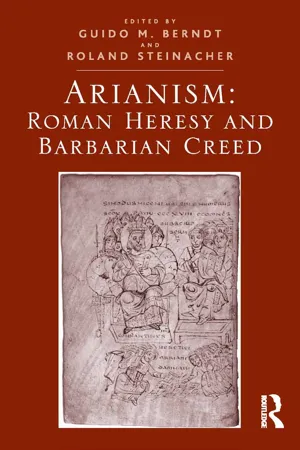
This is the first volume to attempt a comprehensive overview of the evolution of the 'Arian' churches in the Roman world of Late Antiquity and their political importance in the late Roman kingdoms of the 5th-6th centuries, ruled by barbarian warrior elites. Bringing together researchers from the disciplines of theology, history and archaeology, and providing an extensive bibliography, it constitutes a breakthrough in a field largely neglected in historical studies. A polemical term coined by the Orthodox Church (the side that prevailed in the Trinitarian disputes of the 4th century C.E.) for its opponents in theology as well as in ecclesiastical politics, Arianism has often been seen as too complicated to understand outside the group of theological specialists dealing with it and has therefore sometimes been ignored in historical studies. The studies here offer an introduction to the subject, grounded in the historical context, then examine the adoption of Arian Christianity among the Gothic contingents of the Roman army, and its subsequent diffusion in the barbarian kingdoms of the late Roman world.
All index entries shown here correspond to the page numbers within the printed edition only. Within this digital format these page numbers allow for cross referencing only.
References to figures as well as elaborate passages on the entry are in bold
Abragila (homoian presbyter, a Vandal) 174
Acacius of Caesarea (bishop, d. 366) 51–52, 55 n. 22/23, 56, 60, 61 n. 56, 62, 69, 94, 99, 104 n. 43, 146
Achilles (bishop of Alexandria, 311–313) 8
Adaloald (king of the Lombards, r. 616–626) 232, 235
Adrianople (Hadrianopolis/
) 50 n. 3, 64, 65, 111, 141, 155
Aëtios (deacon) 34
Aëtius of Antioch (4th c. theologian) 47, 62, 93, 94, 98, 146
Aëtius, Flavius (magister utriusque militum, patricius, d. 454) 276, 285
Agnellus of Ravenna (bishop of Ravenna, 557–570) 214 and n. 42
Agnellus of Ravenna (9th c. chronicler) 169, 191, 214, 225
Agnes (saint) 159
Agobard of Lyon (bishop, d. 840) 291–92, 292 n. 64
Agricola (martyr) 185
Aiax/Ajax (5th c. Arian missionary) 161, 172, 297
Alahis (Arian duke of Trent and Brescia, king of the Lombards in 689) 237, 238
Alamanni 21, 285
Alans 272
Alaric I (king of the Visigoths, r. 395–410) 112, 155, 156 n. 52, 194, 196, 274
Alaric II (king of the Visigoths, r. 484–507) 160 n. 72, 162 and n. 78, 184, 220, 275, 280
Alavivus (a leader of the Tervingi) 63–64, 73
Alboin (king of the Lombards, r. around 560–572) 22, 232, 234
Alexander (bishop of Alexandria, 313–328) 1, 8–10, 12–13, 88...
Table of contents
Cover Page
Half Title Page
Dedication
Title Page
Copyright Page
Original Title Page
Contents
List of Illustrations
Notes on Contributors
Abbreviations
Preface
Introduction: Framing the Historical and Theological Problems Hanns Christof Brennecke
1a Ulfila und der sogenannte gotische Arianismus
1b Ulfila and the so-called ‘Gothic' Arianism – English Summary
2 Was Ulfila Really a Homoian? Sara Parvis
3 Sabas: ‘Orthodox' or ‘Arian'? Paul Parvis
4 The Homoians Uta Heil
5 Deconstruction of the So-called Germanic Arianism Hanns Christof Brennecke
6 Vulfila pontifex ipseque primas Gothorum minorum, sed non apostolus eorum. Vulfila, Bishop and Secular Leader of His People but not Their Apostle Herwig Wolfram
7 Barbarian ‘Arian' Clergy, Church Organization, and Church Practices1 Ralph W. Mathisen
8 Germanic Language and Germanic Homoianism Brendan Wolfe
9 The Non-Archaeology of Arianism – What Comparing Cases in Carthage, Haïdra and Ravenna Can Tell Us about ‘Arian' Churches Ralf Bockmann
10 The ecclesia legis Gothorum and the Role of ‘Arianism' in Ostrogothic Italy Guido M. Berndt and Roland Steinacher
11 Arrianorum abolevit heresem: The Lombards and the Ghost of Arianism* Piero Majocchi
12 Arianism in Africa Robin Whelan
13 Arianism and Ethnic Identity in Sixth-Century Visigothic Spain* Manuel Koch
14 The Homoians in Gaul Uta Heil
15 Britain: Approaching Controversy on the Western Fringes of the Roman Empire Meritxell Pérez Martínez
Conclusion: The Elusive Nature of an Orthodox Heresy
Bibliography
Index
Trusted by 375,005 students
Access to over 1.5 million titles for a fair monthly price.
Study more efficiently using our study tools.
Frequently asked questions
Yes, you can cancel anytime from the Subscription tab in your account settings on the Perlego website. Your subscription will stay active until the end of your current billing period. Learn how to cancel your subscription
No, books cannot be downloaded as external files, such as PDFs, for use outside of Perlego. However, you can download books within the Perlego app for offline reading on mobile or tablet. Learn how to download books offline
Perlego offers two plans: Essential and Complete
Essential is ideal for learners and professionals who enjoy exploring a wide range of subjects. Access the Essential Library with 800,000+ trusted titles and best-sellers across business, personal growth, and the humanities. Includes unlimited reading time and Standard Read Aloud voice.
Complete: Perfect for advanced learners and researchers needing full, unrestricted access. Unlock 1.5M+ books across hundreds of subjects, including academic and specialized titles. The Complete Plan also includes advanced features like Premium Read Aloud and Research Assistant.
Both plans are available with monthly, semester, or annual billing cycles.
We are an online textbook subscription service, where you can get access to an entire online library for less than the price of a single book per month. With over 1.5 million books across 990+ topics, we’ve got you covered! Learn about our mission
Look out for the read-aloud symbol on your next book to see if you can listen to it. The read-aloud tool reads text aloud for you, highlighting the text as it is being read. You can pause it, speed it up and slow it down. Learn more about Read Aloud
Yes! You can use the Perlego app on both iOS and Android devices to read anytime, anywhere — even offline. Perfect for commutes or when you’re on the go. Please note we cannot support devices running on iOS 13 and Android 7 or earlier. Learn more about using the app
Yes, you can access Arianism: Roman Heresy and Barbarian Creed by Guido M. Berndt, Roland Steinacher in PDF and/or ePUB format, as well as other popular books in History & Ancient History. We have over 1.5 million books available in our catalogue for you to explore.