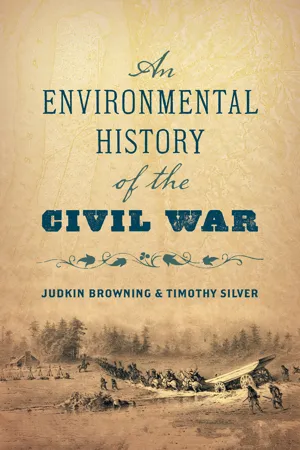
This sweeping new history recognizes that the Civil War was not just a military conflict but also a moment of profound transformation in Americans' relationship to the natural world. To be sure, environmental factors such as topography and weather powerfully shaped the outcomes of battles and campaigns, and the war could not have been fought without the horses, cattle, and other animals that were essential to both armies. But here Judkin Browning and Timothy Silver weave a far richer story, combining military and environmental history to forge a comprehensive new narrative of the war’s significance and impact. As they reveal, the conflict created a new disease environment by fostering the spread of microbes among vulnerable soldiers, civilians, and animals; led to large-scale modifications of the landscape across several states; sparked new thinking about the human relationship to the natural world; and demanded a reckoning with disability and death on an ecological scale. And as the guns fell silent, the change continued; Browning and Silver show how the war influenced the future of weather forecasting, veterinary medicine, the birth of the conservation movement, and the establishment of the first national parks.
In considering human efforts to find military and political advantage by reshaping the natural world, Browning and Silver show not only that the environment influenced the Civil War’s outcome but also that the war was a watershed event in the history of the environment itself.
- 272 pages
- English
- ePUB (mobile friendly)
- Available on iOS & Android
eBook - ePub
An Environmental History of the Civil War
About this book
Information
INDEX
Adams, Charles Francis, 114
Aedes aegypti, 31. See also mosquitoes
African American troops, 140, 143, 160, 188
Alabama, 46, 70, 82; cattle herding in, 127; cultivated land in, 194; loss of livestock in, 191, 195; ore mining in, 111; salt refining in, 162, 163; Union raids in, 66–67, 87, 124
Alabama units: Tenth Regiment Infantry, 23
Albuquerque, NM, 43, 44
Alcott, Louisa May, 154
Alexander, E. Porter, 93
alfalfa, 128
Alton, IL, 36, 37
American Veterinary Medicine Association, 193
Amherst County, VA, 180
amputations, 153, 154
Anaplasma marginale, 128–29
Anaplasmosis, 128
Andersonville prison, 156–57
“Angel’s Glow,” 149–50, 153
Anopheles quadrimaculatus, 27–29. See also mosquitoes
Antietam, Battle of, 6, 77–79, 112, 166; battlefield preservation of, 184–85; burning horses after, 119
Apache Indians, 39
Appomattox, VA, 7, 187, 190, 193, 196
Arizona, 15, 39, 43, 44
Arkansas, 14, 88; cut off from rest of Confederacy, 101; hog cholera in, 126; loss of livestock in, 191–92; salt refining in, 163
ARkStorm, 42–43
Army of Northern Virginia, 72, 155; at Battle of the Wilderness, 141; at Fredericksburg, 183; on Gettysburg campaign, 93, 102, 115; measles in, 11; shortage of food for, 92
Army of Tennessee (Confederate), 106, 115
Army of Tennessee (Union), 140
Army of the Cumberland, 115, 166
Army of the Mississippi (Confederate), 67
Army of the Ohio (Union), 66–67
Army of the Potomac: 12, 29, 140, 152; in Antietam campaign, 76; at Battle of Chancellorsville, 92; at Battle of Gettysburg, 167; at Battle of Spotsylvania, 133; at Battle of the Wilderness, 141, 170; health of, 11, 35, 64; horses in, 109, 112, 114; in “Mud March,” 1–5; in ...
Table of contents
- Cover Page
- Title Page
- Copyright Page
- Contents
- Illustrations
- Introduction: More than the Mud March
- One. Sickness: Spring–Winter 1861
- Two. Weather: Winter 1861–Fall 1862
- Three. Food: Fall 1862–Summer 1863
- Four. Animals: Summer 1863–Spring 1864
- Five. Death and Disability: Spring 1864–Fall 1864
- Six. Terrain: Fall 1864–Spring 1865
- Epilogue: An Environmental Legacy
- Acknowledgments
- Notes
- Bibliography
- Index
Trusted by 375,005 students
Access to over 1.5 million titles for a fair monthly price.
Study more efficiently using our study tools.
Frequently asked questions
Yes, you can cancel anytime from the Subscription tab in your account settings on the Perlego website. Your subscription will stay active until the end of your current billing period. Learn how to cancel your subscription
No, books cannot be downloaded as external files, such as PDFs, for use outside of Perlego. However, you can download books within the Perlego app for offline reading on mobile or tablet. Learn how to download books offline
Perlego offers two plans: Essential and Complete
- Essential is ideal for learners and professionals who enjoy exploring a wide range of subjects. Access the Essential Library with 800,000+ trusted titles and best-sellers across business, personal growth, and the humanities. Includes unlimited reading time and Standard Read Aloud voice.
- Complete: Perfect for advanced learners and researchers needing full, unrestricted access. Unlock 1.5M+ books across hundreds of subjects, including academic and specialized titles. The Complete Plan also includes advanced features like Premium Read Aloud and Research Assistant.
We are an online textbook subscription service, where you can get access to an entire online library for less than the price of a single book per month. With over 1.5 million books across 990+ topics, we’ve got you covered! Learn about our mission
Look out for the read-aloud symbol on your next book to see if you can listen to it. The read-aloud tool reads text aloud for you, highlighting the text as it is being read. You can pause it, speed it up and slow it down. Learn more about Read Aloud
Yes! You can use the Perlego app on both iOS and Android devices to read anytime, anywhere — even offline. Perfect for commutes or when you’re on the go.
Please note we cannot support devices running on iOS 13 and Android 7 or earlier. Learn more about using the app
Please note we cannot support devices running on iOS 13 and Android 7 or earlier. Learn more about using the app
Yes, you can access An Environmental History of the Civil War by Judkin Browning,Timothy Silver in PDF and/or ePUB format, as well as other popular books in History & American Civil War History. We have over 1.5 million books available in our catalogue for you to explore.