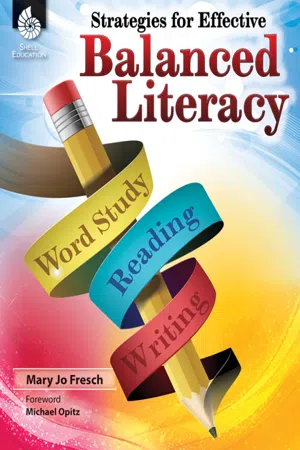
Strategies for Effective Balanced Literacy provides a teacher-friendly guide to the critical elements of a comprehensive balanced literacy framework. Through understanding the developmental progression of word study, reading, and writing, and administering purposeful assessments, teachers can create learning environments to more effectively meet students' needs. The research-based model lessons and flexible, effective strategies help teachers find engaging ways to support all learners and address standards.
- 346 pages
- English
- PDF
- Available on iOS & Android
eBook - PDF
Strategies for Effective Balanced Literacy
About this book
Information
Table of contents
- Cover
- Credits
- Page 3 - Table of Contents
- Page 5 - Foreword
- Page 7 - Acknowledgments
- Page 9 - Introduction
- Page 10 - Essentials of Literacy Development
- Page 10 - Why Balanced Literacy?
- Page 12 - What’s Ahead: Effective Balanced Literacy
- Page 13 - A Day in a Balanced Literacy Classroom
- Page 19 - Conclusion
- Page 20 - How to Use This Book
- Page 21 - Word Study
- Page 22 - Introduction
- Page 23 - Meet Cameron
- Page 24 - Word Study Instruction
- Page 24 - Phonics Historical Time Line
- Page 26 - Best Practices in Phonics Instruction
- Page 26 - Spelling Historical Time Line
- Page 27 - Best Practices in Spelling Instruction
- Page 28 - Vocabulary Historical Time Line
- Page 30 - Best Practices in Vocabulary Instruction
- Page 31 - Setting Up the Word Study Classroom
- Page 31 - Word Study in Kindergarten through Grade 2
- Page 33 - Word Study in Grade 3 through Grade 5
- Page 33 - Word Study in Grade 6 through Grade 8
- Page 35 - Differentiation
- Page 37 - Integrating Technology
- Page 38 - Word Study Strategies Kindergarten through Grade 2
- Page 52 - Grade 3 through Grade 5
- Page 66 - Grade 6 through Grade 8
- Page 81 - Conclusion
- Page 81 - Reflection and Discussion Questions
- Page 83 - Reading
- Page 85 - Introduction
- Page 86 - Meet Isabella
- Page 87 - Setting Up the Reading Classroom
- Page 87 - The Library
- Page 88 - The Reading Zone
- Page 89 - The Listening Area
- Page 91 - Assessing Students in the Reading Classroom
- Page 91 - Early Literacy Assessment
- Page 94 - Oral Reading Record
- Page 98 - Qualitative Reading Inventory
- Page 99 - Questions to Guide Comprehension
- Page 99 - Before Reading
- Page 100 - During Reading
- Page 100 - After Reading
- Page 100 - Question-Answer Relationship
- Page 102 - Guided Reading in Kindergarten through Grade 5
- Page 102 - Best Practices in Guided Reading
- Page 103 - Guided Reading Lessons
- Page 104 - Using Assessments to Create Creating Guided Reading Groups
- Page 105 - Selecting Texts
- Page 107 - Focus on Vocabulary
- Page 108 - Guided Reading in Kindergarten through Grade 2
- Page 125 - Guided Reading in Grade 3 through Grade 5
- Page 141 - Literature Circles in Grade 6 through Grade 8
- Page 141 - Best Practices in Literature Circles
- Page 158 - Modeled and Shared Read Alouds
- Page 158 - Best Practices for Read Alouds
- Page 160 - Selecting Books for Read Alouds
- Page 161 - Modeled Read-Aloud Lessons
- Page 162 - Shared Read-Aloud Lessons
- Page 164 - Independent Reading
- Page 164 - Best Practices for Independent Reading
- Page 165 - Organization
- Page 166 - How Independent Reading Informs Teaching
- Page 167 - Conclusion
- Page 167 - Reflection and Discussion Questions
- Page 169 - Writing
- Page 171 - Introduction
- Page 172 - Meet Malik
- Page 173 - Setting Up the Writing Classroom
- Page 173 - Organization and Writing Tools
- Page 174 - Publishing Center
- Page 175 - Resources
- Page 177 - Modeled and Shared Writing
- Page 177 - Introduction to Modeled Writing
- Page 177 - Best Practices in Kindergarten through Grade 2
- Page 180 - Best Practices in Grade 3 through Grade 5
- Page 183 - Best Practices in Grade 6 through Grade 8
- Page 185 - Introduction to Shared Writing
- Page 186 - Best Practices in Kindergarten through Grade 2
- Page 187 - Best Practices in Grade 3 through Grade 5
- Page 188 - Best Practices in Grade 6 through Grade 8
- Page 190 - Writer’s Workshop
- Page 190 - Introduction to Writer’s Workshop
- Page 191 - How to Organize for Writer’s Workshop
- Page 192 - Best Practices in Kindergarten through Grade 2
- Page 205 - Best Practices in Grade 3 through Grade 5
- Page 218 - Best Practices in Grade 6 through Grade 8
- Page 231 - Assessment in Writer’s Workshop
- Page 233 - Journals
- Page 233 - Introduction to Journal Writing
- Page 234 - Best Practices for Journal Writing
- Page 237 - Conclusion
- Page 237 - Reflection and Discussion Questions
- Page 239 - Appendices
- Page 239 - Appendix A: References Cited
- Page 249 - Appendix B: Additional Resources
- Page 251 - Appendix C: Activity Pages
- Page 340 - Appendix D: Digital Resources
- Thank You Page
Trusted by 375,005 students
Access to over 1.5 million titles for a fair monthly price.
Study more efficiently using our study tools.
Frequently asked questions
Yes, you can cancel anytime from the Subscription tab in your account settings on the Perlego website. Your subscription will stay active until the end of your current billing period. Learn how to cancel your subscription
No, books cannot be downloaded as external files, such as PDFs, for use outside of Perlego. However, you can download books within the Perlego app for offline reading on mobile or tablet. Learn how to download books offline
Perlego offers two plans: Essential and Complete
- Essential is ideal for learners and professionals who enjoy exploring a wide range of subjects. Access the Essential Library with 800,000+ trusted titles and best-sellers across business, personal growth, and the humanities. Includes unlimited reading time and Standard Read Aloud voice.
- Complete: Perfect for advanced learners and researchers needing full, unrestricted access. Unlock 1.5M+ books across hundreds of subjects, including academic and specialized titles. The Complete Plan also includes advanced features like Premium Read Aloud and Research Assistant.
We are an online textbook subscription service, where you can get access to an entire online library for less than the price of a single book per month. With over 1.5 million books across 990+ topics, we’ve got you covered! Learn about our mission
Look out for the read-aloud symbol on your next book to see if you can listen to it. The read-aloud tool reads text aloud for you, highlighting the text as it is being read. You can pause it, speed it up and slow it down. Learn more about Read Aloud
Yes! You can use the Perlego app on both iOS and Android devices to read anytime, anywhere — even offline. Perfect for commutes or when you’re on the go.
Please note we cannot support devices running on iOS 13 and Android 7 or earlier. Learn more about using the app
Please note we cannot support devices running on iOS 13 and Android 7 or earlier. Learn more about using the app
Yes, you can access Strategies for Effective Balanced Literacy by Mary Jo Fresch in PDF and/or ePUB format, as well as other popular books in Didattica & Formazione professionale. We have over 1.5 million books available in our catalogue for you to explore.