eBook - PDF
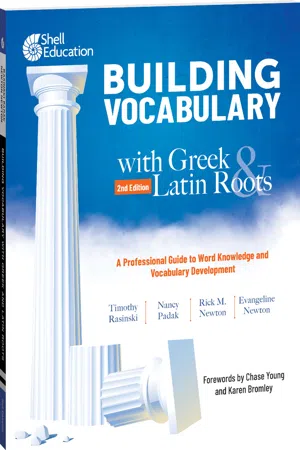
Building Vocabulary with Greek and Latin Roots
A Professional Guide to Word Knowledge and Vocabulary Development
- 194 pages
- English
- PDF
- Available on iOS & Android
eBook - PDF
Building Vocabulary with Greek and Latin Roots
A Professional Guide to Word Knowledge and Vocabulary Development
About this book
Did you know that Greek and Latin roots make up 90% of English words of two or more syllables? Having an extensive vocabulary is key to students' reading comprehension. By adopting the strategies in this book, teachers will help their students read more effectively, setting a foundation for lifelong learning and reading success. This teacher-friendly resource written by Timothy Rasinski, Nancy Padak, Rick M. Newton, and Evangeline Newton provides the latest research on how to teach Greek and Latin roots. It includes anecdotes from teachers who have adopted these strategies and how they play out in today's classrooms. With a research-based rationale for addressing vocabulary in the classroom, this K-12 resource is full of strategies for increasing reading comprehension, instructional planning, and building a word-rich learning environment to support all students including English language learners.
Information
C
H
A
P
T
E
R
1
Teaching
Vocabulary:
What
Does
the
Research
Say?
Have
you
ever
visited
the
National
World
War
II
Museum
in
New
Orleans?
It
is
a
fascinating
place
Among
the
documents
available
for
viewing
is
the
first
draft
of
President
Franklin
Delano
Roosevelt’s
famous
speech
that
begins
“Yesterday,
December 7,
1941—a
date
which
will
live
in
infamy
”
These
powerful
words
helped
the
nation
prepare
for
war
But
they
were
not
the
first
words
FDR
wrote
The
first
draft
of
the
beginning
of
the
speech
reads
“a
date
which
will
live
in
world
history
”
Which
do
you
think
is
more
memorable,
“infamy”
or
“world
history”?
Word
choice
really
does
make
a
difference
Mark
Twain
once
observed
that
“the
difference
between
the
almost
right
word
and
the
right
word
is
really
a
large
matter—
13
Table of contents
- Cover
- Page 2 - Credits
- Page 3 - Table of Contents
- Page 7 - Forewords
- Page 11 - Preface to the Second Edition
- Page 13 - Chapter 1: Teaching Vocabulary: What Does the Research Say?
- Page 15 - Importance of Vocabulary in Literacy Development
- Page 16 - Vocabulary and Reading Comprehension
- Page 18 - The Vocabulary of School
- Page 19 - The Roots Advantage
- Page 21 - Five Principles for Word Learning
- Page 24 - Vocabulary Development for English Learners
- Page 27 - Chapter 2: A Root Awakening
- Page 28 - What Is a Root?
- Page 29 - Moving Along
- Page 29 - Why Teach Roots?
- Page 31 - Increasing Word Awareness
- Page 32 - The Three Kinds of Roots
- Page 39 - Chapter 3: Getting into Words: Patterns, Sounds, and Meaning
- Page 39 - Why Patterns?
- Page 40 - Sound-Based Word Families
- Page 42 - How to Teach Word Families
- Page 44 - Meaning-Based Word Patterns
- Page 47 - Chapter 4: A Developmental Look at Vocabulary Instruction
- Page 48 - Compound Words
- Page 50 - Negating Words with Prefixes
- Page 51 - Some Directional Prefixes
- Page 52 - Word Composition
- Page 52 - What Are Students Learning?
- Page 53 - Some Easy Suffixes
- Page 55 - Back to “Basics”
- Page 56 - “Metaphors Be with You”: Helping Students with Figurative Meaning
- Page 58 - Polysemy: Helping Students Understand Multiple Meanings
- Page 58 - “Run” with This
- Page 59 - A Coherent Pedagogy
- Page 63 - Chapter 5: Planning Vocabulary Instruction & Assessment
- Page 64 - Instructional Planning: The Basics
- Page 65 - Recommendations for Instructional Routines
- Page 70 - Differentiating Instruction
- Page 73 - Vocabulary Assessment
- Page 77 - Chapter 6: Vocabulary Practice Activities
- Page 80 - Text-Based Practice Activities
- Page 84 - Activities to Build a Word-Rich Learning Environment
- Page 86 - Word-Analysis Strategies
- Page 91 - Word-Play Activities
- Page 95 - Card Games
- Page 97 - Word Puzzles
- Page 100 - Vocabulary Activities Chart
- Page 103 - Chapter 7: Roots in Action: Classroom Snapshots
- Page 104 - Root of the Week
- Page 104 - Root Word of the Day
- Page 106 - Roots around the School
- Page 106 - Realia and Children’s Literature
- Page 108 - Writing an Exciting Story
- Page 109 - Words We Are Curious About
- Page 110 - Veni, Vidi, Vici
- Page 112 - Cognate Connections
- Page 115 - Chapter 8: More Strategies for Building Words
- Page 116 - Flexing the Meaning
- Page 117 - Flexing the Form
- Page 117 - A “Spectacular” Etymology
- Page 119 - Flexing and Reflecting with Spect, Spic
- Page 120 - Word Composition: Start with the Base
- Page 122 - Flexing and Reflecting with Trac, Tract
- Page 123 - The Ultimate Test: Does It Make Sense?
- Page 124 - In the Classroom
- Page 127 - Chapter 9: Spelling Matters
- Page 128 - Spelling and Vocabulary Development: From Sound to Meaning
- Page 129 - Spelling Tips for Latin-Based Vocabulary
- Page 131 - What Students Need to Know about Assimilation
- Page 133 - Spelling Tips for Greek-Based Vocabulary
- Page 134 - A Word about Greek and Latin Bases
- Page 137 - Chapter 10: The Story of English—How Did We Get Here?
- Page 139 - The Romano-Celtic Period: 58 BC–AD 450
- Page 141 - Old English: AD 450–1066
- Page 143 - Middle English: 1066–1500
- Page 145 - Modern English: 1500–Present
- Page 147 - The New World: English on the Move
- Page 148 - Learning English Today: The Lessons of History
- Page 150 - Appendix A: Resources for Students
- Page 152 - Appendix B: Resources for Teachers
- Page 158 - Appendix C: Commonly Taught Roots
- Page 172 - Appendix D: Beyond Greek and Latin
- Page 176 - Appendix E: How to Teach Assimilation and Words with Two Prefixes
- Page 182 - Appendix F: Professional Development Ideas
- Page 186 - Glossary
- Page 188 - References Cited
- Thank You
Trusted by 375,005 students
Access to over 1.5 million titles for a fair monthly price.
Study more efficiently using our study tools.
Frequently asked questions
Yes, you can cancel anytime from the Subscription tab in your account settings on the Perlego website. Your subscription will stay active until the end of your current billing period. Learn how to cancel your subscription
No, books cannot be downloaded as external files, such as PDFs, for use outside of Perlego. However, you can download books within the Perlego app for offline reading on mobile or tablet. Learn how to download books offline
Perlego offers two plans: Essential and Complete
- Essential is ideal for learners and professionals who enjoy exploring a wide range of subjects. Access the Essential Library with 800,000+ trusted titles and best-sellers across business, personal growth, and the humanities. Includes unlimited reading time and Standard Read Aloud voice.
- Complete: Perfect for advanced learners and researchers needing full, unrestricted access. Unlock 1.5M+ books across hundreds of subjects, including academic and specialized titles. The Complete Plan also includes advanced features like Premium Read Aloud and Research Assistant.
We are an online textbook subscription service, where you can get access to an entire online library for less than the price of a single book per month. With over 1.5 million books across 990+ topics, we’ve got you covered! Learn about our mission
Look out for the read-aloud symbol on your next book to see if you can listen to it. The read-aloud tool reads text aloud for you, highlighting the text as it is being read. You can pause it, speed it up and slow it down. Learn more about Read Aloud
Yes! You can use the Perlego app on both iOS and Android devices to read anytime, anywhere — even offline. Perfect for commutes or when you’re on the go.
Please note we cannot support devices running on iOS 13 and Android 7 or earlier. Learn more about using the app
Please note we cannot support devices running on iOS 13 and Android 7 or earlier. Learn more about using the app
Yes, you can access Building Vocabulary with Greek and Latin Roots by Timothy Rasinski,Nancy Padak,Rick M. Newton,Evangeline Newton,Rick Newton in PDF and/or ePUB format, as well as other popular books in Education & Teaching Languages. We have over 1.5 million books available in our catalogue for you to explore.