- 170 pages
- English
- PDF
- Available on iOS & Android
eBook - PDF
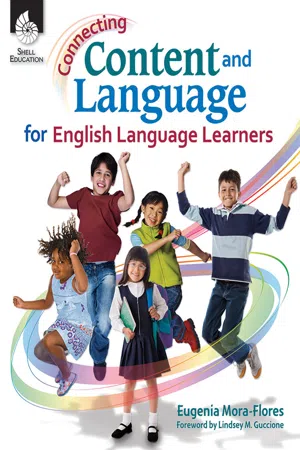
Connecting Content and Language for English Language Learners
About this book
Bridge the gap between content and language and put research into practice to instruct English language learners with strategies that meet their needs in language development and literacy. This must-have book reviews the author's experiences as a teacher in a diverse instructional setting and discusses the challenges and successes teachers experience in the ELL classroom. This resource supports College and Career Readiness Standards.
Information
Table of contents
- Cover
- Credits
- Page 3 - Table of Contents
- Page 4 - Table of Contents (cont.)
- Page 5 - Table of Contents (cont.)
- Page 6 - Table of Contents (cont.)
- Page 7 - Foreword
- Page 9 - Acknowledgements
- Page 11 - Introduction
- Page 17 - Chapter 1: Guiding Principles
- Page 17 - My Journey as a Bilingual Child
- Page 18 - My Experiences as a Teacher of English Language Learners
- Page 24 - Reinventing Myself as a Teacher for English-Only Settings
- Page 26 - Reflection Questions
- Page 27 - Chapter 2: Language Development
- Page 27 - Language Acquisition
- Page 28 - Language Transfer
- Page 31 - Learning a Language
- Page 33 - Learning a Second Language
- Page 37 - Language Development Levels
- Page 40 - Conclusion
- Page 41 - Reflection Questions
- Page 43 - Chapter 3: Academic Language
- Page 44 - Vocabulary
- Page 46 - Functions and Forms of Language
- Page 47 - Academic Language Development
- Page 48 - Language Input
- Page 49 - Specially Designed Academic Instruction in English
- Page 49 - Anticipation Guides
- Page 51 - Carousel
- Page 51 - Jigsaw
- Page 52 - Multimedia Presentations
- Page 53 - Academic Language Output
- Page 55 - Facilitating Thinking
- Page 58 - Conclusion
- Page 59 - Reflection Questions
- Page 61 - Chapter 4: Creating a Language-Rich Environment
- Page 63 - Building a Classroom Community (Physical Space)
- Page 64 - Peer-to-Peer Interaction
- Page 67 - Teacher as Listener
- Page 70 - Low Risk, High Success Contexts
- Page 72 - Interactive Read-Alouds
- Page 73 - Daily Shared-Reading Opportunities
- Page 74 - Words Introduced Orally and in Context
- Page 77 - Abundant Classroom Library
- Page 78 - Explicit Language Environment
- Page 79 - Conclusion
- Page 80 - Reflection Questions
- Page 81 - Chapter 5: Literacy Instruction for English Language Learners: Essential Elements
- Page 83 - Cognates
- Page 85 - Letter-Sound Connections
- Page 86 - Developing Oral Language
- Page 87 - Strategies for Developing Oral Language
- Page 87 - Student-Teacher Talk
- Page 87 - Pair-Share
- Page 90 - Table Talk
- Page 91 - Find Someone Who
- Page 93 - Phonemic Awareness and Phonics
- Page 94 - Strategies for Teaching Phonics
- Page 94 - Word Building
- Page 94 - Word Families
- Page 95 - Letter-Sound Collage
- Page 97 - Phonics Carousel
- Page 98 - Vocabulary Instruction
- Page 99 - Strategies for Teaching Vocabulary
- Page 100 - Vocabulary Self-Selection
- Page 101 - Where in the World?
- Page 101 - Morphology
- Page 103 - Written Discourse
- Page 107 - Scaffolding Writing
- Page 112 - Reading and Writing Connections
- Page 113 - Authentic Writing Opportunities
- Page 113 - Strategies for Teaching Reading Comprehension
- Page 114 - Sticky Notes
- Page 115 - Reflective Journals
- Page 115 - Inquiry Charts
- Page 116 - Survey, Question, Predict, Read, Recite, Review (SQPRRR/SQP3R)
- Page 118 - Student Investment
- Page 119 - Motivation
- Page 120 - Conclusion
- Page 121 - Reflection Questions
- Page 123 - Chapter 6: Developing Language Across the Curriculum
- Page 124 - English Language Development
- Page 127 - Strategies for Teaching ELD
- Page 128 - Tea Party
- Page 129 - Travelers and Talkers
- Page 131 - Lines of Communication
- Page 133 - World in a Bag
- Page 135 - Four-Corner Literature Review
- Page 136 - Content ELD
- Page 140 - Academic Language Development and Content ELD
- Page 141 - Conclusion
- Page 142 - Reflection Questions
- Page 143 - Concluding Thoughts
- Page 145 - Appendices
- Page 145 - Appendix A: Cognates
- Page 152 - Appendix B: Language Functions and Forms
- Page 158 - Appendix C: Glossary
- Page 161 - References
- Thank You Page
Trusted by 375,005 students
Access to over 1.5 million titles for a fair monthly price.
Study more efficiently using our study tools.
Frequently asked questions
Yes, you can cancel anytime from the Subscription tab in your account settings on the Perlego website. Your subscription will stay active until the end of your current billing period. Learn how to cancel your subscription
No, books cannot be downloaded as external files, such as PDFs, for use outside of Perlego. However, you can download books within the Perlego app for offline reading on mobile or tablet. Learn how to download books offline
Perlego offers two plans: Essential and Complete
- Essential is ideal for learners and professionals who enjoy exploring a wide range of subjects. Access the Essential Library with 800,000+ trusted titles and best-sellers across business, personal growth, and the humanities. Includes unlimited reading time and Standard Read Aloud voice.
- Complete: Perfect for advanced learners and researchers needing full, unrestricted access. Unlock 1.5M+ books across hundreds of subjects, including academic and specialized titles. The Complete Plan also includes advanced features like Premium Read Aloud and Research Assistant.
We are an online textbook subscription service, where you can get access to an entire online library for less than the price of a single book per month. With over 1.5 million books across 990+ topics, we’ve got you covered! Learn about our mission
Look out for the read-aloud symbol on your next book to see if you can listen to it. The read-aloud tool reads text aloud for you, highlighting the text as it is being read. You can pause it, speed it up and slow it down. Learn more about Read Aloud
Yes! You can use the Perlego app on both iOS and Android devices to read anytime, anywhere — even offline. Perfect for commutes or when you’re on the go.
Please note we cannot support devices running on iOS 13 and Android 7 or earlier. Learn more about using the app
Please note we cannot support devices running on iOS 13 and Android 7 or earlier. Learn more about using the app
Yes, you can access Connecting Content and Language for English Language Learners by Eugenia Mora-Flores in PDF and/or ePUB format, as well as other popular books in Education & Multicultural Education. We have over 1.5 million books available in our catalogue for you to explore.