The first major English-language biography of Francisco Goya y Lucientes, who ushered in the modern era
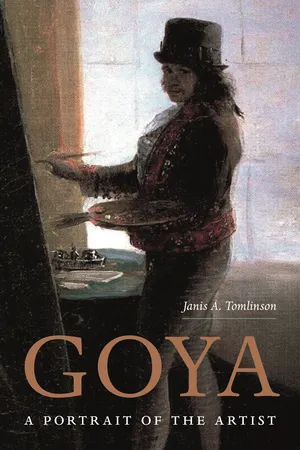
The life of Francisco Goya (1746–1828) coincided with an age of transformation in Spanish history that brought upheavals in the country's politics and at the court which Goya served, changes in society, the devastation of the Iberian Peninsula in the war against Napoleon, and an ensuing period of political instability. In this revelatory biography, Janis Tomlinson draws on a wide range of documents—including letters, court papers, and a sketchbook used by Goya in the early years of his career—to provide a nuanced portrait of a complex and multifaceted painter and printmaker, whose art is synonymous with compelling images of the people, events, and social revolution that defined his life and era.
Tomlinson challenges the popular image of the artist as an isolated figure obsessed with darkness and death, showing how Goya's likeability and ambition contributed to his success at court, and offering new perspectives on his youth, rich family life, extensive travels, and lifelong friendships. She explores the full breadth of his imagery—from scenes inspired by life in Madrid to visions of worlds without reason, from royal portraits to the atrocities of war. She sheds light on the artist's personal trials, including the deaths of six children and the onset of deafness in middle age, but also reconsiders the conventional interpretation of Goya's late years as a period of disillusion, viewing them instead as years of liberated artistic invention, most famously in the murals on the walls of his country house, popularly known as the "black" paintings.
A monumental achievement, Goya: A Portrait of the Artist is the definitive biography of an artist whose faith in his art and his genius inspired paintings, drawings, prints, and frescoes that continue to captivate, challenge, and surprise us two centuries later.
- 436 pages
- English
- ePUB (mobile friendly)
- Available on iOS & Android
eBook - ePub
About this book
Information
Publisher
Princeton University PressYear
2020Print ISBN
9780691234120
9780691192048
eBook ISBN
9780691209845
Topic
ArtSubtopic
European ArtPart I
An Artist from Zaragoza
1
Early Years
1746–1759
THE birth of Francisco Joseph Goya y Lucientes on March 30, 1746, in the hilltop village of Fuendetodos was to become the stuff of legend. Laurent Matheron recounted how one day as the fifteen-year-old Goya was carrying a sack of wheat to the nearby mill, he stopped to rest and hummed softly as he drew on a wall with charcoal the figure of a pig. Fate intervened as an aged monk was passing by; astounded by the young man’s talent, he soon arranged to take Goya to the capital of the province of Aragón, Zaragoza, where he placed the youth in the studio of the town’s leading painter, José Luzán Martínez.1
The circumstances of Goya’s birth and entry into the studio of Luzán are in fact far more prosaic. By 1746 the family of Goya’s father, Braulio José Benito Goya (who signed himself as Joseph Goya) had resided in Zaragoza for almost a century. Joseph was one of eight children born between 1702 and 1717 to the royal notary Pedro Goya and Gertrudis Franqué y Zúñiga, and one of three children still living when Gertrudis died in 1727. Following his father’s death, Joseph, his two sisters, and his aunt Manuela inherited the family’s three adjoining houses in the poor to lower working-class parish of San Gil on the Morería Cerrada (a name that reflected its Moorish heritage).2 By 1739 two of the three houses had been sold to the convent of Santa Fe; the third, between a monastery of discalced Augustinians and the Chapter of San Lorenzo, remained for the time being in the family.3
The sale of the property provided welcome income for Joseph, who had married Gracia Lucientes in 1736 in the church of San Miguel de los Navarros, still standing today with a mudéjar tower and later baroque portal adorned by the figure of Saint Michael vanquishing the devil. The marriage certificate identified Joseph as “a young man who is a gilder by profession” (mancebo de Oficio Dorador) and the bride as a native of Fuendetodos, a village about thirty-five kilometers southeast of Zaragoza; her parents were described as “new residents of this city and members of this Parish.”4 Although new to Zaragoza, the Lucientes family was well established in Fuendetodos, where about three hundred inhabitants earned their livelihood from the cultivation of wheat and barley and the herding of sheep; Gracia’s grandfather Miguel de Lucientes y Navarro became mayor in 1747.5 Joseph and Gracia’s first child, Rita, was baptized in the parish church of San Gil on May 24, 1737, and their second, Tomás, was baptized in San Miguel de los Navarros on December 30, 1739.6 A daughter, Jacinta, was born in 1743; three years later, Francisco Joseph was born in Fuendetodos on March 30, 1746. The birth certificate, dated the following day, describes his parents as “inhabitants of this parish and denizens of Zaragoza.”7
The books of the San Gil parish church in Zaragoza offer a probable explanation for the family’s relocation to Fuendetodos in March 1746. On March 8 and on April 12, the chapter made two loans to Joseph Goya, “to complete the renovation and construction” of Joseph’s house, which served as collateral.8 With renovation ongoing, the house may not have been an ideal setting for bringing a child into the world, even though the family returned to Zaragoza within a month of Goya’s birth.9 The spring census of 1747 records the family in the house, where they remained through the birth in 1750 of Mariano (who would die in infancy) and the death of the seven-year-old Jacinta later that same year; the following year the five-year-old Goya took communion with his twelve-year-old brother, Tomás, in the church of San Gil on July 26, 1751; the next year brought the birth of their last documented sibling, Camilo, who three decades later would owe his position in the church to his well-connected older brother.10
Goya’s youth was spent within the society of the many artists in Zaragoza, which by the mid-eighteenth century was a medium-sized Spanish city of about thirty-five thousand inhabitants.11 His daily life revolved around the trade of his father and older brother Tomás, both gilders, and he grew accustomed to the apprentices who came and went: Joseph Ornos (or Hornos) in 1749, Miguel San Juan in 1750, Manuel Peralta in 1751 and again in 1754, Thomas Martínez in 1751, and Vicente Onzín in 1754 (to be identified as Vicente Uncín in 1755 and as Onzí in 1756 and 1757).12 Miguel San Juan belonged to a family of gilders first documented in Zaragoza during the late seventeenth century; in 1756 both Onzín/Uncín/Onzí and Tomás Goya were working in the village of Puebla de Albortón, a little over thirty kilometers from the city. Apprentices undoubtedly assisted Joseph in gilding the altar of Saint Michael in the Zaragoza church of Santa Engracia (destroyed during the Napoleonic invasion), as well as the organ and choir screen in the church of San Pablo, which earned him 45 libras in 1754, a sum that might be measured against the 150 libras borrowed eight years earlier.13
After 1757 the family no longer lived in the house on the Morería Cerrada, and other residents are recorded there from 1758 to 1762, prior to its sale by the parish to a certain Andrés Garcés; a probable reason for the sale is that the loans made in 1746 had not been repaid. By 1759 Joseph Goya was living with Agustín Campas in the parish of San Gil; “Santa Fee”—a reference to the convent which purchased two of the three Goya family houses twenty years earlier—is penned next to Joseph’s and Agustín’s names. No mention is made of other family members, and the family’s frequent moves in years to follow suggest their financial situation was precarious. This had a lasting effect on Goya, who as an adult took great care of his money, worried about any loans he had to take until he was able to repay them, and sought wise investments as his fortune grew.
According to Goya’s son, his father was thirteen years old when he began his studies with Zaragoza’s leading painter, José Luzán Martínez, where Goya himself remembered studying for four years and learning “the principles of drawing, being made to copy the best prints [Luzán] had.”14 As a youth in Zaragoza, Luzán benefited from the patronage of the noble Pignatelli family, which enabled him to travel in 1730 to Naples, where he studied with Giuseppe Mastroleo. Following his return to Zaragoza, he became an advocate for art education as well as the city’s leading painter of religious imagery and Inquisitional censor. When in 1744 news arrived that in Madrid plans were under way to establish a royal academy of fine arts, Luzán was among the artists who envisioned the creation of a royal academy in Zaragoza. The petition failed, and almost five decades passed before Zaragoza won royal endorsement, with the help of Goya’s friend Martín Zapater. Joseph’s professional connections may have facilitated his son’s admission into the studio of Luzán, whose brothers, Pedro and Juan, were both gilders: Pedro, a master gilder, had traveled with Joseph Goya in 1756 to Calahorra (La Rioja) to paint and gild the case of the organ in the cathedral; following Pedro’s death in 1759, Joseph remained close to his family and was named one of the executors of José Luzán’s will in 1772.15 We might however ask whether special connections were essential to Goya’s entry into Luzán’s studio, known as a “school open to every young man who wanted to take advantage of his learning; [Luzán] teaching them with patience and friendship, with no other objective than their advancement.”16
What inspired Goya to be an artist may never be known, but a project undertaken in 1753 in Zaragoza’s massive basilica of El Pilar introduced him to the power of court patronage at an early age. The basilica, to play a major role in his early career, commemorates the site of the miraculous appearance of the Virgin to the Apostle James, to whom she gave a statue of herself as well as a column (pilar) of jasper to serve as its pedestal, still venerated today. When the court architect Ventura Rodríguez arrived in 1753, he envisioned the Santa Capilla (Holy Chapel), oval in plan and surmounted by a baldachin, to house the sacred column. What took form over the next twelve years is one of the greatest late baroque ensembles in Spain, its main sculptural groups illustrating the appearance of the Virgin to Saint James and his seven disciples, a theme carried into reliefs and medallions in marble, stucco, and bronze adorning the chapel.
The project brought new life to art in Zaragoza, as well as opportunities for her native sons. Zaragoza’s leading sculptor, José Ramírez, created the central groups of the apparition of the Virgin on a cloud surrounded by angels above the main altar, and Saint James with seven converts who witness the miracle from the altar to the left. Arriving from Barcelona in 1760, Carlos Salas contributed marble reliefs depicting the life of the Virgin and, on the chapel’s exterior wall, a relief of the Ascension of the Virgin; Goya’s relationship with Salas dates to this time.17 A student of the Italian painter Corrado Giaquinto, who had recently arrived in Madrid to serve as first court painter to Fernando VI, Antonio González Velázquez painted the chapel’s dome, assisted by Francisco Bayeu, a student of Luzán, and Goya’s future brother-in-law.
Bayeu was the Zaragoza painter who most benefited from the Santa Capilla project. In 1757 he entered a competition at the Royal Academy and won a two-year daily stipend of 4½ reales to study in Madrid and to work again as assistant to González Velázquez, now a court painter. He arrived in the capital in April 1758, accompanied by the four siblings in his charge following the deaths of their parents: two sisters, María Josefa (Goya’s future wife) and María Josefa Matea, and two brothers, Manuel and Ramón, who enrolled in the Royal Academy in October. Their academic careers would be short-lived. To González Velázquez’s great displeasure, Bayeu continued work on paintings commissioned by institutions in Zaragoza and, when confronted by González, responded with “improprieties . . . and other bold and indecorous expressions,” leading to the immediate termination of his pension. Perhaps following the advice of artists in the academy (who were not involved in the aristocratic councillors’ decision to deny his support), Bayeu appealed, explaining that his stipend was insufficient to support his family. In response, the councillors granted a more face-saving strategy by accepting his resignation.18
By early 1759 Bayeu found himself again in Zaragoza and later that year married Sebastiana, the daughter of the painter Juan Andrés Merklein. He returned to Madrid four years later, but in the interim probably met Goya, who in 1783 testified that “it has been twenty years more or less that I have known and have been friendly with Doña María Bayeu . . . having studied in the house of her brother Don Francisco.”19 Goya’s relationship with Bayeu, eventually solidified by his marriage to Bayeu’s sister, played a significant role in his early career.
Both Goya and Bayeu were thus in Zaragoza in October 1759 to witness a rare and splendid occasion: the arrival of Spain’s new royal family. Upon the death of Fernando VI in August 1759 his half brother, Carlos VII of Naples, was proclaimed Carlos III of Spain. The royal family sailed from Naples to Barcelona and made their way to Madrid, stopping in Zaragoza for a brief stay. On October 28, 1759, the royal guard led the procession into the town, followed by Carlos III and Maria Amalia of Saxony in one carriage and the royal children, or infantes, in three others: the first with Carlos, the crown prince (titled in Spain the Príncipe de Asturias; hereafter, the Prince of Asturias), and his brother Gabriel Antonio; the second with Antonio Pascual and Francisco Xavier; and finally the carriage with the infantas, María Josepha and María Luisa.20 Many of their faces are familiar thanks to Goya’s brush, for beyond his portraits of Carlos III and his son Carlos IV, he immortalized the aged María Josepha (1744–1801) and her younger brother Antonio Pascual (1755–1817) forty-one years later in portrait sketches and in the background of The Family of Carlos IV (pl. 19). With their progeny on display, Carlos III and Maria Amalia guaranteed the vigor of the Spanish monarchy, in sharp contrast to the late Fernando VI, who had died widowed, insane, and without heir.
Writing to Bernardo Tanucci, her trusted minister in Naples, the queen described the Aragonese countryside as an improvement over that of Catalunya, but sparsely populated and uncultivated. “In a few words, it looks like a desert. The people are miserable, but their misery does not make them more industrious. Thank God, up to now, we have had a good trip. Carlos’s measles obliges us to remain here a few days. He came down with a mild case and no longer has a fever, so I hope that within a few days we can continue our journey.”21 On November 8 the queen wrote again: “Here, it is a veritable hospital”;22 contrary to her wishes, the royal visit to Zaragoza lasted another three weeks. Carlos III took the delay as an opportunity to hunt in the afternoons, an exercise that may have saved him from the illnesses that struck every other member of his family who, once recuperated, visited the town’s shrines and sites, many of which were destroyed by Napoleon’s forces five decades later. On November 30 the royal departure was announced, and alms were given to churches, convents, monasteries, and the poor. On the first of December, the royal procession left Zaragoza in the same order in which it had arrived. A chronicler reported that the emotions of the day were most evident among the lower classes, who, unable to hide their feelings, sobbed as their new king departed.23
The monthlong presence of the royal family offered the thirteen-year-old Goya a glimpse of a new world. As a student and ...
Table of contents
- Cover Page
- Title Page
- Copyright Page
- Contents
- Main and Supporting Characters
- Acknowledgments
- Introduction
- PART I. AN ARTIST FROM ZARAGOZA
- 1. Early Years
- 2. First Trials
- 3. Italy
- 4. Triumphs of a Native Son
- 5. Settings for the Court of Carlos III
- 6. “Of my invention”
- 7. Goya Meets Velázquez
- 8. The Zaragoza Affair
- PART II. THE PATH OF A COURT PAINTER
- 9. Floridablanca
- 10. Don Luis
- 11. “The happiest man”
- 12. “God has distinguished us”
- 13. A Coronation under Darkening Skies
- 14. Changing Times
- 15. The Best of Times, the Worst of Times
- PART III. WITNESS OF A SILENT WORLD
- 16. “There are no rules in painting”
- 17. Goya and the Duchess
- 18. Dreaming, Enlightened
- 19. Subir y bajar
- 20. “The king and queen are crazy about your friend”
- Color Plates
- 21. The French Connection
- 22. Absences
- 23. Society High and Low
- 24. A Monarchy at Twilight
- PART IV. WAR AND RESTORATION
- 25. The Old Order Falls
- 26. In the Shadow of a New Regime
- 27. On the Home Front
- 28. The Spoils of War
- 29. Portraits of a New Order
- PART V. TRIUMPHS OF CAPRICE
- 30. Disparates
- 31. The Artist’s Retreat
- 32. Farewells
- 33. Paris
- 34. Unsettled in Bordeaux
- 35. “Only my will abounds”
- 36. The Last Year
- Epilogue: Rosario
- Notes
- Bibliography
- Index
- Image Credits
Trusted by 375,005 students
Access to over 1.5 million titles for a fair monthly price.
Study more efficiently using our study tools.
Frequently asked questions
Yes, you can cancel anytime from the Subscription tab in your account settings on the Perlego website. Your subscription will stay active until the end of your current billing period. Learn how to cancel your subscription
No, books cannot be downloaded as external files, such as PDFs, for use outside of Perlego. However, you can download books within the Perlego app for offline reading on mobile or tablet. Learn how to download books offline
Perlego offers two plans: Essential and Complete
- Essential is ideal for learners and professionals who enjoy exploring a wide range of subjects. Access the Essential Library with 800,000+ trusted titles and best-sellers across business, personal growth, and the humanities. Includes unlimited reading time and Standard Read Aloud voice.
- Complete: Perfect for advanced learners and researchers needing full, unrestricted access. Unlock 1.5M+ books across hundreds of subjects, including academic and specialized titles. The Complete Plan also includes advanced features like Premium Read Aloud and Research Assistant.
We are an online textbook subscription service, where you can get access to an entire online library for less than the price of a single book per month. With over 1.5 million books across 990+ topics, we’ve got you covered! Learn about our mission
Look out for the read-aloud symbol on your next book to see if you can listen to it. The read-aloud tool reads text aloud for you, highlighting the text as it is being read. You can pause it, speed it up and slow it down. Learn more about Read Aloud
Yes! You can use the Perlego app on both iOS and Android devices to read anytime, anywhere — even offline. Perfect for commutes or when you’re on the go.
Please note we cannot support devices running on iOS 13 and Android 7 or earlier. Learn more about using the app
Please note we cannot support devices running on iOS 13 and Android 7 or earlier. Learn more about using the app
Yes, you can access Goya by Janis Tomlinson in PDF and/or ePUB format, as well as other popular books in Art & European Art. We have over 1.5 million books available in our catalogue for you to explore.