With emancipation, a long battle for equal citizenship began. Bringing together the histories of religion, race, and the South, Elizabeth L. Jemison shows how southerners, black and white, drew on biblical narratives as the basis for very different political imaginaries during and after Reconstruction. Focusing on everyday Protestants in the Mississippi River Valley, Jemison scours their biblical thinking and religious attitudes toward race. She argues that the evangelical groups that dominated this portion of the South shaped contesting visions of black and white rights.
Black evangelicals saw the argument for their identities as Christians and as fully endowed citizens supported by their readings of both the Bible and U.S. law. The Bible, as they saw it, prohibited racial hierarchy, and Amendments 13, 14, and 15 advanced equal rights. Countering this, white evangelicals continued to emphasize a hierarchical paternalistic order that, shorn of earlier justifications for placing whites in charge of blacks, now fell into the defense of an increasingly violent white supremacist social order. They defined aspects of Christian identity so as to suppress black equality—even praying, as Jemison documents, for wisdom in how to deny voting rights to blacks. This religious culture has played into remarkably long-lasting patterns of inequality and segregation.
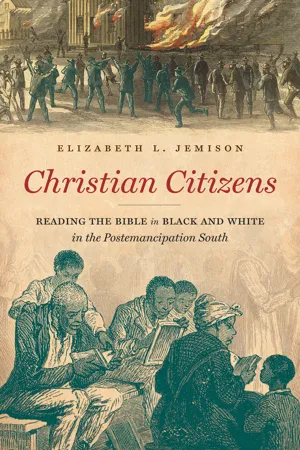
eBook - ePub
Christian Citizens
Reading the Bible in Black and White in the Postemancipation South
- 256 pages
- English
- ePUB (mobile friendly)
- Available on iOS & Android
eBook - ePub
Christian Citizens
Reading the Bible in Black and White in the Postemancipation South
About this book
Information
Topic
Theology & ReligionSubtopic
North American HistoryCHAPTER ONE
Emancipation
Christian Identity amid Slavery’s End, 1863–1866
On a hot Sunday in July 1863 in Natchez, Mississippi, just days after Union troops occupied the city, a church service came to an abrupt halt when “a negro man in … Sunday clothes came up the middle aisle to the pulpit, [and] stopped a little while there.” A white man rose from the startled congregation to demand what the newcomer sought, and the man “said he came to church and wanted a seat” among the white congregants. Union soldiers present laughed as the minister and southern white congregation “looked astounded.” One of those surprised white southerners, a young woman named Kate Foster, recorded the interruption in her diary. She fumed, “I was so angry” at the “impudent scamp” who interrupted her church’s service, and she noted appreciatively that a white man forced him “into the gallery where the servants sit.” Foster’s account of this Sunday service, among stories of nearly a dozen enslaved people who fled her own and neighboring households for freedom that same week, showed that emancipation had arrived in the Mississippi River Valley. The black man who demanded a seat with white congregants was demonstrating his freedom to white Confederates who still believed him enslaved. Emancipation transformed religious, household, and political life for white and black southerners, even though the Civil War would continue for nearly two years.1
Kate Foster could not escape the transformations that emancipation brought to her life at home and in church, but she insisted that God supported the Confederate “war of Independence.” Amid the news of neighboring Vicksburg’s fall to Union troops a few days earlier, Foster appealed to “the goodness of God” because “we all believe He is for us and having this faith how can we doubt for an instant” that God would ensure Confederate victory. In fact, Vicksburg’s fall was divinely ordained, as “God has let it fall to show us our cause does not rest upon the mere fall or holding of any one city.” Despite this setback, Foster claimed that “not for a moment do I think we will be unsuccessful” in the war’s ultimate result. In her diary entry about her interrupted church service and her anger at enslaved people’s departures from her household, she insisted that “we will come out of the furnace doubly purified for the good work” of God. God’s work for “the people of this Confederacy” was nothing short “of maintaining the supremacy of our Father in Heaven.” Confederate Christians alone worshiped God faithfully, she argued, joining many white southern Christians’ claims. For Foster, her two brothers’ absence fighting for the Confederate army increased her urgent desire for Confederate victory as she feared for their safety, yet both would die near the end of the Civil War. In the decades that followed, Kate Foster led Confederate memorial efforts in Natchez and became a local officer of the United Daughters of the Confederacy.2
The black man who entered the white Natchez church in the middle of its Sunday service recognized the promise of freedom and equality that Confederate defeat brought to the region. He dressed for the occasion, and when he told the white congregation that he wanted a seat among them, he indicated his status as a free man. His claim to equal seating in the congregation echoed the self-determination of other previously enslaved people who emancipated themselves by fleeing to Union lines over the days before and after this Sunday. The man extended his newly won freedom to demand religious equality. While the only record of his action lies in the diary of a white slaveholding Confederate woman, her hostile prose still attested to his call for equal treatment. Foster wondered if Union soldiers goaded this man’s action, just as she suspected Union misinformation would be the only reason enslaved people fled her household with their children, showing how loath she was to acknowledge black people’s efforts to direct their own lives. Yet the few minutes this newly free man stood at the front of the white congregation proved to all present that massive changes were underway.
CHURCHES WERE SITES for enacting freedom and making political demands during emancipation, as were farms and towns. Christian theology and churches’ physical spaces served as places to debate slavery, freedom, and Christian identity during emancipation and Confederate defeat. Finding that white southerners recognized neither their independence nor their Christian identity, freedpeople quickly formed their own churches in these years, with aid from northern white antislavery Christians. These three groups—proslavery Confederate Christians, free black people, and antislavery northern missionaries—each created their own ideas for what Christian behavior and Christian citizenship in a postemancipation United States would involve. Whether they saw the Civil War as a fight to establish a Christian slaveholding republic or as a divinely ordained end to slavery, these competing groups used Christian language and Christian institutions to shape their rapidly changing world.
In the emancipation-era Mississippi River Valley, black and white southerners and antislavery northerners used Christian theology to argue for the society they hoped to create. Each group claimed that they behaved as true Christians and rooted their actions in a sacred history reaching back to the Hebrew Bible. Throughout the antebellum period, white southerners crafted a proslavery theology that claimed that being faithful to the Bible demanded supporting slavery, and, facing emancipation, Confederate Christians doubled down on their claims. At the same time, formerly enslaved Christians used their Christian identity to advocate for educational, civic, and political inclusion as fellow Christians and equal citizens with white southerners. White antislavery missionaries positioned themselves as advocates for freedpeople’s best interests, but they often exerted their own paternalism in an effort to mold black Christianity as they saw fit. These different models of Christian behavior would diverge more strongly in the years after emancipation, but they already shaped responses to the transformations of the region in 1863.
Amid emancipation, black and white southerners began to formulate the concepts of Christian citizenship that would organize their religious and political activism through the end of the nineteenth century. Confederate Christians did not consider themselves U.S. citizens as emancipation came to the region, and people of African descent, whether free or enslaved, could not be citizens based on the 1857 Dred Scott Supreme Court ruling. After emancipation, black residents argued in formal petitions and local interactions that they were equal Christians and should be equal citizens with white southerners. Men demanded the right to vote based on their performance of male citizens’ duty in the Union army and on their Christian belief that the Bible opposed racial hierarchy. White southerners used the logic of their proslavery theology to insist that southern white men alone deserved to control the future of the South. In an abrupt shift from their Confederate loyalty, white southerners argued by late 1865 that they were model U.S. citizens and Christians. Opposing white southern Christianity, antislavery missionaries considered themselves allies of freedpeople amid emancipation, but they also wanted to direct black religious life as they saw best. Freedpeople deployed their own concept of Christian identity as they worked for freedom and equal citizenship. They welcomed aid from antislavery missionaries, but when freedpeople insisted that they deserved equal civil and political rights, even ardent white antislavery missionaries grew cautious.
Proslavery Family Order and Confederate Christianity
The Confederate cause drew support from white Christians’ arguments that slavery represented a biblically based system that was morally superior to free labor. Because biblical references to slavery in the ancient Near East or Roman Empire did not involve race-based chattel slavery, southern Christians defended slavery as an abstract ideal of benevolent paternalistic social organization.3 Protestant ministers wrote the majority of all antebellum defenses of slavery, and their zeal caused schisms in the major Protestant denominations in the years leading up to the Civil War. Methodists and Baptists were the two largest denominations in the United States before they divided in the 1840s. Southern Methodists split from the national group in 1844 to defend the ability of a bishop to own slaves, and they organized the Methodist Episcopal Church, South, in 1846. Baptists formed the Southern Baptist Convention in 1845 in a fight over whether missionaries could own slaves. Presbyterians’ 1837 schism between Old School and New School factions served as a proxy fight over growing antislavery sentiment among New School adherents, and in 1861, southern Old School and New School Presbyterians together formed the Presbyterian Church of the Confederate States of America. These divisions severed the nation’s largest voluntary organizations and exacerbated antebellum regional divisions. In separate southern denominations, white southern Christians redoubled their defenses of slavery as a biblically ordained paternalistic hierarchy.4
Slavery, southern white Christians contended, served the best interests of both slaveholders and enslaved, just as marriage allowed husbands to care for their wives. The Bible presented relationships of duty and obedience, rather than rights-based freedoms, as godly means of social organization. All four New Testament instructions for slaves to obey their masters appeared alongside instruction for wives to obey their husbands.5 If the Bible linked marriage and slavery, white southern Christians argued, proslavery Christians were more faithful to the sacred text over newer ideas of individual rights. White women’s legal subordination in marriage, where they lacked property rights, divorce rights, or protection from abuse, had widespread support as the natural order of society. Christian slaveholders’ claims that they treated enslaved people like their children or wives were rhetorical flourishes, not lived reality. Neither married white women nor enslaved people saw their situations as similar. White slave-owning women welcomed the power they had over enslaved people and the labor they received from them. Enslavement was not at all like free white marriage, but the argument that it was would preserve white supremacist proslavery logic of gender and racial hierarchy for decades to come. This benevolent household paternalism formed the core of white southerners’ postemancipation proslavery logic.6
As they connected slavery’s legitimacy to that of marriage, white southerners claimed that the violence endemic to slavery did not affect its legitimacy. Southern ministers readily admitted that some enslaved people faced brutality but, by positioning this violence as comparable to domestic violence, they argued that violence against enslaved people did not undermine benevolent, paternalistic hierarchies any more than the abuse of wives or children weakened the legitimacy of marriage or parental power. Baptist pastor Richard Furman admitted in 1823 that “husbands and fathers have proved tyrants,” but that did not challenge “the husband’s right to govern and the parental authority.” Likewise, slave owners’ legitimacy did not lose validity because of its potential for brutality. As sectional tension rose to a fever pitch, white southern Christians claimed that most antislavery Christians’ acceptance of gender hierarchy in marriage was selfish hypocrisy. Presbyterian minister Frederick Ross’s 1857 Slavery Ordained of God conceded that “every fact in Uncle Tom’s Cabin has occurred in the South,” but brazenly hazarded that “he who will make the horrid examination will discover in New York City … more cruelty from husband to wife, parent to child, than in all the South from master to slave in the same time.” Ross grossly underestimated the violence of slavery and ignored its many forms of physical, sexual, psychological, and cultural violence, yet his fantastic claims showed the extent to which white southern Christians tried to link slavery to marriage and parenthood to shore up slavery’s legitimacy in a system of natural hierarchies. Southern ministers recognized that few critics of slavery agreed with nascent woman’s rights advocates like Elizabeth Cady Stanton or Lucretia Mott, who had begun to argue for marriage reform because of women’s vulnerability to abuse and deprivation of rights. Marriage, parenting, and slavery could all permit violence, white southern Christians conceded, but that abuse did not delegitimize these divinely ordained household relationships.7
The link between slavery and marriage existed only in the rhetoric justifying slavery as biblical paternalism, not in how white enslavers actually acted. White slave-owning women—always a small minority of white women—participated actively in the brutal coercion of slavery. White women used violence to control enslaved people in similar ways as male slave owners, although they would write of themselves after emancipation in very different ways. Slaveholding women assumed the legitimacy of slavery because they benefited from it, and they were ready to believe that God was on the side of antebellum slaveholders and the Confederacy. Kate Foster, with whose account the chapter opened, wrote angrily about emancipation when her white friend Mrs. Dunbar had “to do the house cleaning and nearly all the house work” after two enslaved women left with their children. Incapable of seeing enslaved people’s desire for freedom for themselves and their children, Foster lamented that “if they had any feeling they would feel sorry for Mrs. D and remain faithful.” White slave-owning women could sympathize with each other but not with enslaved women.8
The vast divide between the Christian rhetoric of slavery and its brutal reality emerged clearly in the aspect of slavery that most troubled slaveholding women: white men’s sexual power over enslaved women. Since the seventeenth century, enslaved or free status passed through a child’s mother, reversing centuries of English common law and giving male enslavers legal rights and economic incentive to rape and impregnate women whom they enslaved. Because enslaved people did not have legal control over their bodies, sexual violence against enslaved women was not legally called rape, amplifying its brutal violence. The physical and psychological horrors of enslavement defied white Christian paternalistic arguments most egregiously here. Proslavery Christian writers ignored this endemic sexual violence entirely because it would reveal the lie behind all of their proslavery Christian paternalism. After Reconstruction’s violent end, these same white southerners would appeal to some black Christians as being more sympathetic figures because they had white fathers. The truth of white men’s sexual violence toward enslaved women was universally known, but deliberately obscured. Frederick Douglass and Harriet Jacobs, among other formerly enslaved writers, testified that white women’s inability to control their husbands’ sexual lives increased these angry white women’s violence toward enslaved people. This widely known reality of slavery was a telling indictment of the divide between white Christian men’s rhetoric about slavery as an ideal model of family order and slavery’s lived reality of gender, sexual, and racial violence.9
As they launched the Civil War, white southerners argued that they were fighting for biblical family order and the duty of preserving slavery. In a widely republished Thanksgiving sermon following Lincoln’s election in 1860, New Orleans Presbyterian Rev. Benjamin Palmer urged white southerners “to conserve and perpetuate the institution of domestic slavery” as “the duty which … patriotism and religion alike requires of us all.” Palmer, who pastored New Orleans’s First Presbyterian Church until his death in 1902, became the first moderator of the Presbyterian Church of the Confederate States of America in 1861 and defended social hierarchy based on the slaveholding household for decades after emancipation. In 1860, he sought to “deepen the sentiment of resistance in the Southern mind” and accelerate secession because the South must defend “before all nations, the cause of all religion and all truth.” Other southern clergy reminded their members that enslaved people had “the same claims for religious instruction as our children.” Christian slaves with “their own personal knowledge of the Scriptures … in relation to the mutual duties of master and servants” would be “more faithful and cheerful in … their duties.” Such efforts would make it possible to bring enslaved people more fully under Christian household influence.10
Confederate Christians claimed they fought to defend slavery and the biblical order it represented. Rather than seeing secession as disrupting social order, white southerners argued they were like the Israelites escaping Egyptian slavery, as forced members of the United States. Like the evil pharaoh in Exodus, “Abraham Lincoln … hardened his heart, and stiffened his neck, and would not let the people go.” Lincoln here was the pharaoh who would not allow the freedom of the seceding states, rather than the Moses who led enslaved people to freedom. Southern ministers pointed to an obscure verse from the Hebrew Bible prophet Obadiah, the sole place where the King James Version used the word “confederacy,” to argue that God favored the Confederate States of America, to which God gave “a solemn trust of … slave labor, for the benefit of the world and as a blessing to themselves.” These interpretations of secession as an aid to biblical social order amounted to wartime propaganda to be sure, but as improbable as they might appear after Confederate defeat, they also represented a conceivable expansion of antebellum proslavery Christianity.11
Even southern clergy who were ambivalent about explicitly endorsing political events preached proslavery Christ...
Table of contents
- Cover
- Title Page
- Copyright
- Dedication
- Contents
- Map
- Acknowledgments
- Introduction: Afterlives of Proslavery Christianity
- Chapter One: Emancipation: Christian Identity amid Slavery’s End, 1863–1866
- Chapter Two: Reconstruction: Christian Citizenship and Political Equality, 1867–1874
- Chapter Three: Redemption: Black Rights and Violent Family Order, 1875–1879
- Chapter Four: Paternalism Reborn: New Southern Histories and Racial Violence, 1880–1889
- Chapter Five: Segregation: Violent Order in a Christian Civilization, 1890–1900
- Conclusion: Family Values and Racial Order
- Notes
- Bibliography
- Index
Trusted by 375,005 students
Access to over 1.5 million titles for a fair monthly price.
Study more efficiently using our study tools.
Frequently asked questions
Yes, you can cancel anytime from the Subscription tab in your account settings on the Perlego website. Your subscription will stay active until the end of your current billing period. Learn how to cancel your subscription
No, books cannot be downloaded as external files, such as PDFs, for use outside of Perlego. However, you can download books within the Perlego app for offline reading on mobile or tablet. Learn how to download books offline
Perlego offers two plans: Essential and Complete
- Essential is ideal for learners and professionals who enjoy exploring a wide range of subjects. Access the Essential Library with 800,000+ trusted titles and best-sellers across business, personal growth, and the humanities. Includes unlimited reading time and Standard Read Aloud voice.
- Complete: Perfect for advanced learners and researchers needing full, unrestricted access. Unlock 1.5M+ books across hundreds of subjects, including academic and specialized titles. The Complete Plan also includes advanced features like Premium Read Aloud and Research Assistant.
We are an online textbook subscription service, where you can get access to an entire online library for less than the price of a single book per month. With over 1.5 million books across 990+ topics, we’ve got you covered! Learn about our mission
Look out for the read-aloud symbol on your next book to see if you can listen to it. The read-aloud tool reads text aloud for you, highlighting the text as it is being read. You can pause it, speed it up and slow it down. Learn more about Read Aloud
Yes! You can use the Perlego app on both iOS and Android devices to read anytime, anywhere — even offline. Perfect for commutes or when you’re on the go.
Please note we cannot support devices running on iOS 13 and Android 7 or earlier. Learn more about using the app
Please note we cannot support devices running on iOS 13 and Android 7 or earlier. Learn more about using the app
Yes, you can access Christian Citizens by Elizabeth L. Jemison in PDF and/or ePUB format, as well as other popular books in Theology & Religion & North American History. We have over 1.5 million books available in our catalogue for you to explore.