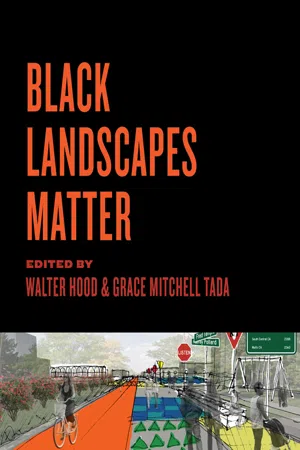
The question "Do black landscapes matter?" cuts deep to the core of American history. From the plantations of slavery to contemporary segregated cities, from freedman villages to northern migrations for freedom, the nation's landscape bears the detritus of diverse origins. Black landscapes matter because they tell the truth. In this vital new collection, acclaimed landscape designer and public artist Walter Hood assembles a group of notable landscape architecture and planning professionals and scholars to probe how race, memory, and meaning intersect in the American landscape.
Essayists examine a variety of U.S. places—ranging from New Orleans and Charlotte to Milwaukee and Detroit—exposing racism endemic in the built environment and acknowledging the widespread erasure of black geographies and cultural landscapes. Through a combination of case studies, critiques, and calls to action, contributors reveal the deficient, normative portrayals of landscape that affect communities of color and question how public design and preservation efforts can support people in these places. In a culture in which historical omissions and specious narratives routinely provoke disinvestment in minority communities, creative solutions by designers, planners, artists, and residents are necessary to activate them in novel ways. Black people have built and shaped the American landscape in ways that can never be fully known. Black Landscapes Matter is a timely and necessary reminder that without recognizing and reconciling these histories and spaces, America's past and future cannot be understood.
During the preelection milieu of 2016, discussions of Black landscapes provoked timely contemplation about race in the built environment, and an exploration of the significant role Black lives, thoughts, and actions have had in the shaping of the American landscape. After November 2016, when the American people elected “The First White President,” the discussion developed an unwelcomed, though palpable, poignancy.1 Illusions of a postracial America inspired by the presidency of Barack Hussein Obama had only partially masked the deep-rooted divisions that have separated, defined, and haunted the melting pot since colonial slavery. I counted myself among the optimistic, if naïve, masses who believed the iconography and message of America’s first Black president could help mend centuries of institutional and embodied racism. I was wrong.
In the days, weeks, months, and years since Donald J. Trump’s election, the not-not-racist past of the world’s greatest democracy has rapidly caught up with the present in a surprisingly virulent postmodern form. White nationalists carried discount-store tiki torches to defend statues of Robert E. Lee in Charlottesville; live Facebook video captured the murder of a Black man by Minnesota police and replays online; criminal charges were brought against Michigan state employees for poisoning the residents of Flint through divestment in public infrastructure; and banners reading “Racism Is as American as Baseball” reached millions in the form of internet memes. It is not a coincidence that most, if not all, of this drama is unfolding in physical, and virtual, public realms. These are the spaces and places where one encounters another and must acknowledge a shared history and proximity. Herein lies the key to why Black landscapes matter to all of us.
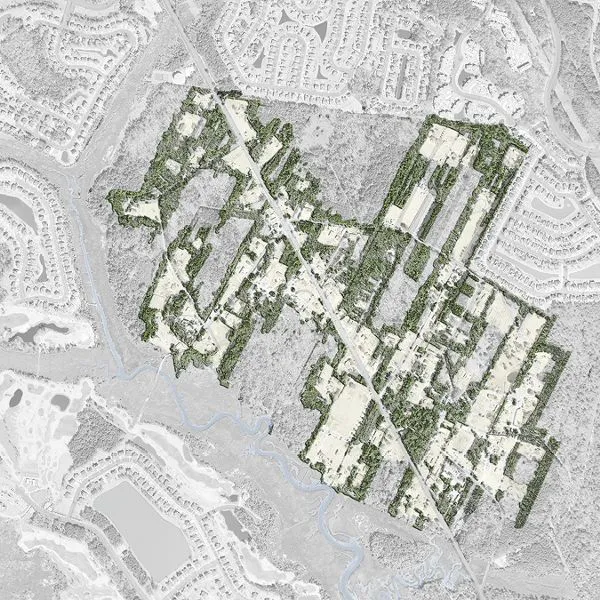
The Lifeways plan illustrates how the cultural and ecological history of a place can inform existing and new landscape patterns. The historic lot lines running perpendicular to Horlbeck Creek were planted to become fifteen-foot easements to enable drainage, provide new tree patches, and allow free play for neighborhood kids. (Hood Design Studio, Phillips Lifeways Plan, Mount Pleasant, South Carolina, 2006)
The notion of a Black landscape cuts deep to the core of American history, present and future. African slave labor built many of the earliest colonial landscapes, from the plantations of the Southeast to the first levees that protected New Orleans against the Mississippi River’s fluctuating waters. Even beloved spaces, such as Central Park in New York City, may be understood through the lens of Black landscapes, having displaced the African American community of Seneca Village prior to construction of the park in the mid-nineteenth century.2 As a white man born in England and raised in New York, I have only ever known America as a heterogeneous mix of races, cultures, and ideas—a radical departure from the rural town on the Blackwater Estuary where I spent the first years of my life. Yet for all the diversity of this country, it is striking how polarized and divided it remains, and how little we know about the Black landscapes that are inseparable from the American landscape we all share. Maybe it’s time we all take a knee and look around.
Notes
1. Ta-Nehisi Coates, “The First White President,” Atlantic, October 2017.
2. Douglas Martin, “A Village Dies, a Park Is Born,” New York Times, January 31, 1997.
INSISTING ON ANSWERS
Louise A. Mozingo
In the summer of 1968, when I turned ten, my family moved to Arlington, Virginia, across the Potomac River from Washington, DC. We had spent the previous few months at an idyllic, if isolated, small military base in the Catoctin Mountains of Maryland, close to Camp David. Before that we had lived for more than four years in Rome, Italy. While living in Rome, we spent summers and Christmas with my maternal grandparents in Gorizia, a town of fifty thousand and an elegant gem in the Veneto region of northeastern Italy.
Having arrived in Italy before my fifth birthday, a sense of continuity about my own life came into being while there. I began to understand myself as living in a city and a town with streets, buildings, sidewalks, shops, restaurants, markets, cafés, piazzas, and churches (many churches), part of a family, but also of a society, inhabiting a particular place and using it in a particular way. I was neither a tourist nor a traveler, but the child of an Italian mother and an American father who first arrived in Rome in July 1944. I became fluent not only in the language of where I was growing up but also in the customs and manners of moving through urban space, most deliciously on foot. I would pause to buy prosciutto, get a gelato, nod to a neighbor, gaze at a fountain, admire a facade, ogle shoes in a store window, wonder at the Christmas fair, and, on special occasions, enjoy a treat at an outdoor café, winter or summer.
In the Italy of my childhood, the public realm provided endless entertainment, a place to observe the built and the human mingling in alluring ways. A place to feel pretty in my new dress, witness the pageantry of my religion, tag along with adults in grown-up activities, and, most happily, to see everybody out—talking, walking, shopping, looking, sitting, and sipping, participating indiscriminately in the spectacle of everyday life. While Italians intensely protected their private realm, reserving the home only for the intimates of one’s clan, the public realm formed an equitable, free domain where the fraught and inevitable tensions of family life could be left behind.
The move to a suburban house in Arlington displaced my daily life in many ways, but most palpably in the way I inhabited the place I lived. From the neighborhood’s endless, shut-tight dwellings, carefully separated by trees and lawn, no one emerged, except the occasional zooming automobile. In the postwar subdivision manner, no sidewalks lined the roadways, and, in any case, there was nothing within walking distance of interest, except more houses. Shopping involved long rides stuck in the car, large parking lots, and vast fluorescently lit indoor spaces. After the pomp of Rome, our suburban church in its own lake of parking seemed dispiriting, at best.
I cannot remember if I voiced my disconcertion, but one Sunday afternoon my father drove us into Washington, to Bassin’s, which, years earlier, in 1961, had opened as Washington’s first sidewalk café. We were the only customers. I began to understand that different rules governed the American public realm. This was the fall of 1968, and Bassin’s stood short blocks away from the site of the King assassination uprising earlier in the year. Whether the National Guard troops remained by that point did not matter, as no one, Black or white, strolled along the sidewalks, the curfew and the fear long since internalized.
The idea that there were places that some could go, and others could not, made no sense to me, yet adults, the media, and the kids at school talked about “sections” of DC and Arlington. Our neighbors would complacently state with a knowing look that that they would never venture “downtown.” As I spent the 1970s visiting relatives in my father’s homeplace of Selma, North Carolina, the textile town of four thousand that he escaped, the racist divides of the American landscape became excruciatingly obvious. The railroad split the small settlement, sequestering the Black residents on the “other side of the tracks,” and violation of these confines aroused obvious suspicion among white residents. I have never forgotten the exclamation of the local district court judge as a Black man walked down the Selma street where the judge and my aunts lived: “What’s that burrhead doing on this side of town?” Given that I was within earshot, I knew the judge chose a racist slur that was, in his mind, restrained. Still, I recognized the threat: a Black man walking on that street was doing so at his own peril.
Back in Arlington, my parents, much to their credit, continued to present Washington, DC, as a desirable place. My mother and I took the slow bus to F Street to visit the grand old department stores, specialty shops, and Reeve’s Bakery, rather than to the new suburban Tyson’s Corner Mall and its food court. An early life in Italy and the defiant optimism of those downtown DC forays instilled in me an enduring faith in the possibilities of the public realm as a place of common ground. My eventual commitment to landscape architecture emerged as my delight in urbanity coupled with the love of all things botanical, color in fall leaves and spring bloom a singular redeeming feature of all those Arlington suburban yards.
As Washington, DC, knit back together in the aftermath of the King assassination, ever so slowly, the reality of an urbane, inclusive public realm of explicit goodwill seemed possible. On a blessed summer evening in 2011, I visited DC’s Columbia Heights, one of the centers of the 1968 uprising. In the wide sidewalks and plazas around the Metro station at Fourteenth and Irving Streets, everyone was out—Black, brown, and white attracted by a newly opened “urban” Target (no parking lot), useful service shops, every mode of food spilling onto sidewalks, a walk-in fountain where kids screeched with delight in sprays of water, and lots of places to sit and hang out. When I saw a line of elderly folks in wheelchairs wheeled out to the curb from an adjacent long-term care facility to take in the glee of the passing scene, I thought the perniciousness of cities divided could, indeed, be overcome: Rome ’66 meets “I Have a Dream” ’63.
I was not entirely wrong, perhaps, but I certainly was not entirely right. As recent events make amply clear, the Selma judge’s narrow-eyed verdict of decades ago still prevails in too many instances, too often, and tragically justifies the most egregious violence possible, the killing of human life. We remain wretchedly divided in place and therefore at heart.
The essays that follow ask exigent questions of us who value, design, and tend the collective metropolitan spaces we, theoretically, share. We must insist on answers; there is urgent work to do.
BLACK LANDSCAPES MATTER . . . THEN AND NOW, HERE AND EVERYWHERE
Anna Livia Brand
For Maxine Adams
The 4800 block of Camp Street in New Orleans is nestled just above the hustle of Magazine Street. It is a block of one- and two-story homes, most of which were built in the late 1800s. Some are renovated, some not. Some have a fresh coat of paint, some not. Some have flipped to new, white property owners due to the forces of post-Katrina gentrification, but many have not. Those that have not are still held by Black homeowners who have owned the homes for two to three generations. Many families live together, a blend of generations in one home. Grandparents watch out for grandkids playing on the sidewalk. Grandchildren now grown bring their children to play, their chorus echoing down the street on the same sidewalk where their fathers or mothers once played. Neighbors watch out for one another: they know each other across generations and across the street. Neighbors watched out for Tyrone’s grandmother, Ms. Petey, who, in her later years, tended to wander. Neighbors watch out for Ms. Adams, whose family built a ramp to the front porch to accommodate her wheelchair, allowing her to come down to the sidewalk and cruise the block. In the hot summer sun, Maxine Adams stops her wheelchair in the shade of the tree at the end of the block outside my house, talking with and sharing the shade with those of us who choose to pause alongside her.
I became neighbors with the folks on Camp Street and lived with them for nearly fifteen years. It was Tyrone, Ms. Petey, Ms. Adams, Mrs. Cummings, Dwayne, Edward, and others on this street who created and shaped, over generations, the everyday Black landscape of this block. Here, the entanglements of racialized prosperity and hardship are best understood in the sharing of everyday battles and the collective practice of making-do and surviving in the space between our front doors. Nearly every home had a front porch, where a chair—or two or three—positioned neighbors to talk with one another, to be with one another in the liminal, sacred space between private homes and the street. From your porch and down the street, you saw which kids were outside to play on a hot, humid summer day. From your porch and across the street, you saw Tyrone waiting for a customer at his improvised driveway car wash, talking with a neighbor who no longer lived on but still visited the block. From your porch and down the street, you saw Ms. Adams on her porch warming herself in the sun on one of the blindingly beautiful southern days. You knew then that you could walk down and say hello, see how she was feeling that day. You knew then that it had been too many days since you had heard her voice. From Mrs. Cummings’s porch, you were given a soft, pale-blue set of booties and hat that she knit for your first child. Here, on her porch, she shared with you her radiant smile when she learned your second son’s name, Arthur—her husband’s name. From your own porch, two doors down, you saw Dwayne catching a smoke on his porch, and you hollered down to see when his son, Jeron, would be home to play with your kids, Luka and Artie. You heard Jeron’s full-of-life voice carry into your front room, and the kids would pile out the door, pulling on shoes or not, getting outside as quickly as they could. Jeron, Luka, Artie, Grey (Elly’s daughter), Baylon (Maxine’s great-grandson and Edward’s son), and Olivia (from down the block) formed a loose gang of mostly Black children from ages two to twelve who made cardboard swords, rode bikes and scooters, and ran the block until collapsing, exhausted, on one of our porches to cool down.
The block was—is—full of life. It bursts with a subtle rhythm that speaks to why Black landscapes matter then, when Ms. Adams and her husband bought the house, and now, as they are reexposed to new rounds of displacement and land vulnerability. When the Adamses bought their house, they were setting in motion and in place a new landscape. Originally a part of the Avart Plantation, the land upon which the Adamses’ house stood was a plantation cultivated by slave labor. After 1829, Louis Bouligny developed the land into a neighborhood that was annexed by the city in 1870. When the Adamses came to the area in the 1960s, they, along with other Black homeowners on this block of sixteen homes, helped establish a Black landscape no longer solely defined by slavery and racial segregation. They held the space and the land and, for more than forty years, they held a Black landscape intact through everyday acts and a spatial praxis of mutuality and love. The spaces of the sidewalk, porch, f...
Table of contents
Cover
Title Page
Copyright Page
CONTENTS
Introduction
Part I. Calls to Action
Part II. Practicing Culture
Part III. Notes from the Field
Notes on Contributors
Bibliography
Index
Trusted by 375,005 students
Access to over 1.5 million titles for a fair monthly price.
Study more efficiently using our study tools.
Frequently asked questions
Yes, you can cancel anytime from the Subscription tab in your account settings on the Perlego website. Your subscription will stay active until the end of your current billing period. Learn how to cancel your subscription
No, books cannot be downloaded as external files, such as PDFs, for use outside of Perlego. However, you can download books within the Perlego app for offline reading on mobile or tablet. Learn how to download books offline
Perlego offers two plans: Essential and Complete
Essential is ideal for learners and professionals who enjoy exploring a wide range of subjects. Access the Essential Library with 800,000+ trusted titles and best-sellers across business, personal growth, and the humanities. Includes unlimited reading time and Standard Read Aloud voice.
Complete: Perfect for advanced learners and researchers needing full, unrestricted access. Unlock 1.5M+ books across hundreds of subjects, including academic and specialized titles. The Complete Plan also includes advanced features like Premium Read Aloud and Research Assistant.
Both plans are available with monthly, semester, or annual billing cycles.
We are an online textbook subscription service, where you can get access to an entire online library for less than the price of a single book per month. With over 1.5 million books across 990+ topics, we’ve got you covered! Learn about our mission
Look out for the read-aloud symbol on your next book to see if you can listen to it. The read-aloud tool reads text aloud for you, highlighting the text as it is being read. You can pause it, speed it up and slow it down. Learn more about Read Aloud
Yes! You can use the Perlego app on both iOS and Android devices to read anytime, anywhere — even offline. Perfect for commutes or when you’re on the go. Please note we cannot support devices running on iOS 13 and Android 7 or earlier. Learn more about using the app
Yes, you can access Black Landscapes Matter by Walter Hood,Grace Mitchell Tada in PDF and/or ePUB format, as well as other popular books in Arquitectura & Planificación urbana y paisajismo. We have over 1.5 million books available in our catalogue for you to explore.