eBook - ePub
The Body
About this book
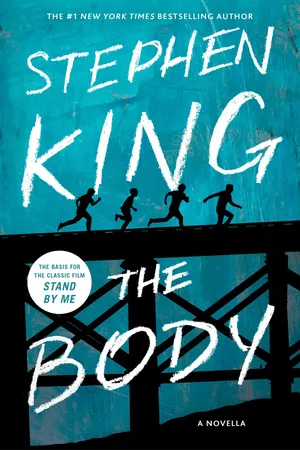
#1 New York Times bestselling author Stephen King’s timeless novella “The Body”—originally published in his short story collection Different Seasons, and adapted into the film classic Stand by Me—is now available as a stand-alone publication.
It’s 1960 in the fictional town of Castle Rock, Maine. Ray Brower, a boy from a nearby town, has disappeared, and twelve-year-old Gordie Lachance and his three friends set out on a quest to find his body along the railroad tracks. During the course of their journey, Gordie, Chris Chambers, Teddy Duchamp, and Vern Tessio come to terms with death and the harsh truths of growing up in a small factory town that doesn’t offer much in the way of a future.
A timeless exploration of the loneliness and isolation of young adulthood, Stephen King’s The Body is an iconic, unforgettable, coming-of-age story.
It’s 1960 in the fictional town of Castle Rock, Maine. Ray Brower, a boy from a nearby town, has disappeared, and twelve-year-old Gordie Lachance and his three friends set out on a quest to find his body along the railroad tracks. During the course of their journey, Gordie, Chris Chambers, Teddy Duchamp, and Vern Tessio come to terms with death and the harsh truths of growing up in a small factory town that doesn’t offer much in the way of a future.
A timeless exploration of the loneliness and isolation of young adulthood, Stephen King’s The Body is an iconic, unforgettable, coming-of-age story.
Frequently asked questions
Yes, you can cancel anytime from the Subscription tab in your account settings on the Perlego website. Your subscription will stay active until the end of your current billing period. Learn how to cancel your subscription.
At the moment all of our mobile-responsive ePub books are available to download via the app. Most of our PDFs are also available to download and we're working on making the final remaining ones downloadable now. Learn more here.
Perlego offers two plans: Essential and Complete
- Essential is ideal for learners and professionals who enjoy exploring a wide range of subjects. Access the Essential Library with 800,000+ trusted titles and best-sellers across business, personal growth, and the humanities. Includes unlimited reading time and Standard Read Aloud voice.
- Complete: Perfect for advanced learners and researchers needing full, unrestricted access. Unlock 1.4M+ books across hundreds of subjects, including academic and specialized titles. The Complete Plan also includes advanced features like Premium Read Aloud and Research Assistant.
We are an online textbook subscription service, where you can get access to an entire online library for less than the price of a single book per month. With over 1 million books across 1000+ topics, weâve got you covered! Learn more here.
Look out for the read-aloud symbol on your next book to see if you can listen to it. The read-aloud tool reads text aloud for you, highlighting the text as it is being read. You can pause it, speed it up and slow it down. Learn more here.
Yes! You can use the Perlego app on both iOS or Android devices to read anytime, anywhere â even offline. Perfect for commutes or when youâre on the go.
Please note we cannot support devices running on iOS 13 and Android 7 or earlier. Learn more about using the app.
Yes, you can access The Body by Stephen King in PDF and/or ePUB format. We have over one million books available in our catalogue for you to explore.
Information
eBook ISBN
97819821055941
The most important things are the hardest things to say. They are the things you get ashamed of, because words diminish themâwords shrink things that seemed limitless when they were in your head to no more than living size when theyâre brought out. But itâs more than that, isnâ t it? The most important things lie too close to wherever your secret heart is buried, like landmarks to a treasure your enemies would love to steal away. And you may make revelations that cost you dearly only to have people look at you in a funny way, not understanding what youâve said at all, or why you thought it was so important that you almost cried while you were saying it. Thatâs the worst, I think. When the secret stays locked within not for want of a teller but for want of an understanding ear.
I was twelve going on thirteen when I first saw a dead human being. It happened in I960, a long time ago⌠although sometimes it doesnât seem that long to me. Especially on the nights I wake up from dreams where the hail falls into his open eyes.
2
We had a treehouse in a big elm which overhung a vacant lot in Castle Rock. Thereâs a moving company on that lot today, and the elm is gone. Progress. It was a sort of social club, although it had no name. There were five, maybe six steady guys and some other wet ends who just hung around. Weâd let them come up when there was a card game and we needed some fresh blood. The game was usually blackjack and we played for pennies, nickel limit. But you got double money on blackjack and five-card-under⌠triple money on six-card-under, although Teddy was the only guy crazy enough to go for that.
The sides of the treehouse were planks scavenged from the shitpile behind Mackey Lumber & Building Supply on Carbine Roadâthey were splintery and full of knotholes we plugged with either toilet paper or paper towels. The roof was a corrugated tin sheet we hawked from the dump, looking over our shoulders all the time we were hustling it out of there, because the dump custodianâs dog was supposed to be a real kid-eating monster. We found a screen door out there on the same day. It was flyproof but really rustyâI mean, that rust was extreme. No matter what time of day you looked out that screen door, it looked like sunset.
Besides playing cards, the club was a good place to go and smoke cigarettes and look at girly books. There were half a dozen battered tin ashtrays that said camels on the bottom, a lot of centerfolds tacked to the splintery walls, twenty or thirty dog-eared packs of Bike cards (Teddy got them from his uncle, who ran the Castle Rock Stationery Shoppeâwhen Teddyâs unc asked him one day what kind of cards we played, Teddy said we had cribbage tournaments and Teddyâs unc thought that was just fine), a set of plastic poker chips, and a pile of ancient Master Detective murder magazines to leaf through if there was nothing else shaking. We also built a 12" x 10" secret compartment under the floor to hide most of this stuff in on the rare occasions when some kidâs father decided it was time to do the weâre-really-good-pals routine. When it rained, being in the club was like being inside a Jamaican steel drum⌠but that summer there had been no rain.
It had been the driest and hottest since 1907âor so the newspapers said, and on that Friday preceding the Labor Day weekend and the start of another school year, even the goldenrod in the fields and the ditches beside the backroads looked parched and poorly. Nobodyâs garden had done doodly-squat that year, and the big displays of canning stuff in the Castle Rock Red & White were still there, gathering dust. No one had anything to put up that summer, except maybe dandelion wine.
Teddy and Chris and I were up in the club on that Friday morning, glooming to each other about school being so near and playing cards and swapping the same old traveling salesman jokes and frenchman jokes. How do you know when a frenchmanâs been in your back yard? Well, your garbage cans are empty and your dog is pregnant. Teddy would try to look offended, but he was the first one to bring in a joke as soon as he heard it, only switching frenchman to polack.
The elm gave good shade, but we already had our shirts off so we wouldnât sweat them up too bad. We were playing three-penny-scat, the dullest card-game ever invented, but it was too hot to think about anything more complicated. Weâd had a pretty fair scratch ballteam until the middle of August and then a lot of kids just drifted away. Too hot.
I was down to my ride and building spades. Iâd started with thirteen, gotten an eight to make twenty-one, and nothing had happened since then. Chris knocked. I took my last draw and got nothing helpful.
âTwenty-nine,â Chris said, laying down diamonds.
âTwenty-two,â Teddy said, looking disgusted.
âPiss up a rope,â I said, and tossed my cards onto the table face down.
âGordieâs out, ole Gordie just bit the bag and stepped out the door,â Teddy bugled, and then gave out with his patented Teddy Duchamp laughâEeee-eee-eee, like a rusty nail being slowly hauled out of a rotten board. Well, he was weird; we all knew it. He was close to being thirteen like the rest of us, but the thick glasses and the hearing aid he wore sometimes made him look like an old man. Kids were always trying to cadge smokes off him on the street, but the bugle in his shirt was just his hearing-aid battery.
In spite of the glasses and the flesh-colored button always screwed into his ear, Teddy couldnât see very well and often misunderstood the things people said to him. In baseball you had to have him play the fences, way beyond Chris in left field and Billy Greer in right. You just hoped no one would hit one that far because Teddy would go grimly after it, see it or not. Every now and then he got bonked a good one, and once he went out cold when he ran full-tilt-boogie into the fence by the treehouse. He lay there on his back with his eyes showing whites for almost five minutes, and I got scared. Then he woke up and walked around with a bloody nose and a huge purple lump rising on his forehead, trying to claim that the ball was foul.
His eyesight was just naturally bad, but there was nothing natural about what had happened to his ears. Back in those days, when it was cool to get your hair cut so that your ears stuck out like a couple of jug-handles, Teddy had Castle Rockâs first Beatle haircutâfour years before anyone in America had ever heard of the Beatles. He kept his ears covered because they looked like two lumps of warm wax.
One day when he was eight, Teddyâs father got pissed at him for breaking a plate. His mother was working at the shoe factory in South Paris when it happened and by the time she found out about it, it was all over.
Teddyâs dad took Teddy over to the big woodstove at the back of the kitchen and shoved the side of Teddyâs head down against one of the cast-iron burner plates. He held it down there for about ten seconds. Then he yanked Teddy up by the hair of the head and did the other side. Then he called the Central Main General Emergency unit and told them to come get his boy. Then he hung up the phone, went into the closet, got his .410, and sat down to watch the daytime stories on TV with the shotgun laid across his knees. When Mrs. Burroughs from next door came over to ask if Teddy was all rightâsheâd heard the screamingâTeddyâs dad pointed the shotgun at her. Mrs. Burroughs went out of the Duchamp house at roughly the speed of light, locked herself into her own house, and called the police. When the ambulance came, Mr. Duchamp let the orderlies in and then went out on the back porch to stand guard while they wheeled Teddy to the old portholed Buick ambulance on a stretcher.
Teddyâs dad explained to the orderlies that while the fucking brass hats said the area was clear, there were still kraut snipers everywhere. One of the orderlies asked Teddyâs dad if he thought he could hold on. Teddyâs dad smiled tightly and told the orderly heâd hold until hell was a Frigidaire dealership, if thatâs what it took. The orderly saluted, and Teddyâs dad snapped it right back at him. A few minutes after the ambulance left, the state police arrived and relieved Norman Duchamp of duty.
Heâd been doing odd things like shooting cats and lighting fires in mailboxes for over a year, and after the atrocity he had visited upon his son, they had a quick hearing and sent him to Togus, which is a VA hospital. Togus is where you have to go if youâre a section eight. Teddyâs dad had stormed the beach at Normandy, and thatâs just the way Teddy always put it. Teddy was proud of his old man in spite of what his old man had done to him, and Teddy went with his mom to visit him every week.
He was the dumbest guy we hung around with, I guess, and he was crazy. Heâd take the craziest chances you can imagine, and get away with them. His big thing was what he called âtruck-dodging.â Heâd run out in front of them on 196 and sometimes theyâd miss him by bare inches. God knew how many heart attacks heâd caused, and heâd be laughing while the windblast from the passing truck rippled his clothes. It scared us because his vision was so lousy, Coke-bottle glasses or not. It seemed like only a matter of time before he misjudged one of those trucks. And you had to be careful what you dared him, because Teddy would do anything on a dare.
âGordieâs out, eeeeee-eee-eee!â
âScrew,â I said, and picked up a Master Detective to read while they played it out. I turned to âHe Stomped the Pretty Co-Ed to Death in a Stalled Elevatorâ and got right into it.
Teddy picked up his cards, gave them one brief look, and said: âI knock.â
âYou four-eyed pile of shit!â Chris cried.
âThe pile of shit has a thousand eyes,â Teddy said gravely, and both Chris and I cracked up. Teddy stared at us with a slight frown, as if wondering what had gotten us laughing. That was another thing about the catâhe was always coming out with weird stuff like âThe pile of shit has a thousand eyes,â and you could never be sure if he meant it to be funny or if it just happened that way. Heâd look at the people who were laughing with that slight frown on his face, as if to say: O Lord what is it this time?
Teddy had a natural thirtyâjack, queen, and king of clubs. Chris had only sixteen and went down to his ride.
Teddy was shuffling the cards in his clumsy way and I was just getting to the gooshy part of the murder story, where this deranged sailor from New Orleans was doing the Bristol Stomp all over this college girl from Bryn Mawr because he couldnât stand being in closed-in places, when we heard someone coming fast up the ladder nailed to the side of the elm. A fist rapped on the underside of the trapdoor.
âWho goes?â Chris yelled.
âVern!â He sounded excited and out of breath.
I went to the trapdoor and pulled the bolt. The trapdoor banged up and Vern Tessio, one of the other regulars, pulled himself into the clubhouse. He was sweating buckets and his hair, which he usually kept combed in a perfect imitation of his rock and roll idol, Bobby Rydell, was plastered to his bullet head in chunks and strings.
âWow, man,â he panted. âWaitâll you hear this.â
âHear what?â I asked.
âLemme get my breath. I ran all the way from my house.â
âI ran all the way home,â Teddy wavered in a dreadful Little Anthony falsetto, âjust to say Iâm soh-reeââ
âFuck your hand, man,â Vern said.
âDrop dead in a shed, Fred,â Teddy returned smartly.
âYou ran all the way from your place?â Chris asked unbelievingly. âMan, youâre crazy.â Vernâs house was two miles down Grand Street. âIt must be ninety out there.â
âThis is worth it,â Vern said. âHoly Jeezum. You wonât believe this. Sincerely.â He slapped his sweaty forehead to show us how sincere he was.
âOkay, what?â Chris asked.
âCan you guys camp out tonight?â Vern was looking at us earnestly, excitedly. His eyes looked like raisins pushed into dark circles of sweat. âI mean, if you tell your folks weâre gonna tent out in my back field?â
âYeah, I guess so,â Chris said, picking up his new hand and looking at it. âBut my dadâs on a mean streak. Drinkin, yâknow.â
âYou got to, man,â Vern said. âSincerely. You wonât believe this. Can you, Gordie?â
âProbably.â
I was able to do most stuff like thatâin fact, Iâd been like the Invisible Boy that whole summer. In April my older brother, Dennis, had been killed in a Jeep accident. That was at Fort Benning, Georgia, where he was in Basic. He and another guy were on their way to the PX and an Army truck hit them broadside. Dennis was killed instantly and his passenger had been in a coma ever since. Dennis would have been twenty-two later that week. Iâd already picked out a birthday card for him at Dahlieâs over in Castle Green.
I cried when I heard, and I cried more at the funeral, and I couldnât believe that Dennis was gone, that anyone that used to knuckle my head or scare me with a rubber spider until I cried or give me a kiss when I fell down and scraped both knees bloody and whisper in my ear, âNow stop cryin, ya baby!ââthat a person who had touched me could be dead. It hurt me and it scared me that he could be dead⌠but it seemed to have taken all the heart out of my parents. For me, Dennis was hardly more than an acquaintance. He was ten years older than me if you can dig it, and he had his own friends and classmates. We ate at the same table for a lot of years, and sometimes he was my friend and sometimes my tormentor, but mostly he was, you know, just a guy. When he died heâd been gone for a year except for a couple of furloughs. We didnât even look alike. It took me a long time after that summer to realize that most of the tears I cried were for my mom and dad. Fat lot of good it did them, or me.
âSo what are you pissing and moaning about, Vern-O?â Teddy asked.
âI knock,â Chris said.
âWhat?â Teddy screamed, immediately forgetting all about Vern. âYou friggin liar! You ainât got no pat hand. I didnât deal you no pat hand.â
Chris smirked. âMake your draw, shitheap.â
Teddy reached for the top card on the pile of Bikes. Chris reached for the Winstons on the ledge behind him. I bent over to pick up my detective magazine.
Vern Tessio said: âYou guys want to go see a dead body?â
Everybody stopped.
3
Weâd all heard about it on the radio, of course. The radio, a Philco with a cracked case which had also been scavenged from the dump, played all the time. We kept it tuned to WALM in Lewiston, which churned out the super-hits and the boss oldies: âWhat in the Worldâs Come Over Youâ by Jack Scott and âThis Timeâ by Troy Shondell and âKing Creoleâ by Elvis and âOnly the Lonelyâ by Roy Orbison. When the news came on we usually switched some mental dial over to Mute. The news was a lot of happy horseshit about Kennedy and Nixon and Quemoy and Matsu and the missile gap and what a shit that Castro was turning out to be after all. But we had all listened to the Ray Brower story a little more closely, because he was a kid our age.
He was from Chamberlain, a town forty miles or so east of Castle Rock. Three days before Vern came busting into the clubhouse after a two-mile run up Grand Street, Ray Brower had gone out with one of his motherâs pots to pick blueberries. When dark came and he still wasnât back, the Browers called the county sheriff and a search startedâfirst just around the kidâs house and then spreading to the surrounding towns of Motton and Durham and Pownal. Everybody got into the actâcops, deputies, game wardens, volunteers. But three days later the kid was still missing. You could tell, hearing about it on the radio, that they were never going to find that poor sucker alive; eventually the search would just peter away into nothi...
Table of contents
- Cover
- Title Page
- Dedication
- Chapter 1
- Chapter 2
- Chapter 3
- Chapter 4
- Chapter 5
- Chapter 6
- Chapter 7
- Chapter 8
- Chapter 9
- Chapter 10
- Chapter 11
- Chapter 12
- Chapter 13
- Chapter 14
- Chapter 15
- Chapter 16
- Chapter 17
- Chapter 18
- Chapter 19
- Chapter 20
- Chapter 21
- Chapter 22
- Chapter 23
- Chapter 24
- Chapter 25
- Chapter 26
- Chapter 27
- Chapter 28
- Chapter 29
- Chapter 30
- Chapter 31
- Chapter 32
- Chapter 33
- Chapter 34
- Acknowledgments
- âNever Flinchâ Teaser
- About the Author
- Copyright
