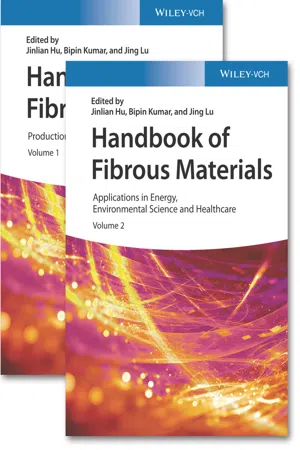
Edited by a leading expert in the field with contributions from experienced researchers in fibers and textiles, this handbook reviews the current state of fibrous materials and provides a broad overview of their use in research and development. Volume One focuses on the classes of fibers, their production and characterization, while the second volume concentrates on their applications, including emerging ones in the areas of energy, environmental science and healthcare.
Unparalleled knowledge of high relevance to academia and industry.
eBook - ePub
Handbook of Fibrous Materials, 2 Volumes
Volume 1: Production and Characterization / Volume 2: Applications in Energy, Environmental Science and Healthcare
- English
- ePUB (mobile friendly)
- Available on iOS & Android
eBook - ePub
Handbook of Fibrous Materials, 2 Volumes
Volume 1: Production and Characterization / Volume 2: Applications in Energy, Environmental Science and Healthcare
About this book
Information
1
Fundamentals of the Fibrous Materials
Jinlian Hu, Md A. Jahid, Narayana Harish Kumar, and Venkatesan Harun
The Hong Kong Polytechnic University, Institute of Textiles and Clothing, Room TQ715, Q Core 7/F, Hung Hom, Kowloon 999077, Hong Kong S.A.R., P.R. China
1.1 Introduction
1.1.1 What Are Fibrous Materials?
A fiber is a material that is defined by Textile Institute [1] as units of matter characterized by flexibility and fineness and a high ratio of length to thickness. In different fields, fibers have very broad meaning such as those for food supplements and fibers in plants or in human body. A fiber is more often referred to the basic unit of making textile yarns and fabrics. Textile fibers should have some specific properties though. For example, cotton plant contains fibers that are strong and soft enough to be spun into yarns that can be woven or knitted into a fabric by textile processing, but human hair is not a textile fiber because it cannot fill up the above properties. So, we can say all textiles are made of fibers, but not all fibers can be used to make textiles. The important requirements for fibers to be twisted into a yarn include a length of at least 5 mm, cohesiveness, flexibility, and sufficient strength, and other important properties include elasticity, fineness, uniformity, luster, and durability. It is also important to remember that all textile fibers are not created equally [2]. Each fiber contains different qualities and will result in a different textile. Some retain heat better than others; some hold dye very well; some are more durable, while some are more comfortable [3].
The origin of fibrous materials may be of organic, inorganic, or metal. They are fine structures that are formed by joining component atoms into molecules. Fibrous materials can be grouped into two major categories: natural and chemical or man-made fibers. The growth of natural fibers is slow and controlled under genetics from fast production of manufactured fibers in terms of structures. Natural fibers include plant or vegetable fibers (such as cotton, flax, ramie, jute, and hemp), animal fibers (such as silk, wool, and hair fibers), and mineral fibers (such as asbestos). Synthetic fibers include regenerated fibers (such as viscose and acetate), synthetics (such as polyester, polyamides, polyolefins), and inorganic fibers such as glass and carbon fibers with completely amorphous or microcrystalline structures [4]. Another class is high-performance fibers that are manufactured ones with improved tensile and other mechanical properties. Finally, smart fibers are an emerging class of fibrous structures that are responsive to stimulus or an environment, tailored with advanced functionalities for many applications.
1.2 Historical Evolution of Fibers
Natural fibers are abundantly available in nature that are biodegradable and sustainable and have played a key role in the human race since nearly 7000 BC [5]. Human beings have been using the fibers from many ages for which there are no records, which itself is a distinct proof that fiber is present from several hundreds of years. The first choice for the human beings to use is natural fibers. Production of synthetic fibers was beginning only in 1910 by commercially producing the rayon fiber, and this was the result of technological development that has not stopped yet on the present era. Natural fibers have been used in many cultures traditionally across the globe in making utilitarian products. Fibrous materials can be obtained naturally from many resources such as plants, leaf, seeds, bark, stem, and grass. Flax is believed to be the oldest fiber and it was obtained in dates back to 6000 BC. Egyptians started to wear the cotton since 4000 BC, and later revolutionary changes occurred to discover ginning and production of different variety of cotton products. Wool fiber was also discovered around 3000 BC, and then around 40 breeds were explored to produce wide range of wool fibers. Dates back to 2500 BC, silk fiber is believed that it was first discovered by a Chinese princess that was obtained from the cocoons of silk worms. The silk processing was found to be kept secret for almost 3000 years and then started to spread all over the world in the later stage.
Even though natural fibers were comfortable and biodegradable, they had some drawbacks such as wrinkling of cotton and flax and delicate handling of silk and wool fibers receptive to shrinkage and moth attack. Growing needs of human race and these disadvantages of fibers paved the way to produce the first man-made fiber with revolutionary technological efforts into rayon, which is known as artificial silk to the present era. In the later stages, other man-made fibers such as acetate, nylon, acrylic, polyester, spandex, polypropylene, lyocell, and microfibers were produced with rapid transformation from science to market and end users around the world. The complete developments in the evolution of human civilization (Figure 1.1) and textile fiber (Figure 1.2) are presented below [6].
1.3 Classification of Fibrous Materials
A comprehensive classification of fibrous materials is depicted in Figure 1.3. Nature offers us abundant resources for getting fibrous materials that grow in various geographical locations and altitudes. Fibrous materials can be further classified into textile and non-textile fibers. The internal characteristics that are suitable for processing from fibers [7] to yarn, fabric, and other utilitarian products can be termed as textile fibers [8, 9]. However, the properties of fibers that are not suitable for clothing could be considered as non-textile fibers and have been found broad horizon of arenas to fulfill the human desired needs in many ways. Non-textile natural fibers are also used in building materials, animal ...
Table of contents
- Cover
- Table of Contents
- Preface
- 1 Fundamentals of the Fibrous Materials
- 2 Animal Fibers: Wool
- 3 Animal Fibers: Silk
- 4 Cellulose Fibers
- 5 Chitosan Fibers
- 6 Collagen Fibers
- 7 Electrospun Fibers for Filtration
- 8 Aramid Fibers
- 9 Conductive Fibers
- 10 Phase Change Fibers
- 11 Bicomponent Fibers
- 12 Superabsorbent Fibers
- 13 Elastic Fibers
- 14 Smart Fibers
- 15 Optical Fibers
- 16 Memory Fibers
- 17 Textile Mechanics: Fibers and Yarns
- 18 Textile Mechanics: Woven Fabrics
- 19 Fabric Making Technologies
- 20 Chemical Characterization of Fibrous Materials
- 21 Soft Computing in Fibrous Materials
- 22 Fiber-Shaped Electronic Devices
- 23 Fibers for Optical Textiles
- 24 Fibers as Energy Materials
- 25 Fiber-Based Sensors and Actuators
- 26 Textile-Based Electronics: Polymer-Assisted Metal Deposition (PAMD)
- 27 Fibers for Medical Compression
- 28 Electrospun Nanofibers for Environmental Protection: Water Purification
- 29 Fibers for Filtration
- 30 Fibrous Materials for Thermal Protection
- 31 Comfort Management of Fibrous Materials
- 32 Fibers for Radiation Protection
- 33 Fibrous Materials for Antimicrobial Applications
- 34 Fibers for Auxetic Applications
- Index
- End User License Agreement
Trusted by 375,005 students
Access to over 1.5 million titles for a fair monthly price.
Study more efficiently using our study tools.
Frequently asked questions
Yes, you can cancel anytime from the Subscription tab in your account settings on the Perlego website. Your subscription will stay active until the end of your current billing period. Learn how to cancel your subscription
No, books cannot be downloaded as external files, such as PDFs, for use outside of Perlego. However, you can download books within the Perlego app for offline reading on mobile or tablet. Learn how to download books offline
Perlego offers two plans: Essential and Complete
- Essential is ideal for learners and professionals who enjoy exploring a wide range of subjects. Access the Essential Library with 800,000+ trusted titles and best-sellers across business, personal growth, and the humanities. Includes unlimited reading time and Standard Read Aloud voice.
- Complete: Perfect for advanced learners and researchers needing full, unrestricted access. Unlock 1.5M+ books across hundreds of subjects, including academic and specialized titles. The Complete Plan also includes advanced features like Premium Read Aloud and Research Assistant.
We are an online textbook subscription service, where you can get access to an entire online library for less than the price of a single book per month. With over 1.5 million books across 990+ topics, we’ve got you covered! Learn about our mission
Look out for the read-aloud symbol on your next book to see if you can listen to it. The read-aloud tool reads text aloud for you, highlighting the text as it is being read. You can pause it, speed it up and slow it down. Learn more about Read Aloud
Yes! You can use the Perlego app on both iOS and Android devices to read anytime, anywhere — even offline. Perfect for commutes or when you’re on the go.
Please note we cannot support devices running on iOS 13 and Android 7 or earlier. Learn more about using the app
Please note we cannot support devices running on iOS 13 and Android 7 or earlier. Learn more about using the app
Yes, you can access Handbook of Fibrous Materials, 2 Volumes by Jinlian Hu, Bipin Kumar, Jing Lu, Jinlian Hu,Bipin Kumar,Jing Lu in PDF and/or ePUB format, as well as other popular books in Technology & Engineering & Materials Science. We have over 1.5 million books available in our catalogue for you to explore.