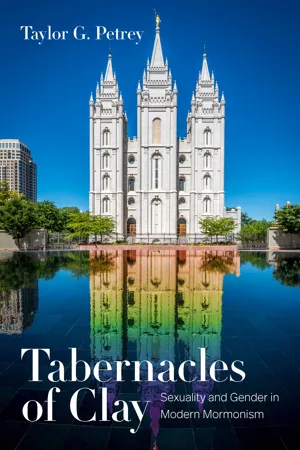
Taylor G. Petrey’s trenchant history takes a landmark step forward in documenting and theorizing about Latter-day Saints (LDS) teachings on gender, sexual difference, and marriage. Drawing on deep archival research, Petrey situates LDS doctrines in gender theory and American religious history since World War II. His challenging conclusion is that Mormonism is conflicted between ontologies of gender essentialism and gender fluidity, illustrating a broader tension in the history of sexuality in modernity itself.
As Petrey details, LDS leaders have embraced the idea of fixed identities representing a natural and divine order, but their teachings also acknowledge that sexual difference is persistently contingent and unstable. While queer theorists have built an ethics and politics based on celebrating such sexual fluidity, LDS leaders view it as a source of anxiety and a tool for the shaping of a heterosexual social order. Through public preaching and teaching, the deployment of psychological approaches to “cure” homosexuality, and political activism against equal rights for women and same-sex marriage, Mormon leaders hoped to manage sexuality and faith for those who have strayed from heteronormativity.
- 288 pages
- English
- ePUB (mobile friendly)
- Available on iOS & Android
eBook - ePub
About this book
Information
Topic
Theology & ReligionSubtopic
Christian DenominationsChapter One: Pure Marriage
In 1946 and 1947, the years immediately following World War II, apostle Spencer W. Kimball (d. 1985) received two church assignments. Kimball had been called as an apostle in 1943 and had held various responsibilities but had not yet clearly found a niche within that role. That began to change when in August 1946 he had a dream in which he saw himself among the Native American tribes in Arizona and New Mexico. One month later, one of his more senior colleagues tasked him to “look after the Indians.” By October, he was establishing connections between the church and the tribes.1 This assignment led Kimball to think about the relationships between races as a central feature of his career, and had significant impacts on the direction of the church in this period.
A few months after establishing connections with the “Indians,” in early 1947 Kimball had another experience that would shape the rest of his career in the church. After the death of one of the apostles who had handled these issues before him, Kimball was asked to take over important pastoral counseling duties for those involved in sexual sins. He wrote in his journal that senior apostle, “[J. Reuben] Clark called me to his office to suggest that they would be sending to me more of the interviews and difficult cases.”2 His biographers explain that “there began for him a disturbing flow of interviews with Church members involved in fornication or adultery or homosexuality.”3 The interview and counseling sessions shaped how Kimball thought about the destructive nature of sexual sin. He devoted himself not only to preaching about repentance but to taking a preventive approach to sin with strict moral guidelines. Part of that preventive approach included a focus on the proper roles of men and women.
This chapter focuses on the interrelationships between race and gender roles in Mormon thought since 1945. Sexual purity will be deferred to the next chapter. Kimball’s dual focuses on racial relations and gender were rife with paradoxes as he worked through and evolved his own thinking on these topics. The connection between these two themes of race and gender roles (including sexuality), however, is not immediately obvious. The analysis in this chapter proceeds from the idea that both race and gender/sexuality are contingent and culturally produced categories, not natural givens. As Siobhan B. Somerville has pointed out, the history of discourses about race as a category “must be understood as a crucial part of the history and representation of sexual formations, including lesbian and gay identity and compulsory heterosexuality in the United States.”4 The efforts to fix the differences between races and to enforce particular sexual configurations are related projects of modernity. I add to Somerville’s analysis the importance of gender hierarchy in the discourses of race and sexuality.
Mormon teachings in this period expressed great anxiety about racial and gender purity. The coexisting conflicts over interracial marriage and gender roles were not historical accidents but intersected on the issue of boundary production and maintenance. Church leaders saw racial mixture as a fundamental threat to the existence of the LDS priesthood. They advanced doctrines of racial purity to enforce acceptable kinds of marriage. By “racial purity,” I refer to teachings that race was a natural or divinely instituted category and that the different races should not procreate with one another. Concurrently, church leaders also believed relaxing gender norms would undermine the family and society. Church leaders taught that it was a duty to maintain “gender purity” by closely guarding how marriages were governed and what kinds of labor were permissible. The intense interests in policing the differences between the races and between sexes were related phenomena, and the eventual softening on these issues also followed a similar trajectory.
Interracial Marriage and the Politics of Segregation
From the mid-nineteenth century until 1978—when Kimball would receive a new revelation for the LDS church—race was a defining factor in Mormon teaching about sexual relations relating to who should marry whom. Several cultural and religious changes eventually brought an end to these teachings, but they were once deeply entrenched. The massive cultural and legal shifts in thinking about race after World War II preceded these eventual changes to Mormon doctrines. Americans in general were moving around for greater educational and economic opportunities and mingling with those of different races, religions, and regions to a greater extent than they had before. African Americans continued to migrate to northern cities for manufacturing jobs, creating new opportunities for contact and pressures for integration with white institutions. The war itself had brought greater racial interconnections. Black and white soldiers served side by side in many cases, and numbers of American soldiers serving in the Asian theater sought to marry Japanese women and bring them home. These cultural changes were followed by legal changes. The California Supreme Court struck down the state’s ban on interracial marriage in Perez v. Sharp in 1948; many other states then revoked similar laws.5 Over the next two decades, many Americans relaxed their opposition to interracial marriage.
Other Americans resisted this cultural transition toward greater racial integration because they believed it could undermine marriage. White southern Protestants (and many in the North and the West) rooted their social and legal arguments in biblical prohibitions of exogamy.6 A 1948 pamphlet by J. David Simpson, a Presbyterian pastor, was titled Non-segregation Means Eventual Inter-marriage. He argued that there was “no doubt that God did not want the racial bounds separating the races broken down into hybrid races which will most certainly eventuate if all races move in and out among themselves with non-segregation and free social inter-mingling.”7 In 1954, Reverend G. T. Gillespie addressed the Synod of Mississippi of the Presbyterian Church of the United States, declaring that divine providence was behind the separation and segregation of the races and that the “chief reason for segregation is the desirability of preventing such intimacies as might lead to intermarriage and the amalgamation of the races.”8 The idea of racial mixing, “hybrid races,” or “amalgamation” was at that time seen in moral terms and was believed to be able to biologically weaken white supremacy. In his review of the 1958 conviction of Mildred Delores Jeter and Richard Perry Loving for miscegenation, Virginia judge Leon M. Bazile concluded, “The Almighty God created the races white, black, yellow, malay, and red. . . . The fact that he separated the races shows that he did not intend for the races to mix.”9 The pro-segregation arguments hinged on the ideas that there were separate races, that this separation was ordained by God, and that intermingling the races would upset the natural and divine order in such a way as to eventually erase racial difference altogether. Such ideologies trace their lineage back at least to the period of American slavery. In 1967, in Loving vs. Virginia, the U.S. Supreme Court unanimously ruled against Bazile’s decision, concluding that antimiscegenation laws violated the Constitution.
Mormon leaders in the 1950s and 1960s, as much as any southerners, accepted this mythology as divine revelation. But they also had their own texts and traditions that supplemented these religious justifications for racial separation, not least their prohibition of black people to priesthood offices and participation in certain priesthood ordinances. Like their conservative religious peers, Mormons looked to the biblical stories of the sons of the patriarch Noah—Ham, Shem, and Japheth—for ideologies of race and racial difference. In Genesis, Noah cursed his grandson Canaan, son of Ham: “A servant of servants shall he be unto his brethren” (9:25, KJV). From this text, racist teachings justified the enslavement of Africans, whom many biblicists believed to be descendants of Canaan.10 Others believed that Africans owed their descent to Cain, the first son of Adam who had been “cursed” with a “mark” for slaying his brother Abel (Gen. 4:11, 15). Such theories held that the descendants of these lineages were divinely cursed, while other lineages held God’s favor. Further, Israelites were biblically enjoined to marry within their tribes, which many white Americans interpreted to prohibit interracial marriage.
To these stories, Mormonism’s nineteenth-century founder, Joseph Smith, had added new scriptures that supported theories of racial difference and separation.11 The Book of Mormon recounts how skin color differences were meant to prevent intermarriage. The Nephite peoples were “white, and exceedingly fair and delightsome,” while the Lamanite peoples had been cursed with a “skin of blackness” so “they might not be enticing unto” the Nephites.12 The text favorably compares the whiteness of the Nephites with that of European Americans.13 Mormons commonly understood the Lamanites to be the ancestors of Native Americans, not Africans, but the text expressed the sentiment that difference in skin color should “not be enticing” in interrelationships. Smith also provided a miraculous translation of another scriptural text, the Book of Abraham, later canonized in the Pearl of Great Price. In that narrative, the biblical Ham, the cursed son of Noah, was specifically connected with the inhabitants of Egypt. Consequently, the first pharaoh, although a righteous man, was “of that lineage by which he could not have the right of Priesthood.”14 Though some black men were ordained to the priesthood under Joseph Smith’s leadership, from Brigham Young until 1978 this text was interpreted to justify the exclusion of black men from ordination into the LDS priesthood orders and black men and women from temple rites, including “sealings,” or “celestial marriage.”15
Mormon leaders also put forward unique doctrines of racial separatism that affected how they thought about marriage. Many Mormons considered themselves to be descendants of the scattered tribes of ancient Israel. In 1863, president of the church Brigham Young warned, “If the white man who belongs to the chosen seed mixes his blood with the seed of Cain, the penalty, under the law of God, is death on the spot. This will always be so.”16 Such white-black relationships existed at the time among Mormons but provoked scandal. Indeed, Young’s confrontation with several interracial marriages and extramarital sex between black Mormon men and white Mormon women deeply influenced his views that black men should not be ordained to the priesthood.17 These views depended on ideas about racial purity and the danger of “mixing” through sexual exchange.
LDS teachings on race gained greater importance and clarification in the mid-twentieth century as leaders feared losing racial control amid the broader social trends toward racial equality and integration.18 Like other segregationists after World War II, Mormon leaders publicly and privately expressed concern over interracial marriage, which prominent apostle J. Reuben Clark (d. 1961) called “a wicked virus” in 1946.19 In 1949, after a series of exchanges over the course of a few years, a sociologist expressed surprise and frustration upon learning that there was a “fixed doctrine” about “the Negro” that codified LDS notions of white supremacy. The First Presidency wrote to him that the priesthood restriction was not a policy but rather a doctrine based on the conduct of spirits in the preexistence. The leaders elaborated that “social intercourse” between blacks and whites was “not welcome” because it would lead to intermarriage, “which the Lord has forbidden.” The sociologist who was the recipient of the letter was not unfamiliar with Mormons; he had himself grown up in Utah, was a practicing Mormon, and had even published a book on Mormon life.20 His lack of awareness about the doctrines on race suggested that church leaders had not emphasized the doctrines of racial separation in previous decades.
American attention to integration and civil rights also set the background to the renewed opposition to “race mixing” in LDS teaching. In 1954, the Supreme Court’s decision in Brown v. Board of Education set in motion the controversial task of integrating public schools, though private businesses and neighborhoods remained places where it was legal and culturally acceptable to enforce segregation. Church president David O. McKay did not want to bring the church into the public debates about the issue, so he advised church leaders to “use our influence quietly” to oppose those civil rights that would lead to greater integration.21 In the 1950s, J. Reuben Clark, by then McKay’s First Counselor, authorized the use of LDS chapels to organize communities to “prevent negro settlement” and urged Belle Spafford (d. 1982), the president of the Relief Society—the LDS women’s organization—to use her influence to prevent the National Council of Women from favoring “negro equality.”22
While the efforts to work behind the scenes rather than in the public to oppose civil rights reflected some ambivalence, church leaders did not necessarily use their influence quietly. Several prominent officials publicly spoke in favor of segregation and antimiscegenation legislation. In their capacity as church leaders, they declared segregation to be the will of the Lord. They deployed the same theological arguments as southern segregationists, but they added special concerns about the effect that racial mixing would have on the ability of God’s chosen people to be ordained to the LDS priesthood orders. Apostle Mark E. Petersen (d. 1984) publicly insisted that “the Lord segregated the Negro and who is man to change that segregation?”23 Born in 1900, Petersen believed in divinely designed, hierarchical racial lineages. In his address at the church’s flagship school, Brigham Young University (BYU), in 1954, just a few months after Brown, Petersen argued that socially mingling with “Negroes” should be resisted, just as mingling with sin should be resisted. He believed that “the Negro seeks absorption with the white race. He will not be satisfied until he achieves it by intermarriage.”24 For Petersen, LDS beliefs against ordaining black men to the priesthood sustained his segregationist fears. Invoking the Jim Crow legal blood quotient of “one drop” of “black blood” to establish ancestry, Petersen reflected segregationist racism. “If there is one drop of Negro blood in my children,” he warned, “they receive the curse.” After a few generations of acceptable intermarriage, “who could hold [the priesthood] in all America?”25 Petersen’s...
Table of contents
- Cover Page
- Tabernacles of Clay
- Copyright Page
- Dedication
- Contents
- Acknowledgments
- Introduction: Modern Mormonism and Gender Theory in Context
- Chapter One: Pure Marriage
- Chapter Two: Sodom and Cumorah
- Chapter Three: Politics and the Patriarchal Order
- Chapter Four: Proclaiming the New Heterosexual Family
- Chapter Five: The Death and Resurrection of “the Homosexual”
- Concluding Thoughts: Mormonism in the History of Sexuality
- Notes
- Index
Trusted by 375,005 students
Access to over 1.5 million titles for a fair monthly price.
Study more efficiently using our study tools.
Frequently asked questions
Yes, you can cancel anytime from the Subscription tab in your account settings on the Perlego website. Your subscription will stay active until the end of your current billing period. Learn how to cancel your subscription
No, books cannot be downloaded as external files, such as PDFs, for use outside of Perlego. However, you can download books within the Perlego app for offline reading on mobile or tablet. Learn how to download books offline
We are an online textbook subscription service, where you can get access to an entire online library for less than the price of a single book per month. With over 1.5 million books across 990+ topics, we’ve got you covered! Learn about our mission
Look out for the read-aloud symbol on your next book to see if you can listen to it. The read-aloud tool reads text aloud for you, highlighting the text as it is being read. You can pause it, speed it up and slow it down. Learn more about Read Aloud
Yes! You can use the Perlego app on both iOS and Android devices to read anytime, anywhere — even offline. Perfect for commutes or when you’re on the go.
Please note we cannot support devices running on iOS 13 and Android 7 or earlier. Learn more about using the app
Please note we cannot support devices running on iOS 13 and Android 7 or earlier. Learn more about using the app
Yes, you can access Tabernacles of Clay by Taylor G. Petrey in PDF and/or ePUB format, as well as other popular books in Theology & Religion & Christian Denominations. We have over 1.5 million books available in our catalogue for you to explore.