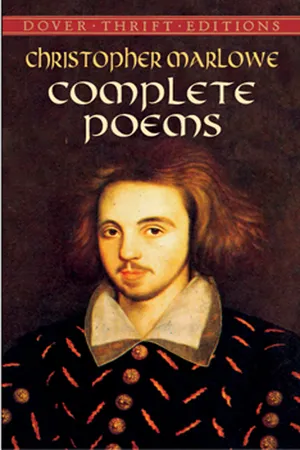
Best known for his tragic plays and his refined and polished blank verse, Christopher Marlowe (1564–1593) was born in the same year as fellow writer William Shakespeare. Marlowe's career was cut short by a tavern brawl, in which he died under circumstances as mysterious and violent as any of his dramas. This complete collection of Marlowe's poetry includes his translations of Ovid's "Elegies" and the First Book from Lucan's "Civil Hero." The celebrated "Hero and Leander," left unfinished at Marlowe's death, is also featured (the poem was later completed by George Chapman; only Marlowe's work appears here), as is the poet's most famous creation, "The Passionate Shepherd to His Love."
- 112 pages
- English
- ePUB (mobile friendly)
- Available on iOS & Android
eBook - ePub
Complete Poems
About this book
Information
Topic
LiteraturaSubtopic
Poesía europeaOvid’s Elegies: Book Two
ELEGIA I
Quod pro gigantomachia amores scribere sit coactus
I, Ovid, poet of my wantonness,
Born at Peligny, to write more address.
So Cupid wills; far hence be the severe:
You are unapt my looser lines to hear.
Let maids whom hot desire to husbands lead,
And rude boys touched with unknown love, me read,
That some youth hurt as I am with Love’s bow
His own flame’s best acquainted signs may know,
And long admiring say, ‘By what means learned
Hath this same poet my sad chance discerned?’
I durst the great celestial battles tell,
Hundred-hand Gyges, and had done it well,
With earth’s revenge, and how Olympus’ top
High Ossa bore, Mount Pelion up to prop.
Jove and Jove’s thunderbolts I had in hand,
Which for his heaven fell on the giants’ band.
My wench her door shut, Jove’s affairs I left,
Even Jove himself out of my wit was reft.
Pardon me, Jove, thy weapons aid me nought,
Her shut gates greater lightning than thine brought.
Toys and light elegies, my darts, I took,
Quickly soft words hard doors wide open strook.
Verses reduce the hornèd bloody moon,
And call the sun’s white horses back at noon.
Snakes leap by verse from caves of broken mountains,
And turnèd streams run backward to their fountains.
Verses ope doors; and locks put in the post,
Although of oak, to yield to verse’s boast.
What helps it me of fierce Achill to sing?
What good to me will either Ajax bring?
Or he who warred and wandered twenty year?
Or woeful Hector, whom wild jades did tear?
But when I praise a pretty wench’s face,
She in requital doth me oft embrace.
A great reward: heroes, O famous names,
Farewell; your favour nought my mind inflames.
Wenches, apply your fair looks to my verse,
Which golden Love doth unto me rehearse.
Born at Peligny, to write more address.
So Cupid wills; far hence be the severe:
You are unapt my looser lines to hear.
Let maids whom hot desire to husbands lead,
And rude boys touched with unknown love, me read,
That some youth hurt as I am with Love’s bow
His own flame’s best acquainted signs may know,
And long admiring say, ‘By what means learned
Hath this same poet my sad chance discerned?’
I durst the great celestial battles tell,
Hundred-hand Gyges, and had done it well,
With earth’s revenge, and how Olympus’ top
High Ossa bore, Mount Pelion up to prop.
Jove and Jove’s thunderbolts I had in hand,
Which for his heaven fell on the giants’ band.
My wench her door shut, Jove’s affairs I left,
Even Jove himself out of my wit was reft.
Pardon me, Jove, thy weapons aid me nought,
Her shut gates greater lightning than thine brought.
Toys and light elegies, my darts, I took,
Quickly soft words hard doors wide open strook.
Verses reduce the hornèd bloody moon,
And call the sun’s white horses back at noon.
Snakes leap by verse from caves of broken mountains,
And turnèd streams run backward to their fountains.
Verses ope doors; and locks put in the post,
Although of oak, to yield to verse’s boast.
What helps it me of fierce Achill to sing?
What good to me will either Ajax bring?
Or he who warred and wandered twenty year?
Or woeful Hector, whom wild jades did tear?
But when I praise a pretty wench’s face,
She in requital doth me oft embrace.
A great reward: heroes, O famous names,
Farewell; your favour nought my mind inflames.
Wenches, apply your fair looks to my verse,
Which golden Love doth unto me rehearse.
ELEGIA II
Ad Bagoum, ut custodiam puellae sibi commissae laxiorem habeat
Bagous, whose care doth thy mistress bridle,
While I speak some few yet fit words, be idle.
I saw the damsel walking yesterday
There where the porch doth Danaus’ fact display.
She pleased me soon, I sent, and did her woo,
Her trembling hand writ back she might not do.
And asking why, this answer she redoubled,
Because thy care too much thy mistress troubled.
Keeper, if thou be wise, cease hate to cherish;
Believe me, whom we fear, we wish to perish.
Nor is her husband wise; what needs defence,
When unprotected there is no expense?
But furiously he follow his love’s fire,
And think her chaste whom many do desire.
Stol’n liberty she may by thee obtain,
Which giving her, she may give thee again.
Wilt thou her fault learn, she may make thee tremble;
Fear to be guilty, then thou mayst dissemble.
Think when she reads, her mother letters sent her;
Let him go forth known, that unknown did enter;
Let him go see her though she do not languish,
And then report her sick and full of anguish.
If long she stays, to think the time more short,
Lay down thy forehead in thy lap to snort.
Enquire not what with Isis may be done,
Nor fear lest she to the theatres run.
Knowing her scapes, thine honour shall increase,
And what less labour than to hold thy peace?
Let him please, haunt the house, be kindly used,
Enjoy the wench, let all else be refused.
Vain causes feign of him, the true to hide,
And what she likes let both hold ratified.
When most her husband bends the brows and frowns,
His fawning wench with her desire he crowns.
But yet sometimes to chide thee let her fall
Counterfeit tears, and thee lewd hangman call.
Object thou then what she may well excuse,
To stain all faith in truth, by false crimes’ use.
Of wealth and honour so shall grow thy heap;
Do this and soon thou shalt thy freedom reap.
On tell-tales’ necks thou seest the link-knit chains,
The filthy prison faithless breasts restrains.
Water in waters, and fruit flying touch
Tantalus seeks, his long tongue’s gain is such;
While Juno’s watchman Io too much eyed,
Him timeless death took, she was deified.
I saw one’s legs with fetters black and blue,
By whom the husband his wife’s incest knew.
More he deserved; to both great harm he framed;
The man did grieve, the woman was defamed.
Trust me, all husbands for such faults are sad,
Nor make they any man that hear them glad.
If he loves not, deaf ears thou dost importune;
Or if he loves, thy tale breeds his misfortune.
Nor is it easily proved, though manifest,
She safe by favour of her judge doth rest.
Though himself see, he’ll credit her denial,
Condemn his eyes, and say there is no trial.
Spying his mistress’ tears, he will lament
And say, ‘This blab shall suffer punishment.’
Why fight’st ’gainst odds? To thee, being cast, do hap
Sharp stripes; she sitteth in the judge’s lap.
To meet for poison or vile facts we crave not,
My hands an unsheathed shining weapon have not.
We seek that, through thee, safely love we may;
What can be easier than the thing we pray?
While I speak some few yet fit words, be idle.
I saw the damsel walking yesterday
There where the porch doth Danaus’ fact display.
She pleased me soon, I sent, and did her woo,
Her trembling hand writ back she might not do.
And asking why, this answer she redoubled,
Because thy care too much thy mistress troubled.
Keeper, if thou be wise, cease hate to cherish;
Believe me, whom we fear, we wish to perish.
Nor is her husband wise; what needs defence,
When unprotected there is no expense?
But furiously he follow his love’s fire,
And think her chaste whom many do desire.
Stol’n liberty she may by thee obtain,
Which giving her, she may give thee again.
Wilt thou her fault learn, she may make thee tremble;
Fear to be guilty, then thou mayst dissemble.
Think when she reads, her mother letters sent her;
Let him go forth known, that unknown did enter;
Let him go see her though she do not languish,
And then report her sick and full of anguish.
If long she stays, to think the time more short,
Lay down thy forehead in thy lap to snort.
Enquire not what with Isis may be done,
Nor fear lest she to the theatres run.
Knowing her scapes, thine honour shall increase,
And what less labour than to hold thy peace?
Let him please, haunt the house, be kindly used,
Enjoy the wench, let all else be refused.
Vain causes feign of him, the true to hide,
And what she likes let both hold ratified.
When most her husband bends the brows and frowns,
His fawning wench with her desire he crowns.
But yet sometimes to chide thee let her fall
Counterfeit tears, and thee lewd hangman call.
Object thou then what she may well excuse,
To stain all faith in truth, by false crimes’ use.
Of wealth and honour so shall grow thy heap;
Do this and soon thou shalt thy freedom reap.
On tell-tales’ necks thou seest the link-knit chains,
The filthy prison faithless breasts restrains.
Water in waters, and fruit flying touch
Tantalus seeks, his long tongue’s gain is such;
While Juno’s watchman Io too much eyed,
Him timeless death took, she was deified.
I saw one’s legs with fetters black and blue,
By whom the husband his wife’s incest knew.
More he deserved; to both great harm he framed;
The man did grieve, the woman was defamed.
Trust me, all husbands for such faults are sad,
Nor make they any man that hear them glad.
If he loves not, deaf ears thou dost importune;
Or if he loves, thy tale breeds his misfortune.
Nor is it easily proved, though manifest,
She safe by favour of her judge doth rest.
Though himself see, he’ll credit her denial,
Condemn his eyes, and say there is no trial.
Spying his mistress’ tears, he will lament
And say, ‘This blab shall suffer punishment.’
Why fight’st ’gainst odds? To thee, being cast, do hap
Sharp stripes; she sitteth in the judge’s lap.
To meet for poison or vile facts we crave not,
My hands an unsheathed shining weapon have not.
We seek that, through thee, safely love we may;
What can be easier than the thing we pray?
ELEGIA III
Ad Eunuchum servantem dominam
Aye me, a eunuch keeps my mistress chaste,
That cannot Venus’ mutual pleasure taste.
Who first deprived young boys of their best part,
With selfsame wounds he gave he ought to smart.
To kind requests thou wouldst more gentle prove,
If ever wench had made lukewarm thy love:
Thou wert not born to ride, or arms to bear,
Thy hands agree not with the warlike spear.
Men handle those; all manly hopes resign,
Thy mistress’ ensigns must be likewise thine.
Please her, her hate makes others thee abhor;
If she discards thee, what use serv’st thou for?
Good form there is, years apt to play together,
Unmeet is beauty without use to wither.
She may deceive thee, though thou her protect,
What two determine never wants effect.
Our prayers move thee to assist our drift,
While thou hast time yet to bestow that gift.
That cannot Venus’ mutual pleasure taste.
Who first deprived young boys of their best part,
With selfsame wounds he gave he ought to smart.
To kind requests thou wouldst more gentle prove,
If ever wench had made lukewarm thy love:
Thou wert not born to ride, or arms to bear,
Thy hands agree not with the warlike spear.
Men handle those; all manly hopes resign,
Thy mistress’ ensigns must be likewise thine.
Please her, her hate makes others thee abhor;
If she discards thee, what use serv’st thou for?
Good form there is, years apt to play together,
Unmeet is beauty without use to wither.
She may deceive thee, though thou her protect,
What two determine never wants effect.
Our prayers move thee to assist our drift,
While thou hast time yet to bestow that gift.
ELEGIA IV
Quod amet mulieres, cuiuscunque formae sint
I mean not to defend the scapes of any,
Or justify my vices being many.
For I confess, if that might merit favour,
Here I display my lewd and loose behaviour.
I loathe, yet after that I loathe I run;
O how the burden irks, that we should shun.
I cannot rule myself, but where love please
Am driven like a ship upon rough seas.
No one face likes me best, all faces move,
A hundred reasons make me ever love.
If any eye me with a modest look,
I burn, and by that blushful glance am took.
And she that’s coy I like, for being no clown,
Methinks she would be nimble when she’s down.
Though her sour looks a Sabine’s brow resemble,
I think she’ll do, but deeply can dissemble.
If she be learned, then for her skill I crave her;
If not, because she’s simple I would have her.
Before Callimachus one prefers me far;
Seeing she likes my books, why should we jar?
Another rails at me, and that I write;
Yet would I lie with her if that I might.
Trips she, it likes me well; plods she, what then?
She would be nimbler, lying with a man.
And when one sweetly sings, then straight I long
To quaver on her lips even in her song.
Or if one touch the lute with art and cunning,
Who would not love those hands for their swift running?
And her I like that with a majesty
Folds up her arms and makes low courtesy.
To leave myself, that am in love with all,
Some one of these might make the chastest fall.
If she be tall, she’s like an Amazon,
And therefore fills the bed she lies upon;
If short, she lies the rounder; to say troth,
Both short and long please me, for I love both.
I think what one undecked would be, being dressed;
Is she attired? Then show her graces best.
A white wench thralls me, so doth golden yellow;
And nut-brown girls in doing have no fellow.
If her white neck be shadowed with black hair,
Why, so was Leda’s, yet was Leda fair.
Amber-tressed is she? Then on the morn think I;
My love alludes to every history.
A young wench pleaseth, and an old is good:
This for her looks, that for her womanhood.
Nay what is she that any Roman loves
But my ambitious ranging mind approves?
Or justify my vices being many.
For I confess, if that might merit favour,
Here I display my lewd and loose behaviour.
I loathe, yet after that I loathe I run;
O how the burden irks, that we should shun.
I cannot rule myself, but where love please
Am driven like a ship upon rough seas.
No one face likes me best, all faces move,
A hundred reasons make me ever love.
If any eye me with a modest look,
I burn, and by that blushful glance am took.
And she that’s coy I like, for being no clown,
Methinks she would be nimble when she’s down.
Though her sour looks a Sabine’s brow resemble,
I think she’ll do, but deeply can dissemble.
If she be learned, then for her skill I crave her;
If not, because she’s simple I would have her.
Before Callimachus one prefers me far;
Seeing she likes my books, why should we jar?
Another rails at me, and that I write;
Yet would I lie with her if that I might.
Trips she, it likes me well; plods she, what then?
She would be nimbler, lying with a man.
And when one sweetly sings, then straight I long
To quaver on her lips even in her song.
Or if one touch the lute with art and cunning,
Who would not love those hands for their swift running?
And her I like that with a majesty
Folds up her arms and makes low courtesy.
To leave myself, that am in love with all,
Some one of these might make the chastest fall.
If she be tall, she’s like an Amazon,
And therefore fills the bed she lies upon;
If short, she lies the rounder; to say troth,
Both short and long please me, for I love both.
I think what one undecked would be, being dressed;
Is she attired? Then show her graces best.
A white wench thralls me, so doth golden yellow;
And nut-brown girls in doing have no fellow.
If her white neck be shadowed with black hair,
Why, so was Leda’s, yet was Leda fair.
Amber-tressed is she? Then on the morn think I;
My love alludes to every history.
A young wench pleaseth, and an old is good:
This for her looks, that for her womanhood.
Nay what is she that any Roman loves
But my ambitious ranging mind approves?
ELEGIA V
Ad amicam corruptam
No love is so dear (quivered Cupid, fly!)
That my chief wish should be so oft to die.
Minding thy fault, with death I wish to revel;
Alas, a wench is a perpetual evil.
No intercepted lines thy deeds display,
No gifts given secretly thy crime bewray;
O would my proofs as vain might be withstood,
Aye me, poor soul, why is my cause so good?
He’s happy, that his love dares boldly credit,
To whom his wench can say, ‘I never did it.’
He’s cruel, and too much his grief doth favour,
That seeks the conquest by her loose behaviour.
Poor wretch, I saw when thou didst think I slumbered;
Not drunk, your faults on the spilt wine I numbered.
I saw your nodding eyebrows much to speak,
Even from your cheeks part of a voice did break.
Not silent were thine eyes, the board with wine
Was scribbled, and thy fingers writ a line.
I knew your speech (what do not lovers see?)
And words that seemed for certain marks to be.
Now many guests were gone, the feast being done,
The youthful sort to divers pastimes run.
I saw you then unlawful kisses join
(Such with my tongue it likes me to purloin).
None such the sister gives her brother grave,
But such kind wenches let their lovers have.
Phoebus gave not Diana such, ’tis thought,
But Venus often to her Mars such brought.
‘What dost?’ I cried, ‘transport’st thou my delight?...
That my chief wish should be so oft to die.
Minding thy fault, with death I wish to revel;
Alas, a wench is a perpetual evil.
No intercepted lines thy deeds display,
No gifts given secretly thy crime bewray;
O would my proofs as vain might be withstood,
Aye me, poor soul, why is my cause so good?
He’s happy, that his love dares boldly credit,
To whom his wench can say, ‘I never did it.’
He’s cruel, and too much his grief doth favour,
That seeks the conquest by her loose behaviour.
Poor wretch, I saw when thou didst think I slumbered;
Not drunk, your faults on the spilt wine I numbered.
I saw your nodding eyebrows much to speak,
Even from your cheeks part of a voice did break.
Not silent were thine eyes, the board with wine
Was scribbled, and thy fingers writ a line.
I knew your speech (what do not lovers see?)
And words that seemed for certain marks to be.
Now many guests were gone, the feast being done,
The youthful sort to divers pastimes run.
I saw you then unlawful kisses join
(Such with my tongue it likes me to purloin).
None such the sister gives her brother grave,
But such kind wenches let their lovers have.
Phoebus gave not Diana such, ’tis thought,
But Venus often to her Mars such brought.
‘What dost?’ I cried, ‘transport’st thou my delight?...
Table of contents
- Title Page
- Copyright Page
- Note
- Table of Contents
- Ovid’s Elegies: Book One
- Ovid’s Elegies: Book Two
- Ovid’s Elegies: Book Three
- The Passionate Shepherd to His Love
- Hero and Leander
- Lucan’s First Book
Trusted by 375,005 students
Access to over 1.5 million titles for a fair monthly price.
Study more efficiently using our study tools.
Frequently asked questions
Yes, you can cancel anytime from the Subscription tab in your account settings on the Perlego website. Your subscription will stay active until the end of your current billing period. Learn how to cancel your subscription
No, books cannot be downloaded as external files, such as PDFs, for use outside of Perlego. However, you can download books within the Perlego app for offline reading on mobile or tablet. Learn how to download books offline
Perlego offers two plans: Essential and Complete
- Essential is ideal for learners and professionals who enjoy exploring a wide range of subjects. Access the Essential Library with 800,000+ trusted titles and best-sellers across business, personal growth, and the humanities. Includes unlimited reading time and Standard Read Aloud voice.
- Complete: Perfect for advanced learners and researchers needing full, unrestricted access. Unlock 1.5M+ books across hundreds of subjects, including academic and specialized titles. The Complete Plan also includes advanced features like Premium Read Aloud and Research Assistant.
We are an online textbook subscription service, where you can get access to an entire online library for less than the price of a single book per month. With over 1.5 million books across 990+ topics, we’ve got you covered! Learn about our mission
Look out for the read-aloud symbol on your next book to see if you can listen to it. The read-aloud tool reads text aloud for you, highlighting the text as it is being read. You can pause it, speed it up and slow it down. Learn more about Read Aloud
Yes! You can use the Perlego app on both iOS and Android devices to read anytime, anywhere — even offline. Perfect for commutes or when you’re on the go.
Please note we cannot support devices running on iOS 13 and Android 7 or earlier. Learn more about using the app
Please note we cannot support devices running on iOS 13 and Android 7 or earlier. Learn more about using the app
Yes, you can access Complete Poems by Christopher Marlowe in PDF and/or ePUB format, as well as other popular books in Literatura & Poesía europea. We have over 1.5 million books available in our catalogue for you to explore.