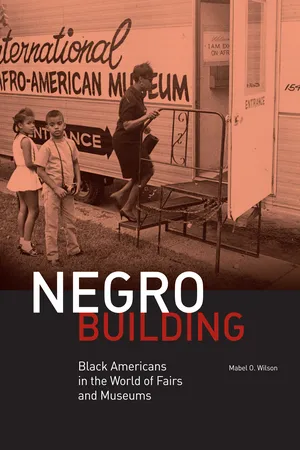
Focusing on Black Americans' participation in world's fairs, Emancipation expositions, and early Black grassroots museums, Negro Building traces the evolution of Black public history from the Civil War through the civil rights movement of the 1960s. Mabel O. Wilson gives voice to the figures who conceived the curatorial content: Booker T. Washington, W. E. B. Du Bois, Ida B. Wells, A. Philip Randolph, Horace Cayton, and Margaret Burroughs. Originally published in 2012, the book reveals why the Black cities of Chicago and Detroit became the sites of major Black historical museums rather than the nation's capital, which would eventually become home for the Smithsonian's National Museum of African American History and Culture, which opened in 2016.
Focusing on Black Americans' participation in world's fairs, Emancipation expositions, and early Black grassroots museums, Negro Building traces the evolution of Black public history from the Civil War through the civil rights movement of the 1960s. Mabel
- 462 pages
- English
- PDF
- Available on iOS & Android
eBook - PDF
About this book
Information
.
Map,
Atlanta
Cotton
States
and
International
Exposition,
.
From
The
Official
Catalogue
of
the
Cotton
States
and
International
Exposition,
Atlanta
Georgia,
U.S.A.
September
to
December
,
(Atlanta:
Clafin
Mellichamp
Publishers,
).
Table of contents
- Cover
- Title Page
- Copyright Page
- Dedication Page
- Table of Contents
- List of Figures
- Acknowledgments
- Introduction
- Prologue
- Chapter 1. Progress of a Race: The Black Side’s Contribution to Atlanta’s World’s Fair
- Chapter 2. Exhibiting the American Negro
- Chapter 3. Remembering Emancipation Up North
- Chapter 4. Look Back, March Forward
- Chapter 5. To Make a Black Museum
- Epilogue
- Notes
- Bibliography
- Index
Trusted by 375,005 students
Access to over 1.5 million titles for a fair monthly price.
Study more efficiently using our study tools.
Frequently asked questions
Yes, you can cancel anytime from the Subscription tab in your account settings on the Perlego website. Your subscription will stay active until the end of your current billing period. Learn how to cancel your subscription
No, books cannot be downloaded as external files, such as PDFs, for use outside of Perlego. However, you can download books within the Perlego app for offline reading on mobile or tablet. Learn how to download books offline
We are an online textbook subscription service, where you can get access to an entire online library for less than the price of a single book per month. With over 1.5 million books across 990+ topics, we’ve got you covered! Learn about our mission
Look out for the read-aloud symbol on your next book to see if you can listen to it. The read-aloud tool reads text aloud for you, highlighting the text as it is being read. You can pause it, speed it up and slow it down. Learn more about Read Aloud
Yes! You can use the Perlego app on both iOS and Android devices to read anytime, anywhere — even offline. Perfect for commutes or when you’re on the go.
Please note we cannot support devices running on iOS 13 and Android 7 or earlier. Learn more about using the app
Please note we cannot support devices running on iOS 13 and Android 7 or earlier. Learn more about using the app
Yes, you can access Negro Building by Mabel O. Wilson in PDF and/or ePUB format, as well as other popular books in Art & Museum Studies. We have over 1.5 million books available in our catalogue for you to explore.