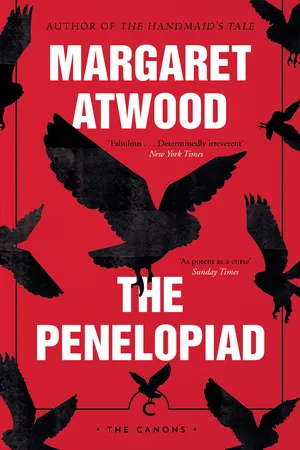
Penelope. Immortalised in legend and myth as the devoted wife of the glorious Odysseus, silently weaving and unpicking and weaving again as she waits for her husband's return.
Now Penelope wanders the underworld, spinning a different kind of thread: her own side of the story - a tale of lust, greed and murder.
- 224 pages
- English
- ePUB (mobile friendly)
- Available on iOS & Android
eBook - ePub
The Penelopiad
About this book
Information
i
A Low Art
Now that I’m dead I know everything. This is what I wished would happen, but like so many of my wishes it failed to come true. I know only a few factoids that I didn’t know before. Death is much too high a price to pay for the satisfaction of curiosity, needless to say.
Since being dead – since achieving this state of bonelessness, liplessness, breastlessness – I’ve learned some things I would rather not know, as one does when listening at windows or opening other people’s letters. You think you’d like to read minds? Think again.
Down here everyone arrives with a sack, like the sacks used to keep the winds in, but each of these sacks is full of words – words you’ve spoken, words you’ve heard, words that have been said about you. Some sacks are very small, others large; my own is of a reasonable size, though a lot of the words in it concern my eminent husband. What a fool he made of me, some say. It was a specialty of his: making fools. He got away with everything, which was another of his specialties: getting away.
He was always so plausible. Many people have believed that his version of events was the true one, give or take a few murders, a few beautiful seductresses, a few one-eyed monsters. Even I believed him, from time to time. I knew he was tricky and a liar, I just didn’t think he would play his tricks and try out his lies on me. Hadn’t I been faithful? Hadn’t I waited, and waited, and waited, despite the temptation – almost the compulsion – to do otherwise? And what did I amount to, once the official version gained ground? An edifying legend. A stick used to beat other women with. Why couldn’t they be as considerate, as trustworthy, as all-suffering as I had been? That was the line they took, the singers, the yarn-spinners. Don’t follow my example, I want to scream in your ears – yes, yours! But when I try to scream, I sound like an owl.
Of course I had inklings, about his slipperiness, his wiliness, his foxiness, his – how can I put this? – his unscrupulousness, but I turned a blind eye. I kept my mouth shut; or, if I opened it, I sang his praises. I didn’t contradict, I didn’t ask awkward questions, I didn’t dig deep. I wanted happy endings in those days, and happy endings are best achieved by keeping the right doors locked and going to sleep during the rampages.
But after the main events were over and things had become less legendary, I realised how many people were laughing at me behind my back – how they were jeering, making jokes about me, jokes both clean and dirty; how they were turning me into a story, or into several stories, though not the kind of stories I’d prefer to hear about myself. What can a woman do when scandalous gossip travels the world? If she defends herself she sounds guilty. So I waited some more.
Now that all the others have run out of air, it’s my turn to do a little story-making. I owe it to myself. I’ve had to work myself up to it: it’s a low art, tale-telling. Old women go in for it, strolling beggars, blind singers, maidservants, children – folks with time on their hands. Once, people would have laughed if I’d tried to play the minstrel – there’s nothing more preposterous than an aristocrat fumbling around with the arts – but who cares about public opinion now? The opinion of the people down here: the opinion of shadows, of echoes. So I’ll spin a thread of my own.
The difficulty is that I have no mouth through which I can speak. I can’t make myself understood, not in your world, the world of bodies, of tongues and fingers; and most of the time I have no listeners, not on your side of the river. Those of you who may catch the odd whisper, the odd squeak, so easily mistake my words for breezes rustling the dry reeds, for bats at twilight, for bad dreams.
But I’ve always been of a determined nature. Patient, they used to call me. I like to see a thing through to the end.
ii
The Chorus Line:
A Rope-Jumping Rhyme
A Rope-Jumping Rhyme
we are the maids
the ones you killed
the ones you failed
we danced in air
our bare feet twitched
it was not fair
with every goddess, queen, and bitch
from there to here
you scratched your itch
we did much less
than what you did
you judged us bad
you had the spear
you had the word
at your command
we scrubbed the blood
of our dead
paramours from floors, from chairs
from stairs, from doors,
we knelt in water
while you stared
at our bare feet
it was not fair
you licked our fear
it gave you pleasure
you raised your hand
you watched us fall
we danced on air
the ones you failed
the ones you killed
iii
My Childhood
Where shall I begin? There are only two choices: at the beginning or not at the beginning. The real beginning would be the beginning of the world, after which one thing has led to another; but since there are differences of opinion about that, I’ll begin with my own birth.
My father was King Icarius of Sparta. My mother was a Naiad. Daughters of Naiads were a dime a dozen in those days; the place was crawling with them. Nevertheless, it never hurts to be of semidivine birth. Or it never hurts immediately.
When I was quite young my father ordered me to be thrown into the sea. I never knew exactly why, during my lifetime, but now I suspect he’d been told by an oracle that I would weave his shroud. Possibly he thought that if he killed me first, his shroud would never be woven and he would live forever. I can see how the reasoning might have gone. In that case, his wish to drown me came from an understandable desire to protect himself. But he must have misheard, or else the oracle herself misheard – the gods often mumble – because it was not his shroud that was at issue, but my father-in-law’s shroud. If that was the prophecy it was a true one, and indeed the weaving of this particular shroud proved a great convenience to me later on in my life.
The teaching of crafts to girls has fallen out of fashion now, I understand, but luckily it had not in my day. It’s always an advantage to have something to do with your hands. That way, if someone makes an inappropriate remark, you can pretend you haven’t heard it. Then you don’t have to answer.
But perhaps this shroud-weaving oracle idea of mine is baseless. Perhaps I have only invented it in order to make myself feel better. So much whispering goes on, in the dark caverns, in the meadows, that sometimes it’s hard to know whether the whispering is coming from others or from the inside of your own head. I use head figuratively. We have dispensed with heads as such, down here.
No matter – into the sea I was thrown. Do I remember the waves closing over me, do I remember the breath leaving my lungs and the sound of bells people say the drowning hear? Not in the least. But I was told the story: there is always some servant or slave or old nurse or busybody ready to regale a child with the awful things done to it by its parents when it was too young to remember. Hearing this discouraging anecdote did not improve my relations with my father. It is to this episode – or rather, to my knowledge of it – that I attribute my reserve, as well as my mistrust of other people’s intentions.
It was stupid of Icarius to try to drown the daughter of a Naiad, however. Water is our element, it is our birthright. Although we are not such good swimmers as our mothers, we do have a way of floating, and we’re well connected among the fish and seabirds. A flock of purple-striped ducks came to my rescue and towed me ashore. After an omen like that, what could my father do? He took me back, and renamed me – duck was my new nickname. No doubt he felt guilty about what he’d almost done: he became, if anything, rather too affectionate towards me.
I found this affection difficult to reciprocate. You can imagine. There I would be, strolling hand in hand with my apparently fond male parent along a cliff edge or a river bank or a parapet, and the thought would occur to me that he might suddenly decide to shove me over or bash me to death with a rock. Preserving a calm façade under these circumstances was a challenge. After such excursions I would retire to my room and dissolve in floods of tears. (Excessive weeping, I might as well tell you now, is a handicap of the Naiad-born. I spent at least a quarter of my earthly life crying my eyes out. Fortunately in my time there were veils. They were a practical help for disguising red, puffy eyes.)
My mother, like all Naiads, was beautiful, but chilly at heart. She had waving hair and dimples, and rippling laughter. She was elusive. When I was little I often tried to throw my arms around her, but she had a habit of sliding away. I like to think that she may have been responsible for calling up that flock of ducks, but probably she wasn’t: she preferred swimming in the river to the care of small children, and I often slipped her mind. If my father hadn’t had me thrown into the sea she might have dropped me in herself, in a fit of absent-mindedness or irritation. She had a short attention span and rapidly changing emotions.
You can see by what I’ve told you that I was a child who learned early the virtues – if such they are – of self-sufficiency. I knew that I would have to look out for myself in the world. I could hardly count on family support.
iv
The Chorus Line: Kiddie Mourn, A Lament by the Maids
We too were children. We too were born to the wrong parents. Poor parents, slave parents, peasant parents, and serf parents; parents who sold us, parents from whom we were stolen. These parents were not gods, they were not demi-gods, they were not nymphs or Naiads. We were set to work in the palace, as children; we drudged from dawn to dusk, as children. If we wept, no one dried our tears. If we slept, we were kicked awake. We were told we were motherless. We were told we were fatherless. We were told we were lazy. We were told we were dirty. We were dirty. Dirt was our concern, dirt was our business, dirt was our specialty, dirt was our fault. We were the dirty girls. If our owners or the sons of our owners or a visiting nobleman or the sons of a visiting nobleman wanted to sleep with us, we could not refuse. It did us no good to weep, it did us no good to say we were in pain. All this happened to us when we were children. If we were pretty children our lives were worse. We ground the flour for lavish wedding feasts, then we ate the leftovers; we would never have a wedding feast of our own, no rich gifts would be exchanged for us; our bodies had little value. But we wanted to sing and dance too, we wanted to be happy too. As we grew older we became polished and evasive, we mastered the secret sneer. We swayed our hips, we lurked, we winked, we signalled with our eyebrows, even when we were children; we met boys behind the pigpens, noble boys and ignoble boys alike. We rolled around in the straw, in the mud, in the dung, on the beds of soft fleece we were making up for our masters. We drank the wine left in the wine cups. We spat onto the serving platters. Between the bright hall and the dark scullery we crammed filched meat into our mouths. We laughed together in our attics, in our nights. We snatched what we could.
v
Asphodel
It’s dark here, as many have remarked. ‘Dark Death’, they used to say. ‘The gloomy halls of Hades’, and so forth. Well, yes, it is dark, but there are advantages – for instance, if you see someone you’d rather not speak to you can always pretend you haven’t recognised them.
There are of course the fields of asphodel. You can walk around in them if you want. It’s brighter there, and a certain amount of vapid dancing goes on, though the region sounds better than it is – the fields of asphodel has a poetic lilt to it. But just consider. Asphodel, asphodel, asphodel – pretty enough white flowers, but a person gets tired of them after a while. It would have been better to supply some variety – an assortment of colours, a few winding paths and vistas and stone benches and fountains. I would have preferred the odd hyacinth, at least, and would a sprinkling of crocuses have been too much to expect? Though we never get spring here, or any other seasons. You do have to wonder who designed the place.
Have I mentioned the fact that there’s nothing to eat except asphodel?
But I shouldn’t complain.
The darker grottoes are more interesting – the conversation there is better, if you can find a minor rascal of some sort – a pickpocket, a stockbroker, a small-time pimp. Like a lot of goody-goody girls, I was always secretly attracted to men of that kind.
I don’t frequent the really deep levels much, though. That’s where the punishments are dealt out to the truly villainous, those who were not sufficiently punished while alive. It’s hard to put up with the screams. The torture is mental torture, however, since we don’t have bodies any more. What the gods really like is to conjure up banquets – big platters of meat, heaps of bread, bunches of grapes – and then snatch them away. Making people roll heavy stones up steep hills is another of their favourite jests. I sometimes have a yen to go down there: it might help me to remember what it was like to have real hunger, what it was like to have real fatigue.
Every once in a while the fogs part and we get a glimpse of the world of the living. It’s like rubbing the glass on a dirty window, making a space to look through. Sometimes the barrier dissolves and we can go on an outing. Then we get very excited, and there is a great deal of squeaking.
These outings can take place in many ways. Once upon a time, anyone who wished to consult us would slit the throat of a sheep or cow or pig and let the blood flow into a trench in the ground. We’d smell it and make a beeline for the site, like flies to a carcass. There we’d be, chirping and fluttering, thousands of us, like the contents of a giant wastepaper basket caught in a tornado, while some self-styled hero held us off...
Table of contents
- Cover
- About the Author
- Also By Margaret Atwood
- Title Page
- Copyright
- Dedication
- Table of Contents
- Introduction
- Chapter I: A Low Art
- Chapter II The Chorus Line: A Rope-Jumping Rhyme
- Chapter III: My Childhood
- Chapter IV: The Chorus Line: Kiddie Mourn, A Lament By The Maids
- Chapter V: Asphodel
- Chapter VI: My Marriage
- Chapter VII: The Scar
- Chapter VIII: The Chorus Line: If I Was A Princess, A Popular Tune
- Chapter IX: The Trusted Cackle-Hen
- Chapter X: The Chorus Line: The Birth Of Telemachus, An Idyll
- Chapter XI: Helen Ruins My Life
- Chapter XII: Waiting
- Chapter XIII: The Chorus Line: The Wily Sea Captain, A Sea Shanty
- Chapter XIV: The Suitors Stuff Their Faces
- Chapter XV: The Shroud
- Chapter XVI: Bad Dreams
- Chapter XVII: The Chorus Line: Dreamboats, A Ballad
- Chapter XVIII: News Of Helen
- Chapter XIX: Yelp Of Joy
- Chapter XX: Slanderous Gossip
- Chapter XXI: The Chorus Line: The Perils Of Penelope, A Drama
- Chapter XXII: Helen Takes A Bath
- Chapter XXIII: Odysseus And Telemachus Snuff The Maids
- Chapter XXIV: The Chorus Line: An Anthropology Lecture
- Chapter XXV: Heart Of Flint
- Chapter XXVI: The Chorus Line: The Trial Of Odysseus, As Videotaped By The Maids
- Chapter XXVII: Home Life In Hades
- Chapter XXVIII: The Chorus Line: We’Re Walking Behind You, A Love Song
- Chapter XXIX: Envoi
- Notes
- Acknowledgements
Trusted by 375,005 students
Access to over 1.5 million titles for a fair monthly price.
Study more efficiently using our study tools.
Frequently asked questions
Yes, you can cancel anytime from the Subscription tab in your account settings on the Perlego website. Your subscription will stay active until the end of your current billing period. Learn how to cancel your subscription
No, books cannot be downloaded as external files, such as PDFs, for use outside of Perlego. However, you can download books within the Perlego app for offline reading on mobile or tablet. Learn how to download books offline
Perlego offers two plans: Essential and Complete
- Essential is ideal for learners and professionals who enjoy exploring a wide range of subjects. Access the Essential Library with 800,000+ trusted titles and best-sellers across business, personal growth, and the humanities. Includes unlimited reading time and Standard Read Aloud voice.
- Complete: Perfect for advanced learners and researchers needing full, unrestricted access. Unlock 1.5M+ books across hundreds of subjects, including academic and specialized titles. The Complete Plan also includes advanced features like Premium Read Aloud and Research Assistant.
We are an online textbook subscription service, where you can get access to an entire online library for less than the price of a single book per month. With over 1.5 million books across 990+ topics, we’ve got you covered! Learn about our mission
Look out for the read-aloud symbol on your next book to see if you can listen to it. The read-aloud tool reads text aloud for you, highlighting the text as it is being read. You can pause it, speed it up and slow it down. Learn more about Read Aloud
Yes! You can use the Perlego app on both iOS and Android devices to read anytime, anywhere — even offline. Perfect for commutes or when you’re on the go.
Please note we cannot support devices running on iOS 13 and Android 7 or earlier. Learn more about using the app
Please note we cannot support devices running on iOS 13 and Android 7 or earlier. Learn more about using the app
Yes, you can access The Penelopiad by Margaret Atwood in PDF and/or ePUB format, as well as other popular books in Literature & Literature General. We have over 1.5 million books available in our catalogue for you to explore.