![]()
‘On every mantelpiece stand photographs wreathed with ivy, smiling, true to the past . . .’
Dusty, bulging, old: they are all the same, these albums. The same faces, the same photos. Every family was touched by the war and every family has an album like this. Even as we prepare to open it, the act of looking at the album is overlaid by the emotions it will engender. We look at the pictures as if reading a poem about the experience of seeing them.
I turn the dark, heavy pages. The dust smell of old photographs.
The dead queuing up to enlist. Marching through the dark town, disappearing beyond the edge of the frame. Some turn up later, in the photos from hospital: marching away and convalescing, nothing in between. Always close to hand, the countryside seems empty in these later pictures, a register of absence. Dry stone walls and rivers. Portraits and group portraits. Officers and other ranks. The loved and the unloved, indistinguishable from each other.
‘Memory has a spottiness,’ writes Updike, ‘as if the film was sprinkled with developer instead of immersed in it.’ Each of these photos is marred, spotted, blotched; their imperfections make them seem like photos of memories. In some there is an encroaching white light, creeping over the image, wiping it out. Others are fading: photos of forgetting. Eventually nothing will remain but blank spaces.
A nurse in round glasses and long uniform (‘Myself’ printed beneath in my grandmother’s perfect hand). A group of men in hospital. Two with patches over their eyes, three with arms in slings. One
in his ghastly suit of grey,
Legless, sewn short at the elbow.
A stern-faced sister stands at the end of the back row, each name diligently inked beneath the picture. My mother’s father is the second on the left, in the back row.
Born (illegitimate) in Worthen in Shropshire, eighteen miles from Oswestry where Wilfred Owen was born. Farm labourer. Able only to read and write his name. Enlisted in 1914. Served on the Somme as a driver (of horses), where, according to family legend, he once went up to the front-line trenches in place of a friend whose courage had suddenly deserted him. Later, back in the reserve trench, he shovelled the remains of his best friend into a sandbag. (Every family has the same album, every family has a version of the same legend.) Returned to Shropshire in 1919 and resumed the life he had left.
Worked, went to war, married, worked.
He died aged ninety-one, able still only to write his name.
Everything I have said about my grandfather is true. Except he is not the man second from the left in the photograph. I do not know who that is. It makes no difference. He could be anyone’s grandfather.
Like many young men, my grandfather was under age when he turned up to enlist. The recruiting sergeant told him to come back in a couple of days when he was two years older. My grandfather duly returned, added a couple of years to his age and was accepted into the army.
Similar episodes are fairly common in the repertoire of recruitment anecdotes, but I never doubted the veracity of this particular version of it, which my mother told several times over the years. It came as a surprise, then, to discover from his death certificate that my grandfather was born in November 1893 (the same year as Owen), and so was twenty when war broke out. One of the commonly circulating stories of the 1914 generation had been so thoroughly absorbed by my family that it had become part of my grandfather’s biography.
He is everyone’s grandfather.
Seven-thirty a.m. Mist lies over the fields of the Somme. Trees are smudged shapes. Nothing moves. Power lines sag and vanish over absent hedges. Birds call invisibly. Only the road can be sure of where it is going.
I stop for breakfast – an apple, a banana, yoghurt slurped from the carton – and consult the map I bought yesterday. A friend who was driving from Paris to catch a dawn ferry at Calais had given me a lift to Amiens. From there I hitched in the direction of Albert because, from my newly acquired map, it was the nearest station to the villages whose names I vaguely recognize: Beaumont-Hamel, Mametz, Pozières . . . I want to visit the cemeteries on the Somme but have no clear idea of what they are like or which ones are particularly worth visiting. On my map, near Thiepval, is printed in heavy type: ‘Memorial Brit.’ When I began hitching this morning, I did not know what I would find or where I would go – I still don’t, except that at some point in the day I will visit Thiepval. For now I cram everything back in my rucksack and continue walking.
Within an hour, exactly as forecast, the mist starts to thin. Level slopes of fields appear. The dusty blaze of rape. Dipping flatness. I walk towards a large cemetery, the most distant rows of headstones barely visible.
The cemetery is separated from the surrounding field by a low wall, dissolved in places by the linger of mist. Close to this wall a large cross appears as a mossy blur, like the trunk of a tree. The noise of the gate being unlatched sends birds flocking from branches and back. The gravel is loud beneath my feet. Near the gate, on a large stone – pale, horizontal, altar-like – is written:
THEIR NAME LIVETH FOR EVERMORE
Between this stone and the cross are rows of white headstones, bordered by perfect grass. Flowers: purple, dull red, flame-yellow.
Most of the headstones give simply the regiment, name, rank and, where it is known, the date of the soldier’s death, sometimes his age. Occasionally quotations have been added, but the elaborate biblical sentiments are superfluous; they neither add to nor detract from the uniform pathos of the headstones, some of which do not even bear a name:
A SOLDIER
OF THE GREAT WAR
KNOWN UNTO GOD
The cross has a bronze sword running down the centre, pointing to the ground. Gradually the mist thins enough for the cross to cast a promise of shadow, a darker haze, so faint it is barely there. Pale sunlight.
The high left-hand wall of the cemetery is a memorial to the New Zealand dead with no known graves ‘who fell in the Battles of the Somme September and October 1916’. Inscribed along its length are 1,205 names.
Near the gate is a visitors’ book and register of graves. The name of the cemetery is Caterpillar Valley. There are 5,539 men buried here.
‘We will remember them’
The Great War ruptured the historical continuum, destroying the legacy of the past. Wyndham Lewis sounds the characteristic note when he calls it ‘the turning-point in the history of the earth’, but there is a sense in which, for the British at least, the war helped to preserve the past even as it destroyed it. Life in the decade and a half preceding 1914 has come to be viewed inevitably and unavoidably through the optic of the war that followed it. The past as past was preserved by the war that shattered it. By ushering in a future characterized by instability and uncertainty, it embalmed for ever a past characterized by stability and certainty.
Things were, of course, less settled than the habitual view of pre-August 1914 tempts us to believe. For many contemporary observers the war tainted the past, revealing and making explicit a violence that had been latent in the preceding peace. Eighty years on, this sense of crouched and gathering violence has been all but totally filtered out of our perception of the pre-war period. Militant suffragettes, class unrest, strikes, Ireland teetering on the brink of civil war – all are shaded and softened by the long, elegiac shadows cast by the war.
European civilization may have been ‘breaking down even before war destroyed it’, but our abiding sense of the quietness of the Edwardian frame of mind is, overwhelmingly, derived from and enhanced by the holocaust that followed it. The glorious summer of 1914 seems, even, to have been generated by the cataclysm that succeeded it.
In a persuasive passage, Johan Huizinga admonished the historian to
maintain towards his subject an indeterminist point of view. He must constantly put himself at a point in the past at which the known factors still seem to permit different outcomes.
But history does not lie uniformly over events. Here and there it forms drifts – and these drifts are at their deepest between the years 1914 and 1918. Watching footage of the Normandy landings, we can experience D-Day as it happened. History hangs in the balance, waiting to be made. The Battle of the Somme, by contrast, is deeply buried in its own aftermath. The euphoric intoxication of the early days of the French Revolution – ‘Bliss was it in that dawn’ – remains undiminished by the terror lying in wait a few chapters on. The young men queuing up to enlist in 1914 have the look of ghosts. They are queuing up to be slaughtered: they are already dead. By Huizinga’s terms, the Great War urges us to write the opposite of history: the story of effects generating their cause.
They shall grow not old, as we that are left grow old:
Age shall not weary them, nor the years condemn.
At the going down of the sun and in the morning
We will remember them.
These incantatory rhythms and mantra-like repetitions are intoned every year on Remembrance Day. They are words we hear but rarely see in print. We know them – more or less – by heart. They seem not to have been written but to have pulsed into life in the nation’s collective memory, to have been generated, down the long passage of years, by the hypnotic spell of Remembrance they are used to induce.
But they were written, of course, by Laurence Binyon, in September 1914: before the fallen actually fell. ‘For the Fallen’, in other words, is a work not of remembrance but of anticipation, or more accurately, the anticipation of remembrance: a foreseeing that is also a determining.
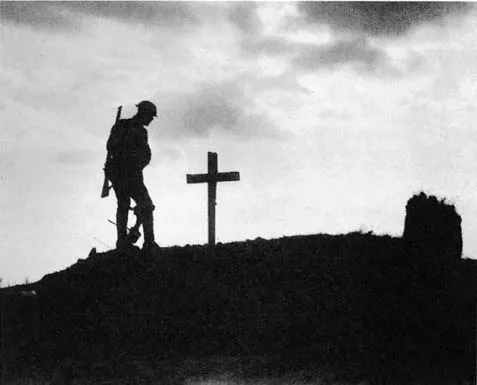
On 22 August 1917 at Pilkem Ridge near Ypres, Ernest Brooks took one of the iconographic photographs of the Great War. Head bowed, rifle on his back, a soldier is silhouetted against the going down of the sun, looking at the grave of a dead comrade, remembering him. A photograph from the war – the Battle of Third Ypres (or Passchendaele as it is better known) was still raging, the armistice was fifteen months distant – it is also a photograph of the way the war will come to be remembered. It is a photograph of the future, of the future’s view of the past. It is a photograph of Binyon’s poem, of a sentiment. We will remember them.
If several of the terms by which we remember the war were established in advance of its conclusion, many crucial elements were embodied in a single dramatic event two years before it started.
Between November 1911 and January 1912 two teams of men – one British, headed by a naval officer, Robert Falcon Scott, the other Norwegian, headed by Roald Amundsen – were engaged in the last stage of a protracted race to the South Pole. Using dogs and adapting themselves skilfully to the hostile environment, the Norwegian team reached the Pole on 15 December and returned safely. Scott, leader of an ill-prepared expedition which relied on strength-sapping man-hauling, reached the Pole on 17 January. Defeated, the five-man team faced a gruelling 800-mile trudge back to safety. By 21 March, eleven miles from the nearest depot of food and fuel, the three exhausted surviving members of the expedition – Scott, Dr Edward Wilson and Henry Bowers – pitched their tent and sat out a blizzard. At some point Scott seems to have made the decision that it was better to stay put and preserve the record of their struggle rather than die in their tracks. They survived for at least nine days while Scott, in Roland Huntford’s phrase, ‘prepared his exit from the stage’ and addressed letters to posterity: ‘We are setting a good example to our countrymen, if not by getting into a tight place, by facing it like men when we get there.’ Despite its failure, the expedition, wrote Scott, ‘has shown that Englishmen can endure hardships, help one another and meet death with as great a fortitude as ever in the past’. The tradition of heroic death which aggrandizes his own example is also invigorated by it: ‘We are showing that Englishmen can still die with a bold spirit, fighting it out to the end . . . I think this makes an example for Englishmen of the future.’
The anticipation of memory
On 12 November, in the collapsed tent, the bodies and their documents were found by a rescue party and the legend of Scott of the Antarctic began to take immediate effect. ‘Of their suffering, hardship and devotion to one another,’ wrote a member of the rescue team, ‘the world will soon know the deeds that were done were equally as great as any committed on Battlefield and won the respect and honour of every true Britisher.’
Scott’s headstrong incompetence had actually meant that, from an early stage, the expedition had been riddled by tension. Captain Oates – the ‘very gallant Englishman’ of legend – had earlier written that ‘if Scott fails to get to the Pole he jolly well deserves it’. Although clad in the guise of scientific discovery, Scott’s expedition contributed nothing to the knowledge of polar travel unless it was to emphasize ‘the grotesque futility of man-hauling’. But with Scott, futility (the title of one of only a handful of poems published by Wilfred Owen in his lifetime) becomes an important component of the heroic. That Scott had turned the expedition into an affair of ‘heroism for heroism’s sake’ only enhanced the posthumous glory that greeted news of his death when it reached England on 11 February ...