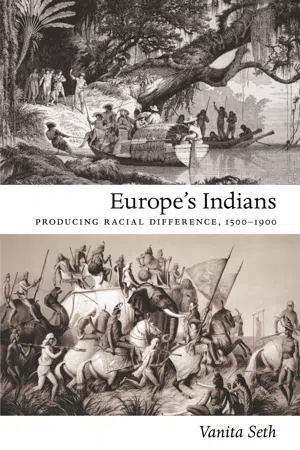
Europe's Indians forces a rethinking of key assumptions regarding difference—particularly racial difference—and its centrality to contemporary social and political theory. Tracing shifts in European representations of two different colonial spaces, the New World and India, from the late fifteenth century through the late nineteenth, Vanita Seth demonstrates that the classification of humans into racial categories or binaries of self–other is a product of modernity. Part historical, part philosophical, and part a history of science, her account exposes the epistemic conditions that enabled the thinking of difference at distinct historical junctures. Seth's examination of Renaissance, Classical Age, and nineteenth-century representations of difference reveals radically diverging forms of knowing, reasoning, organizing thought, and authorizing truth. It encompasses stories of monsters, new worlds, and ancient lands; the theories of individual agency expounded by Hobbes, Locke, and Rousseau; and the physiological sciences of the nineteenth century. European knowledge, Seth argues, does not reflect a singular history of Reason, but rather multiple traditions of reasoning, of historically bounded and contingent forms of knowledge. Europe's Indians shows that a history of colonialism and racism must also be an investigation into the historical production of subjectivity, agency, epistemology, and the body.
eBook - PDF
Europe's Indians
Producing Racial Difference, 1500–1900
- 307 pages
- English
- PDF
- Available on iOS & Android
eBook - PDF
Europe's Indians
Producing Racial Difference, 1500–1900
About this book
Information
Publisher
Duke University Press BooksYear
2010Print ISBN
9780822347644
9780822347453
eBook ISBN
9780822392941
Topic
PhilosophySubtopic
Epistemology in PhilosophyTable of contents
- Contents
- Acknowledgments
- Introduction
- 1. Self and Similitude: Renaissance Representations of the New World
- 2. “Constructing” Individuals and “Creating” History: Subjectivity in Hobbes, Locke, and Rousseau
- 3. Traditions of History: Mapping India’s Past
- 4. Of Monsters and Man: The Peculiar History of Race
- Epilogue
- Notes
- Bibliography
- Index
Trusted by 375,005 students
Access to over 1.5 million titles for a fair monthly price.
Study more efficiently using our study tools.
Frequently asked questions
Yes, you can cancel anytime from the Subscription tab in your account settings on the Perlego website. Your subscription will stay active until the end of your current billing period. Learn how to cancel your subscription
No, books cannot be downloaded as external files, such as PDFs, for use outside of Perlego. However, you can download books within the Perlego app for offline reading on mobile or tablet. Learn how to download books offline
Perlego offers two plans: Essential and Complete
- Essential is ideal for learners and professionals who enjoy exploring a wide range of subjects. Access the Essential Library with 800,000+ trusted titles and best-sellers across business, personal growth, and the humanities. Includes unlimited reading time and Standard Read Aloud voice.
- Complete: Perfect for advanced learners and researchers needing full, unrestricted access. Unlock 1.5M+ books across hundreds of subjects, including academic and specialized titles. The Complete Plan also includes advanced features like Premium Read Aloud and Research Assistant.
We are an online textbook subscription service, where you can get access to an entire online library for less than the price of a single book per month. With over 1.5 million books across 990+ topics, we’ve got you covered! Learn about our mission
Look out for the read-aloud symbol on your next book to see if you can listen to it. The read-aloud tool reads text aloud for you, highlighting the text as it is being read. You can pause it, speed it up and slow it down. Learn more about Read Aloud
Yes! You can use the Perlego app on both iOS and Android devices to read anytime, anywhere — even offline. Perfect for commutes or when you’re on the go.
Please note we cannot support devices running on iOS 13 and Android 7 or earlier. Learn more about using the app
Please note we cannot support devices running on iOS 13 and Android 7 or earlier. Learn more about using the app
Yes, you can access Europe's Indians by Vanita Seth, Julia Adams, George Steinmetz, Julia Adams,George Steinmetz in PDF and/or ePUB format, as well as other popular books in Philosophy & Epistemology in Philosophy. We have over 1.5 million books available in our catalogue for you to explore.