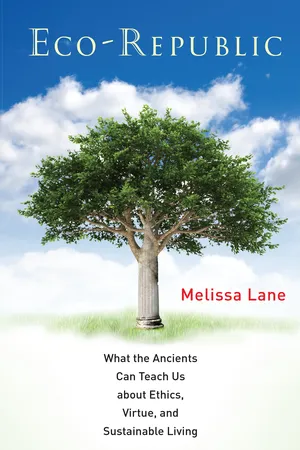
An ecologically sustainable society cannot be achieved without citizens who possess the virtues and values that will foster it, and who believe that individual actions can indeed make a difference. Eco-Republic draws on ancient Greek thought—and Plato's Republic in particular—to put forward a new vision of citizenship that can make such a society a reality. Melissa Lane develops a model of a society whose health and sustainability depend on all its citizens recognizing a shared standard of value and shaping their personal goals and habits accordingly. Bringing together the moral and political ideas of the ancients with the latest social and psychological theory, Lane illuminates the individual's vital role in social change, and articulates new ways of understanding what is harmful and what is valuable, what is a benefit and what is a cost, and what the relationship between public and private well-being ought to be.
Eco-Republic reveals why we must rethink our political imagination if we are to meet the challenges of climate change and other urgent environmental concerns. Offering a unique reflection on the ethics and politics of sustainability, the book goes beyond standard approaches to virtue ethics in philosophy and current debates about happiness in economics and psychology. Eco-Republic explains why health is a better standard than happiness for capturing the important links between individual action and social good, and diagnoses the reasons why the ancient concept of virtue has been sorely neglected yet is more relevant today than ever.
[…] what do you think would happen, if [a released prisoner] went back to sit in his old seat in the cave? Wouldn’t his eyes be blinded by the darkness, because he had come in suddenly out of the sunlight? … And if he had to discriminate between the shadows, in competition with the other prisoners, while he was still blinded and before his eyes got used to the darkness – a process that would take some time – wouldn’t he be likely to make a fool of himself? And they would say that his visit to the upper world had ruined his sight, and that the ascent was not worth even attempting.
(The character of Socrates speaking in Plato, Republic, Book 7, 516e–517a)1
‘Crazy!’ ‘Lunatic!’ ‘What is he talking about?’ ‘How dare he challenge our way of life?’, people call out angrily to one another, hostile to a person newly arrived in their midst. The newcomer has challenged the fundaments of their social order. According to his presumptuous proclamation, what they call success is actually failure. Their career paths to power and prestige lead to public damage, not to public service. What they take to be solid facts are dangerous illusions. The technologies and infrastructure and assumptions in which they have invested their time and money and belief are fraudulent; the glare of reality would expose these as wishful delusions. The newcomer is likely to be shunned at best, stoned at worst. How could anyone be expected to tolerate such arrogant insults to their whole way of life?
Pull back the camera on this scene, however, and it appears in a new light. The busy self-righteousness of this political order is indeed, in reality, built on foundations of sand. The prizes they strive for are made of smoke and mirrors; success in their competitions is self-undermining. In fact, powerful figures, invested in the maintenance of this existing delusional social order, parade the objects and languages in which the people believe, denying that any external challenge to them could be valid. Denial of the external perspective looks from this higher vantage point like keeping one’s head in the sand, refusing to face what is obvious and valid.
A passive citizen body, a conniving and self-interested set of sophistic opinion-formers and demagogic political leaders, a systematically misleading and damaging order of political structures and common beliefs and appetites: this is how Plato portrays the effects of his contemporaries’ system of education – by which he means, very broadly, the effects of their system of values and practices. He describes the cities of his day as no more than caves. Trapped inside, people box at shadows, elbowing each other to achieve advantage and pre-eminence, while being all the time unknowing captives of a delusional state. The artificial firelight inside is but a feeble and perverse imitation of the light of the Sun which stands outside and above every given cave.
I have taught Plato’s image of the Cave – for that is what I have been describing, from Book 7 of Plato’s Republic – to hundreds of people, old and young, students and senior citizens, corporate executives and public officials. Several years before beginning this book, it began to nag at me. In clinging to the comforts and familiarities of our current way of life and its fossil-fuel infrastructure, despite a mounting consensus of scientific studies documenting the damage which this is doing, are we trapping ourselves in Plato’s cave? What would it mean for our conceptions of our cities and our selves if we were to dare to leave the cave, facing the challenge of making our conveniences and competitions conform to the implacable demands of external reality?
This book is an attempt to answer that question. It does so by taking seriously the challenge which Plato poses, while developing a more positive answer than he offered to the question of whether a democratic society could conceivably generate such change from within. Plato portrays the democratic society of his day (or rather of his teacher Socrates’ day, in fifth-century B.C. Athens, Greece) as a cave from which only one or two exceptional people may be able to escape. In fact he envisions only forced escape, as if someone would have to be plucked out of captivity by powers on the outside, and he depicts the Sun as an image for a single fixed and given truth, rather than a truth attained by the progress of human science and debate.
Today, our understanding of the way that science and knowledge-formation takes place in liberal democratic societies is very different from that of the Republic. Rather than seeing one or two people as possessed of a unique and given truth, the rest as benighted and deluded, we understand that knowledge is broadly produced and shared, with even specialized science being a debate among specialists that has public resonance, rather than an esoteric matter for a chosen few. Yet these differences do not obliterate an important commonality. Plato’s image of knowers (in our case, scientists) having something to tell us that violates our most cherished assumptions, that makes people so angry as to deny and attack them as the messengers, has powerful resonance with our current predicament. The idea of man-made global warming has been such an idea, greeted with as much hostility and ridicule as Plato’s cave denizens mustered for their unwelcome messengers from the outside world. (So too was the idea of passive smoking.) Now, ideas of the near-term, absolute, and wrenching changes that may be required of us appear as similar anathema to our cherished cave-like certainties. Denial and inertia in confronting the required changes are temptations that are very widely shared.
While ecological sustainability is by no means limited to the issues of climate or energy, I take those issues as my primary focus both as illustrative and as inherently important. The corresponding denial that interests me is not the straight-out denial of climate change, nor the undoubtedly significant role of the self-interested corporate deniers, but rather the everyday behavioural denial of those of us (almost all of us) who claim to accept the scientific case for the rising threat of climate change but who deny or evade the necessities of change which coping with that threat would impose. My starting point is the evolving International Panel on Climate Change (IPCC) position – representing international governmental as well as scientific consensus, albeit one which develops with recurrent need for self-criticism and correction – that climate change represents a real and present threat of disruption and damage to humans and to many aspects of the earth’s ecosystems.2 Those who reject that standpoint may still find aspects of this book of interest, insofar as it sketches out an ancient road map for social change, but will not share its primary purpose: to chart the psychosocial contours of what acting from such a standpoint will require.3
Strikingly, the term which Plato’s character Socrates uses to describe what might force people out of the cave, or bring them to accept philosophers as rulers, is ‘necessity’ (anank
). Only necessity can force us to give up our most cherished illusions, to recognize with the aid of scientific enlightenment that our caves are no longer sustainable. Yet for Plato, necessity was not always or only something external to human action. It was not only a reference to flash floods or earthquakes. Rather, the same word could refer to the human response to natural or even political imperatives: ‘necessity’ could become operative through human action, including both political compulsion and individual initiative.
Insofar as unsustainability is unsustainable, something will sooner or later have to give.4 So if necessity is the spur to getting people to give up the illusions in which they have deeply invested, that does not let us off the hook. There is a constructive role for human agency in channelling necessity, allowing it to be the mother of invention of a better world rather than a sheer and sudden force threatening to explode our cave. This book outlines what an intelligent response to ecological necessity in the domain of the political theory of the interplay between individual and society requires. Its focus is not on the politics of national or international negotiations, but on the associated and unfolding changes in individual and social outlook which may both prompt and be reinforced by such negotiations. An intuitive and imaginative model inspired by the ancients is what I seek to provide.
1
Introduction:
Inertia as Failure of the Political Imagination
The image of the Cave propounded in the prologue may seem too strong to be either palatable or plausible. How can one dare to say that dominant systems of values and practices and norms are fundamentally misguided? In fact we have just been through an eerily similar indictment of another dominant system of thought and action in the form of the global financial crisis. Consider the AAA-rated securities that were actually worthless; models of risk which ruled out of necessary consideration the very dangers which threatened to bring the system down; the promises to avoid moral hazard which were immediately broken. The topsy-turvy nature of reality, in which our cherished faith in house prices rising, the ‘great moderation’ of the financial markets, and the ending of the cycle of boom and bust were all exposed as delusions, show us to have been trapped in a precarious cave of our own making, wilfully hiding from the searching light which would reveal the cracks in its foundation.1
How can people trap themselves – how do we trap ourselves – in such caves of delusion? In Britain, the Queen posed this question on a visit to the scholars enrolled in the prestigious ranks of the British Academy: how was it that no one had noticed that the credit crunch was looming? (In fact, a few people had predicted such a crunch; the question was really why conventional wisdom wrote them off as fools and knaves, dismissing them as dangerous and deluded threats to the secure certainties of the cave.) The answer from the academicians was surprising. It was an appeal to the imagination.
So in summary, Your Majesty, the failure to foresee the timing, extent and severity of the [financial] crisis and to head it off, while it had many causes, was principally a failure of the collective imagination of many bright people, both in this country and internationally, to understand the risks to the system as a whole.2
This book proposes a parallel answer to the question of why – with mounting scientific evidence, and a plethora of available technologies – Western democracies by and large are still mired in inertia, unwilling to take the steps necessary to meet the looming challenge of climate change. Like the credit crunch, our failure to rise to – or in some cases even admit – the reality of the challenge is in large part a failure of the collective imagination.
In the financial realm, this collective imagination formed a limiting horizon, making some possibilities not so much literally unthinkable as outside the boundaries of ‘normal’ processes of reasoning and of ‘normal’ standards of the desirable and the admirable. The same phenomenon is at work in the looming ecological crisis. Even where rational solutions are available, such as zero-impact building or a ban on plastic bags, we see them neglected or evaded as inconsistent with the current imaginative horizon. One executive of a major British construction company has reflected ruefully on this phenomenon, observing that most builders do not build in zero-impact ways ‘because they believe it isn’t possible’ – even though it demonstrably is.3 When even an ardent inventor admits that the time-lag in adoption of the best and most useful new inventions tends to be fifteen years, because people are so resistant to change, an inquiry into the inertial drag of the imagination is a necessary complement to the multiple studies of the economic costs, technological possibilities, and normative ethical demands of climate change which dominate the field.4
Intimations of the need for an imaginative change
The need for a transformation of the ways in which we conceive the terms of political and economic life is increasingly felt, if inchoately expressed. One way it is sometimes spoken about is in the declaration, ‘We need a new mythology.’ In the space of six months, I heard that said – in almost exactly those words – by an equity funds manager, the head of an economics think-tank, and the former head of a national UK environmental NGO.5 It’s not a sentiment you would usually associate with any of them. It’s not a sentiment that has been widely expressed in modern Western political life at all. In calling for a new mythology, what these leaders of business and NGOs meant is that we need a new vision of normality, of what fundamentally constitutes the relationships between public and private, the role of the individual, the values and costs and benefits which are socially acknowledged.6 They mean that the technical, economic, and political debates have left something out: not that we need a literal ‘mythology’ in the sense of a made-up lie or fable or rationalization, but rather that we need to reconsider the basic units of value and meaning which we perceive and in light of which we reason.
I will interpret what these diverse social leaders meant by ‘mythology’ as referring to the more or less conscious assumptions, paradigms, and approaches that inform our perception and so structure the prevailing social ‘ethos’, the ‘structure of response lodged in the motivations that inform everyday life’, as one philosopher, G. A. Cohen of Oxford University, has described it.7 Cohen argued that an egalitarian ethos was an indispensable conceptual element of social justice. My complementary claim is that transforming the way in which we imagine the social ethos is indispensable to the actual process of social change. If ‘ethics’ are rooted in ‘ethos’ (as indeed they were for the Greeks, being etymological kin), then both are rooted in turn in the way in which the faculty of imagination conceives them.
The Stern Review of the economics of climate change used more muted language to make a similar point. It called for public policy on climate change to ‘seek to change notions of what responsible behaviour means’: this is treated as a key lever for mitigating (limiting) the carbon emissions causing climate change.8 The meaning of responsible behaviour is rooted in ideas about the meaning of harm which in turn connect to a wide range of beliefs, practices, emotions, and desires. The Stern Review assumed that it was the role of the state – public policy – to engage in changing such ideas. I will argue that while the state can play a role in this process, it is likely to start and to succeed in doing so only as part of a larger process in which individuals and groups throughout society can play an active part. Each of us can play a role in re-imagining the social ethos, even though doing so is a complex process which is beyond any one person’s control.
Why worry about these fuzzy issues? Why not just focus on making markets work better by incorporating carbon emissions – climate change having been identified by the Stern Review as ‘market failure on the greatest scale the world has seen’?9 If we want to save capitalism while saving the planet, it might be objected, surely the urgent problems are technical and legal rather than psychosocial. Free markets constrained by law and regulation have been the preferred means of producing most private goods with a degree of collective harmony by most of the rich economies of the world over the last century. Markets work by incentivizing people to prioritize and economize on scarce resources, laws by expectations and sanctions making the law-abiding keep within permitted boundaries. On this view, the most important first step is regulatory, to establish a carbon price within a deep and liquid global carbon market or set of interlocking markets, either by cap-and-trade or by a carbon tax. Once this is done, coupled with a rationalization of the system of public subsidies in line with the goal of reducing emissions, we will be a large part of the way towards solving the problem by incentivizing the introduction of appropriate technologies. What can a discussion of fuzzy ideas about imagination and ethos and mythology add to such a practical, real-world approach?
Such a technical and legal approach is essential, and urgent. But we need to ask why it has not yet been implemented, and whether it will be able to do the job fast enough, all by itself. On both counts, my answer is that the psychosocial approach is a necessary complement. As to the first question, a large part of the reason for the delay is that real-world political change depends on there being enough individuals with the new vision and values to give politicians (especially, but not only, democratic politicians) courage, and political cover, to act. One leading environmentalist has recalled a moment early in the UK’s New Labour government when Prime Minister Tony Blair was asking NGO leaders to suggest radical steps that would signal that New Labour was taking the climate change agenda seriously. One...
Table of contents
Cover
Title Page
Copyright
Contents
Acknowledgements
Part I: Inertia
Part II: Imagination
Part III: Initiative
Notes
Works Cited
Index
Trusted by 375,005 students
Access to over 1.5 million titles for a fair monthly price.
Study more efficiently using our study tools.
Frequently asked questions
Yes, you can cancel anytime from the Subscription tab in your account settings on the Perlego website. Your subscription will stay active until the end of your current billing period. Learn how to cancel your subscription
No, books cannot be downloaded as external files, such as PDFs, for use outside of Perlego. However, you can download books within the Perlego app for offline reading on mobile or tablet. Learn how to download books offline
Perlego offers two plans: Essential and Complete
Essential is ideal for learners and professionals who enjoy exploring a wide range of subjects. Access the Essential Library with 800,000+ trusted titles and best-sellers across business, personal growth, and the humanities. Includes unlimited reading time and Standard Read Aloud voice.
Complete: Perfect for advanced learners and researchers needing full, unrestricted access. Unlock 1.5M+ books across hundreds of subjects, including academic and specialized titles. The Complete Plan also includes advanced features like Premium Read Aloud and Research Assistant.
Both plans are available with monthly, semester, or annual billing cycles.
We are an online textbook subscription service, where you can get access to an entire online library for less than the price of a single book per month. With over 1.5 million books across 990+ topics, we’ve got you covered! Learn about our mission
Look out for the read-aloud symbol on your next book to see if you can listen to it. The read-aloud tool reads text aloud for you, highlighting the text as it is being read. You can pause it, speed it up and slow it down. Learn more about Read Aloud
Yes! You can use the Perlego app on both iOS and Android devices to read anytime, anywhere — even offline. Perfect for commutes or when you’re on the go. Please note we cannot support devices running on iOS 13 and Android 7 or earlier. Learn more about using the app
Yes, you can access Eco-Republic by Melissa Lane in PDF and/or ePUB format, as well as other popular books in Philosophy & Ancient & Classical Philosophy. We have over 1.5 million books available in our catalogue for you to explore.