Skya documents a transformation in the ideology of State Shint? in the late nineteenth century and the early twentieth. He shows that within the religion, support for the German-inspired theory of constitutional monarchy that had underpinned the Meiji Constitution gave way to a theory of absolute monarchy advocated by the constitutional scholar Hozumi Yatsuka in the late 1890s. That, in turn, was superseded by a totalitarian ideology centered on the emperor: an ideology advanced by the political theorists Uesugi Shinkichi and Kakehi Katsuhiko in the 1910s and 1920s. Examining the connections between various forms of Shint? nationalism and the state, Skya demonstrates that where the Meiji oligarchs had constructed a quasi-religious, quasi-secular state, Hozumi Yatsuka desired a traditional theocratic state. Uesugi Shinkichi and Kakehi Katsuhiko went further, encouraging radical, militant forms of extreme religious nationalism. Skya suggests that the creeping democracy and secularization of Japan's political order in the early twentieth century were the principal causes of the terrorism of the 1930s, which ultimately led to a holy war against Western civilization.
eBook - PDF
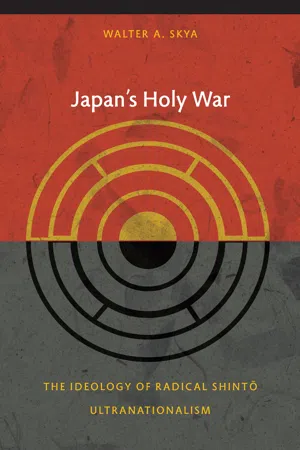
Japan's Holy War
The Ideology of Radical Shinto Ultranationalism
- 401 pages
- English
- PDF
- Available on iOS & Android
eBook - PDF
Japan's Holy War
The Ideology of Radical Shinto Ultranationalism
About this book
Japan's Holy War reveals how a radical religious ideology drove the Japanese to imperial expansion and global war. Bringing to light a wealth of new information, Walter A. Skya demonstrates that whatever other motives the Japanese had for waging war in Asia and the Pacific, for many the war was the fulfillment of a religious mandate. In the early twentieth century, a fervent nationalism developed within State Shint?. This ultranationalism gained widespread military and public support and led to rampant terrorism; between 1921 and 1936 three serving and two former prime ministers were assassinated. Shint? ultranationalist societies fomented a discourse calling for the abolition of parliamentary government and unlimited Japanese expansion.
Information
Publisher
Duke University Press BooksYear
2009Print ISBN
9780822344230
9780822344254
eBook ISBN
9780822392460
Table of contents
- Contents
- Acknowledgments
- Introduction
- I. Emperor Ideology and the Debate over State and Sovereignty in the Late Meiji Period
- II. Emperor Ideology and the Debate over State and Sovereignty in the Taishō Period
- III. Radical Shintō Ultranationalism and Its Triumph in the Early Shōwa Period
- Conclusion
- Notes
- Select Bibliography
- Index
Trusted by 375,005 students
Access to over 1.5 million titles for a fair monthly price.
Study more efficiently using our study tools.
Frequently asked questions
Yes, you can cancel anytime from the Subscription tab in your account settings on the Perlego website. Your subscription will stay active until the end of your current billing period. Learn how to cancel your subscription
No, books cannot be downloaded as external files, such as PDFs, for use outside of Perlego. However, you can download books within the Perlego app for offline reading on mobile or tablet. Learn how to download books offline
Perlego offers two plans: Essential and Complete
- Essential is ideal for learners and professionals who enjoy exploring a wide range of subjects. Access the Essential Library with 800,000+ trusted titles and best-sellers across business, personal growth, and the humanities. Includes unlimited reading time and Standard Read Aloud voice.
- Complete: Perfect for advanced learners and researchers needing full, unrestricted access. Unlock 1.5M+ books across hundreds of subjects, including academic and specialized titles. The Complete Plan also includes advanced features like Premium Read Aloud and Research Assistant.
We are an online textbook subscription service, where you can get access to an entire online library for less than the price of a single book per month. With over 1.5 million books across 990+ topics, we’ve got you covered! Learn about our mission
Look out for the read-aloud symbol on your next book to see if you can listen to it. The read-aloud tool reads text aloud for you, highlighting the text as it is being read. You can pause it, speed it up and slow it down. Learn more about Read Aloud
Yes! You can use the Perlego app on both iOS and Android devices to read anytime, anywhere — even offline. Perfect for commutes or when you’re on the go.
Please note we cannot support devices running on iOS 13 and Android 7 or earlier. Learn more about using the app
Please note we cannot support devices running on iOS 13 and Android 7 or earlier. Learn more about using the app
Yes, you can access Japan's Holy War by Walter Skya, Rey Chow, Harry Harootunian, Masao Miyoshi, Rey Chow,Harry Harootunian,Masao Miyoshi in PDF and/or ePUB format, as well as other popular books in History & 20th Century History. We have over 1.5 million books available in our catalogue for you to explore.