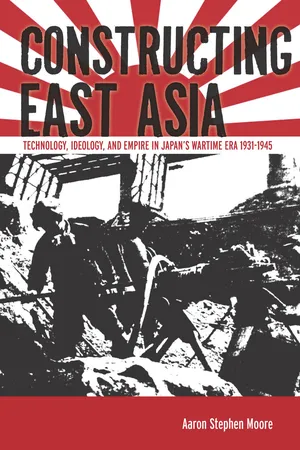
The conventional understanding of Japanese wartime ideology has for years been summed up by just a few words: anti-modern, spiritualist, and irrational. Yet such a cut-and-dried picture is not at all reflective of the principles that guided national policy from 1931–1945. Challenging the status quo, Constructing East Asia examines how Japanese intellectuals, bureaucrats, and engineers used technology as a system of power and mobilization—what historian Aaron Moore terms a "technological imaginary"—to rally people in Japan and its expanding empire. By analyzing how these different actors defined technology in public discourse, national policies, and large-scale infrastructure projects, Moore reveals wartime elites as far more calculated in thought and action than previous scholarship allows. Moreover, Moore positions the wartime origins of technology deployment as an essential part of the country's national policy and identity, upending another predominant narrative—namely, that technology did not play a modernizing role in Japan until the "economic miracle" of the postwar years.
eBook - ePub
Constructing East Asia
Technology, Ideology, and Empire in Japan’s Wartime Era, 1931-1945
- 328 pages
- English
- ePUB (mobile friendly)
- Available on iOS & Android
eBook - ePub
Constructing East Asia
Technology, Ideology, and Empire in Japan’s Wartime Era, 1931-1945
About this book
Information
Publisher
Stanford University PressYear
2013Print ISBN
9780804797245
9780804785396
eBook ISBN
9780804786690
Table of contents
- Cover
- Copyright
- Title Page
- Dedication
- Contents
- List of Figures
- Acknowledgments
- Introduction: The Technological Imaginary of Imperial Japan
- 1. Revolutionary Technologies of Life
- 2. Technologies of Asian Development
- 3. Constructing the Continent
- 4. Damming the Empire
- 5. Designing the Social Mechanism
- Epilogue: Legacies of Techno-Fascism and Techno-Imperialism in Postwar Japan
- Reference Matter
- Notes
- Works Cited
- Index
Trusted by 375,005 students
Access to over 1.5 million titles for a fair monthly price.
Study more efficiently using our study tools.
Frequently asked questions
Yes, you can cancel anytime from the Subscription tab in your account settings on the Perlego website. Your subscription will stay active until the end of your current billing period. Learn how to cancel your subscription
No, books cannot be downloaded as external files, such as PDFs, for use outside of Perlego. However, you can download books within the Perlego app for offline reading on mobile or tablet. Learn how to download books offline
Perlego offers two plans: Essential and Complete
- Essential is ideal for learners and professionals who enjoy exploring a wide range of subjects. Access the Essential Library with 800,000+ trusted titles and best-sellers across business, personal growth, and the humanities. Includes unlimited reading time and Standard Read Aloud voice.
- Complete: Perfect for advanced learners and researchers needing full, unrestricted access. Unlock 1.5M+ books across hundreds of subjects, including academic and specialized titles. The Complete Plan also includes advanced features like Premium Read Aloud and Research Assistant.
We are an online textbook subscription service, where you can get access to an entire online library for less than the price of a single book per month. With over 1.5 million books across 990+ topics, we’ve got you covered! Learn about our mission
Look out for the read-aloud symbol on your next book to see if you can listen to it. The read-aloud tool reads text aloud for you, highlighting the text as it is being read. You can pause it, speed it up and slow it down. Learn more about Read Aloud
Yes! You can use the Perlego app on both iOS and Android devices to read anytime, anywhere — even offline. Perfect for commutes or when you’re on the go.
Please note we cannot support devices running on iOS 13 and Android 7 or earlier. Learn more about using the app
Please note we cannot support devices running on iOS 13 and Android 7 or earlier. Learn more about using the app
Yes, you can access Constructing East Asia by Aaron Stephen Moore in PDF and/or ePUB format, as well as other popular books in Geschichte & Geschichte des 20. Jahrhunderts. We have over 1.5 million books available in our catalogue for you to explore.