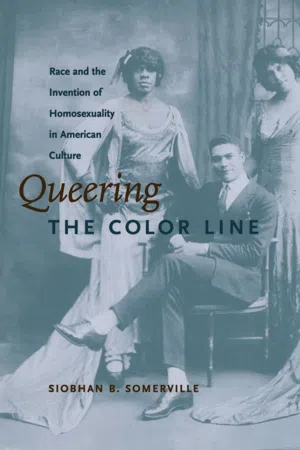
eBook - PDF
Queering the Color Line
Race and the Invention of Homosexuality in American Culture
- English
- PDF
- Available on iOS & Android
eBook - PDF
Queering the Color Line
Race and the Invention of Homosexuality in American Culture
About this book
Queering the Color Line transforms previous understandings of how homosexuality was "invented" as a category of identity in the United States beginning in the late nineteenth century. Analyzing a range of sources, including sexology texts, early cinema, and African American literature, Siobhan B. Somerville argues that the emerging understanding of homosexuality depended on the context of the black/white "color line," the dominant system of racial distinction during this period. This book thus critiques and revises tendencies to treat race and sexuality as unrelated categories of analysis, showing instead that race has historically been central to the cultural production of homosexuality.
At about the same time that the 1896 Supreme Court Plessy v. Ferguson decision hardened the racialized boundary between black and white, prominent trials were drawing the public's attention to emerging categories of sexual identity. Somerville argues that these concurrent developments were not merely parallel but in fact inextricably interrelated and that the discourses of racial and sexual "deviance" were used to reinforce each other's terms. She provides original readings of such texts as Havelock Ellis's late nineteenth-century work on "sexual inversion," the 1914 film A Florida Enchantment, the novels of Pauline E. Hopkins, James Weldon Johnson's Autobiography of an Ex-Coloured Man, and Jean Toomer's fiction and autobiographical writings, including Cane. Through her analyses of these texts and her archival research, Somerville contributes to the growing body of scholarship that focuses on discovering the intersections of gender, race, and sexuality.
Queering the Color Line will have broad appeal across disciplines including African American studies, gay and lesbian studies, literary criticism, cultural studies, cinema studies, and gender studies.
At about the same time that the 1896 Supreme Court Plessy v. Ferguson decision hardened the racialized boundary between black and white, prominent trials were drawing the public's attention to emerging categories of sexual identity. Somerville argues that these concurrent developments were not merely parallel but in fact inextricably interrelated and that the discourses of racial and sexual "deviance" were used to reinforce each other's terms. She provides original readings of such texts as Havelock Ellis's late nineteenth-century work on "sexual inversion," the 1914 film A Florida Enchantment, the novels of Pauline E. Hopkins, James Weldon Johnson's Autobiography of an Ex-Coloured Man, and Jean Toomer's fiction and autobiographical writings, including Cane. Through her analyses of these texts and her archival research, Somerville contributes to the growing body of scholarship that focuses on discovering the intersections of gender, race, and sexuality.
Queering the Color Line will have broad appeal across disciplines including African American studies, gay and lesbian studies, literary criticism, cultural studies, cinema studies, and gender studies.
Frequently asked questions
Yes, you can cancel anytime from the Subscription tab in your account settings on the Perlego website. Your subscription will stay active until the end of your current billing period. Learn how to cancel your subscription.
No, books cannot be downloaded as external files, such as PDFs, for use outside of Perlego. However, you can download books within the Perlego app for offline reading on mobile or tablet. Learn more here.
Perlego offers two plans: Essential and Complete
- Essential is ideal for learners and professionals who enjoy exploring a wide range of subjects. Access the Essential Library with 800,000+ trusted titles and best-sellers across business, personal growth, and the humanities. Includes unlimited reading time and Standard Read Aloud voice.
- Complete: Perfect for advanced learners and researchers needing full, unrestricted access. Unlock 1.4M+ books across hundreds of subjects, including academic and specialized titles. The Complete Plan also includes advanced features like Premium Read Aloud and Research Assistant.
We are an online textbook subscription service, where you can get access to an entire online library for less than the price of a single book per month. With over 1 million books across 1000+ topics, we’ve got you covered! Learn more here.
Look out for the read-aloud symbol on your next book to see if you can listen to it. The read-aloud tool reads text aloud for you, highlighting the text as it is being read. You can pause it, speed it up and slow it down. Learn more here.
Yes! You can use the Perlego app on both iOS or Android devices to read anytime, anywhere — even offline. Perfect for commutes or when you’re on the go.
Please note we cannot support devices running on iOS 13 and Android 7 or earlier. Learn more about using the app.
Yes, you can access Queering the Color Line by Siobhan B. Somerville in PDF and/or ePUB format, as well as other popular books in Social Sciences & Human Sexuality in Psychology. We have over one million books available in our catalogue for you to explore.
Information
Publisher
Duke University Press BooksYear
2000Print ISBN
9780822324430, 9780822324072eBook ISBN
9780822378761Table of contents
- Contents
- Acknowledgments
- Introduction
- 1. Scientific Racism and the Invention of the Homosexual Body
- 2. The Queer Career of Jim Crow: Racial and Sexual Transformation in Early Cinema
- 3. Inverting the Tragic Mulatta Tradition: Race and Homosexuality in Pauline E. Hopkins's Fiction
- 4. Double Lives on the Color Line: "Perverse" Desire in The Autobiography if an Ex-Coloured Man
- 5. "Queer to Myself As I Am to You": Jean Toomer, Racial Disidentification, and Queer Reading
- Conclusion
- Appendix
- Notes
- Bibliography
- Index