Between 1877 and 1930 — years rife with tensions over citizenship, suffrage, immigration, and “the Negro problem” — African American activists promoted an array of strategies for progress and power built around “racial destiny,” the idea that black Americans formed a collective whose future existence would be determined by the actions of its members. In Righteous Propagation, Michele Mitchell examines the reproductive implications of racial destiny, demonstrating how it forcefully linked particular visions of gender, conduct, and sexuality to collective well-being.
Mitchell argues that while African Americans did not agree on specific ways to bolster their collective prospects, ideas about racial destiny and progress generally shifted from outward-looking remedies such as emigration to inward-focused debates about intraracial relationships, thereby politicizing the most private aspects of black life and spurring race activists to calcify gender roles, monitor intraracial sexual practices, and promote moral purity. Examining the ideas of well-known elite reformers such as Mary Church Terrell and W. E. B. DuBois, as well as unknown members of the working and aspiring classes, such as James Dubose and Josie Briggs Hall, Mitchell reinterprets black protest and politics and recasts the way we think about black sexuality and progress after Reconstruction.
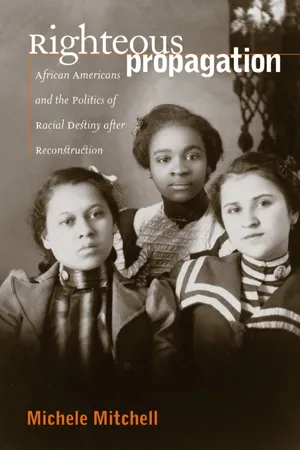
eBook - ePub
Righteous Propagation
African Americans and the Politics of Racial Destiny after Reconstruction
- 416 pages
- English
- ePUB (mobile friendly)
- Available on iOS & Android
eBook - ePub
Righteous Propagation
African Americans and the Politics of Racial Destiny after Reconstruction
About this book
Information
1
A GREAT, GRAND, & ALL IMPORTANT QUESTION AFRICAN AMERICAN EMIGRATION TO LIBERIA
God is just and with his own hand,
He will shape our destiny;
If our future be in this land,
Or in that beyond the sea.
He will shape our destiny;
If our future be in this land,
Or in that beyond the sea.
—A History of the Club Movement
Among the Colored Women of the
United States of America (1902)
Among the Colored Women of the
United States of America (1902)
Emigrationism became increasingly popular as a strategy for collective advancement once the demise of Reconstruction signaled a certain death of federal efforts to protect black civil rights. Diminution of interventionist tactics to integrate African Americans into the national polity facilitated reconciliation between North and South, which was further enabled by the relatively new discourse of social Darwinism. Social Darwinism suggested that a “natural” biological hierarchy made it difficult, if not impossible, for different races to inhabit the same territory as equal beings since the manly, competitive Anglo-Saxon was bound, in theory, to dominate weaker colored races. The supposed failure of Reconstruction substantiated social Darwinist claims that, by fiat of biology, black people were incapable of reaching the same heights of civilization as “Anglo-Saxon,” “Alpine,” and “Nordic” peoples.1
The United States endured severe, recurring economic depressions and successive labor strikes throughout this era of political backlash and racialist theory. As the chasm between rich and poor widened, as tensions between working and owning classes erupted into outright warfare on occasion, most black Americans remained in impoverished surroundings little better than those of their enslaved ancestors. African American women, men, and children simply refused to accept their immiseration, however. In addition to building an array of “uplift” institutions between 1877 and 1900, black people used various forms of migration to seek opportunity and avoid, if only temporarily, what appeared to be unrelenting persecution. From “Exodusters” who tramped toward Kansas during the late 1870s to people who left rural backwaters for towns, from workers who ventured north for better jobs to sharecroppers who pushed westward in search of land they could call their own, African American people associated freedom with territory. Even when black women and men merely fantasized that New Mexico, Texas, and Oklahoma would one day become all-black states, the seductive connection between territory and freedom fostered hope that there was a place, somewhere, where the race would face less hostility, exploitation, and turmoil.
Whether their destination was Pennsylvania, Arkansas, or California, many late-nineteenth-century African Americans shared the opinion of James Dubose of Orchard Knob, Tennessee—they simply could not remain below the Mason-Dixon line. “How much lonnger are we to be left hear to suffer and dy[?],” Dubose wondered with dolorous yet righteous overtones. “I wish to God that there was a Law passed in the United States to day that would compell Every collord man to leave the Southern States as it would bee all for the better for boath Whyte and Black. We never can live in peace ... with the whytes.” Black people, Dubose contended, needed to squeeze from under the heels of whites and “go to them Selves” by crossing the ocean to Liberia.2 In 1891, two years after Dubose uttered his desire for collective liberation, Thomas Cox expressed his own belief that Liberia presented the greatest freedom for black Americans. “We the Anglo-African race . . . are constantl[y] wandering from one territory to another to breath a few breaths of liberity,” Cox wrote. “The Negroes of the South wan[t] to emigrate to a land of liberity and peace. . . . I myself have heard Thousands say if they knew How to get to Liberia they would go immediately.”3
The “thousands” of black Americans willing to contemplate leaving the United States were, in a sense, part of a massive, international demographic shift that began during the late nineteenth century. Economic downturns, religious persecution, and ethnic strife induced a variety of Europeans to leave their native countries, while the availability of jobs abroad encouraged Chinese, Japanese, Korean, and Filipino workers to sail for Hawaii and the western coast of the United States. Immigrants from Asia and Europe alike were propelled by powerful, interconnected forces active during the 1870s, 1880s, and 1890s: “the movement of workers, capital, and technology across national borders.” Score upon score of dislocated workers, many of whom worked the land, left their native countries with hopes of obtaining property or finding work that paid a living wage. By the early twentieth century, an “enormous intercontinental population movement” resulted in “settler” societies throughout the Americas, Australia, and Africa.4
The willingness of certain black Americans to uproot themselves and begin anew on another continent corresponded with broader global patterns in that African American emigrants’ hunger for autonomy was similar to the thirst for opportunity felt by Asian and European immigrants to the United States. Still, given that African Americans were making the transition from chattel slavery to free labor during the late nineteenth century, emigration to Liberia was a relatively unique phenomenon, if not a delayed reverse migration of a people rented by the Atlantic slave trade generations earlier. Even the mere desire to emigrate on the part of people unable to leave the United States due to poverty, misfortune, or timing called matters of race and citizenship into question.
Working-poor people—tenant farmers, domestics, washerwomen, day laborers—viewed Liberia as a place where they could improve their prospects and feel the self-possessed satisfaction of uncontested citizenship. Men and women with education or training craved upward mobility as they harbored hopes that their hard-won skills would blaze the path of progress. Teachers, doctors, preachers, and missionaries were similarly motivated by longings for personal and collective development; many of these race men and women believed Liberia a propitious site for civilizing missions. Whatever their occupation or educational attainment, the emigration-minded were frequently influenced by ongoing racial antipathy and conflict; as early as 1878, lynching, election violence, harsh conditions, and rank discrimination generated prospective emigrants in state after state.5 Emigrationists wanted to inhabit land where the integrity of their manhood and womanhood would no longer be assailed on a daily basis; they wanted their children to flourish in an environment free from racial and sexual terrorism.6 These desires hardly disappeared by the end of the century. As James Harris of St. Louis, Missouri, confessed in 1894, “we are starving . . . lynched worse than cattle and we have not any protection of the law whatever. . . . We would do better if we were all in Africa.”7
Prospective emigrants embraced politicized concepts as well. When Thomas Fields wrote to the American Colonization Society from Texas in 1883, he simultaneously expressed his “zeal . . . for Africa” and noted his appreciation for lectures by a prominent ACS associate, the Afro-Caribbean intellectual Edward Wilmot Blyden. W. H. Holloway of Cleveland County, Arkansas, harbored nationalist sentiments similar to those expressed by African Methodist Episcopal (AME) bishop Henry McNeal Turner. As Holloway divulged in 1891, “I appreciate the land of my Mother and Father and [am] a Race lover of the deepest strain. . . . [I] want to inhabit a free and independent country where Ethiopia can stretch forth her hands unto God and be a mighty nation. . . . My people here . . . are tired and cannot stand the oppression . . . of the high-handed Southern white man.” Seven years later, a man from Oklahoma Territory named James McHenry believed that “America negroes” lagged behind other people because the race had no nation to declare, embrace, defend. For McHenry, peoplehood was synonymous with nationhood; “becom[ing] a people” required concerted, collective effort to build up “our own . . . Little Republic of Liberia.” Black nationalism might not have informed everyone interested in emigration, yet as the sentiments of Cox, Holloway, and McHenry attest, it could wield considerable influence.8 Put another way, if yearnings for peoplehood on the part of emigration-minded African Americans emerged out of longings to secure a positive destiny for the race, some individuals expressed those longings in race-based, nationalistic terms.
In rhetoric as well as strategy, incipient forms of black nationalist thought informed sizable grassroots movements such as South Carolina’s Liberian Exodus Association. Even small independent clubs where like-minded individuals primarily exchanged ideas and shared dreams were founded out of impulses to preserve African Americans as a people. Individual women and men not belonging to clubs often invoked race pride in order to plead their case to the American Colonization Society. Those women and men that wrote to the society were likely, and perhaps acutely, aware of its problematic legacy as far as African Americans were concerned; they requested information, passage, and support from ACS agents nonetheless.
If black Americans’ decisions regarding emigration involved a variety of factors, emigrationist sentiment contained gendered and sexualized aspects. Some African Americans and Americo-Liberians even viewed Africa as a haven where black men could at long last express, flaunt, and flex their manhood. Emigrationist thought offered somewhat less overt pronouncements about womanhood, yet it still incorporated apprehensions regarding women’s sexuality. Emigrationism did not challenge gender norms and sexual behaviors promoted by the aspiring class and elite, but convictions—some of which were gendered—about African Americans’ right to claim U.S. citizenship generally left leading race women and men chilly toward emigration during the 1880s and 1890s.9
Elite and “representative colored men” tended—as a group—to be firm antiemigrationists while those most likely to contemplate emigration were aspiring-class, working-class, and working-poor black Americans.10 Emigration was hardly a last-ditch strategy of the downtrodden, however. As part of a complicated nexus of migratory impulses and contemporary anxieties, emigration suggestively connected two paramount issues—collective survival and national identity. As Alabama minister J. P. Barton put it, “the better class of the colored people” wanted to see their “fatherland” in order to make an informed choice between a new life in a frontier settlement and continued existence in a contentiously heterogeneous, postemancipation society. For an emigrationist such as Barton, the very act of investigating possibilities in Liberia made a woman or man particularly enterprising.11
In certain communities where emigrationist fervor took root, emigrationists could proclaim that the “better class” consisted of those individuals wanting to build a black nation on the northwest coast of Africa. Going to Liberia both entailed risk and demonstrated considerable pluck—an independent spirit that drove women and men to persevere in the face of illness, heartbreak, frustration, and misgivings. For those longing to go to Liberia, emigration was a means of resolving a deep-seated question about where African Americans could best work out their own destiny. Emigrationists’ desire to “settle this great, gran[d] and all important question” likely seemed a noble quest to end the misery of a people still in bondage decades after the official abolition of chattel slavery.12 By century’s end, however, emigrationist women, men, and children would find out what many pioneering members of the Liberia Exodus Association discovered during the late 1870s: emigration involved its share of peril as well as promise.
By the late nineteenth century when black women and men searched for possibilities and acted upon convictions, African Americans’ interest in—and debate over—settling outside the United States had existed for over three-quarters of a century. Paul Cuffe financed his own exploratory mission to West Africa from Boston in 1811 and then accompanied thirty-eight other African Americans to Sierra Leone in late 1815.13 Cuffe’s latter expedition would prove somewhat of an isolated effort: no other early-nineteenth-century independent black-conceived schemes sent emigrants to Sierra Leone, let alone Liberia. After Cuffe’s singular effort, however, emigration schemes began to encounter considerable resistance within free black communities. This was particularly the case during the 1830s when abolitionist fervor led many northern black women and men—including prominent race men such as James Forten, Absalom Jones, and Richard Allen—to equate emigration with racists’ desire to fortify slavery by colonizing free blacks outside of the United States.14 Moreover, as emigration and colonization were collapsed together by black abolitionists eager to make the point that free blacks should not estrange themselves from those who remained in bondage, Liberia seemed especially tainted by its association with the American Colonization Society.
Established in 1817, the American Colonization Society began as a benevolent cause that, whether its founders intended or not, at times functioned as a front for the interests of southern slaveholders. The ACS was opposed to slavery but was nonetheless at cross-purposes with mainstream abolition: the ACS considered free people of color a threat to national stability, and many of the “free” people the society sent to Liberia were manumitted with the expressed understanding that they would leave the United States. Founding members were imbued with a belief that colonization would spread Christianity among Africans, and some even hoped to establish an American empire in Africa. As a whole, colonizationists did not adhere to “crude negrophobia,” yet one of their major aims was to rid the nation of Negroes. If the ACS fell far short of this goal, the society did remove approximately 11,200 people of African descent from the United States between 1817 and 1866. And, whereas the society functioned in a reduced capacity after the Civil War, it still managed to provide free passage and rations to over 4,000 additional emigrants.15
Certain constants informed the guiding philosophy of the ACS over the course of the nineteenth century. To begin, the society never championed African American civil rights, and it retained a basic assumption about blacks’ capacity to become productive citizens. Some white colonizationists argued that African Americans were indeed U.S. citizens, and many contended racial prejudice was the largest stumbling block in the path of black collective progress.16 Colonizationists generally recognized that racism was “historical and cultural in its origins”—something created rather than innate—still the society envisioned a decidedly bleak future for people of African descent in the United States: citizenship was something that “God meant [negroes] should have, but which [they] cannot have here.”17 White colonizationists routinely expressed discomfort over the presence of black people in the United States, and that discomfort, in turn, infused the society with a palpable white nationalist sensibility. The ACS also constructed colonization as a resolutely “masculine endeavor,” one that would ostensibly enable black men to achieve manhood in Liberia as pioneers, heads of household, and political actors. Not only was colonization gendered male by the ACS, men dominated the very debate among African Americans over the legitimacy of colonization and Liberia—a debate that remained lively until the Civil War.18
Between 1820 and 1840, free blacks generally rejected both the American Colonization Society and emigration to Liberia, as emigrationists typically advocated black removal to Canada, Haiti, the North American West, Mexico, and the British West Indies.19 Liberia was more than controversial among black emigrationists—it was all but universally loathed. In 1832, for instance, an anonymous race woman from Philadelphia who advocated black emigration to Mexico was repulsed by the idea of supporting anything associated with the American Colonization Society. Whereas this Philadelphian did not share Maria Stewart’s sentiment that being impaled by a bayonet was preferable to either emigration or affiliation with the ACS, she did proclaim that “no one detests [their cause of colonization] more than I do. I would not be taken to Africa, were the Society to make me queen of the country.”20 In many respects, each woman represented two prevalent free black attitudes toward colonization before 1850: complete rejection of emigration altogether or conditional support of emigration to any lo...
Table of contents
- Table of Contents
- Title Page
- Copyright Page
- Dedication
- Acknowledgements
- NOTE ON USAGE & TERMINOLOGY
- Righteous PROPAGATION
- PROLOGUE: TO BETTER OUR CONDITION ONE WAY OR ANOTHER
- 1 - A GREAT, GRAND, & ALL IMPORTANT QUESTION AFRICAN AMERICAN EMIGRATION TO LIBERIA
- 2 - THE BLACK MAN’S BURDEN IMPERIALISM AND RACIAL MANHOOD
- 3 - THE STRONGEST, MOST INTIMATE HOPE OF THE RACE SEXUALITY, REPRODUCTION, AND ...
- 4 - THE RIGHTEOUS PROPAGATION OF THE NATION CONDUCT, CONFLICT, AND SEXUALITY
- 5 - MAKING THE HOME LIFE MEASURE UP ENVIRONMENT, CLASS, AND THE HEALTHY RACE HOUSEHOLD
- 6 - THE COLORED DOLL IS A LIVE ONE! MATERIAL CULTURE, BLACK CONSCIOUSNESS, AND ...
- 7 - A BURDEN OF RESPONSIBILITY GENDER, “MISCEGENATION,” AND RACE TYPE
- 8 - WHAT A PURE, HEALTHY, UNIFIED RACE CAN ACCOMPLISH COLLECTIVE REPRODUCTION ...
- EPILOGUE
- NOTES
- BIBLIOGRAPHY
Trusted by 375,005 students
Access to over 1.5 million titles for a fair monthly price.
Study more efficiently using our study tools.
Frequently asked questions
Yes, you can cancel anytime from the Subscription tab in your account settings on the Perlego website. Your subscription will stay active until the end of your current billing period. Learn how to cancel your subscription
No, books cannot be downloaded as external files, such as PDFs, for use outside of Perlego. However, you can download books within the Perlego app for offline reading on mobile or tablet. Learn how to download books offline
Perlego offers two plans: Essential and Complete
- Essential is ideal for learners and professionals who enjoy exploring a wide range of subjects. Access the Essential Library with 800,000+ trusted titles and best-sellers across business, personal growth, and the humanities. Includes unlimited reading time and Standard Read Aloud voice.
- Complete: Perfect for advanced learners and researchers needing full, unrestricted access. Unlock 1.5M+ books across hundreds of subjects, including academic and specialized titles. The Complete Plan also includes advanced features like Premium Read Aloud and Research Assistant.
We are an online textbook subscription service, where you can get access to an entire online library for less than the price of a single book per month. With over 1.5 million books across 990+ topics, we’ve got you covered! Learn about our mission
Look out for the read-aloud symbol on your next book to see if you can listen to it. The read-aloud tool reads text aloud for you, highlighting the text as it is being read. You can pause it, speed it up and slow it down. Learn more about Read Aloud
Yes! You can use the Perlego app on both iOS and Android devices to read anytime, anywhere — even offline. Perfect for commutes or when you’re on the go.
Please note we cannot support devices running on iOS 13 and Android 7 or earlier. Learn more about using the app
Please note we cannot support devices running on iOS 13 and Android 7 or earlier. Learn more about using the app
Yes, you can access Righteous Propagation by Michele Mitchell in PDF and/or ePUB format, as well as other popular books in Social Sciences & North American History. We have over 1.5 million books available in our catalogue for you to explore.