Implemented in the 1970s at the point of the bayonet and in the shadow of the torture chamber, the neoliberal policies of Augusto Pinochet's dictatorship reversed many of the gains in wages, benefits, and working conditions that Chile's workers had won during decades of struggle and triggered a severe economic crisis. Later refined and softened, Pinochet's neoliberal model began, finally, to promote economic growth in the mid-1980s, and it was maintained by the center-left governments that followed the restoration of democracy in 1990. Yet, despite significant increases in worker productivity, real wages stagnated, the expected restoration of labor rights faltered, and gaps in income distribution continued to widen. To shed light on this history and these ongoing problems, the contributors look at industries long part of the Chilean economy—including textiles and copper—and industries that have expanded more recently—including fishing, forestry, and agriculture. They not only show how neoliberalism has affected Chile's labor force in general but also how it has damaged the environment and imposed special burdens on women. Painting a sobering picture of the two Chiles—one increasingly rich, the other still mired in poverty—these essays suggest that the Chilean miracle may not be as miraculous as it seems.
Contributors.
Paul Drake
Volker Frank
Thomas Klubock
Rachel Schurman
Joel Stillerman
Heidi Tinsman
Peter Winn
eBook - PDF
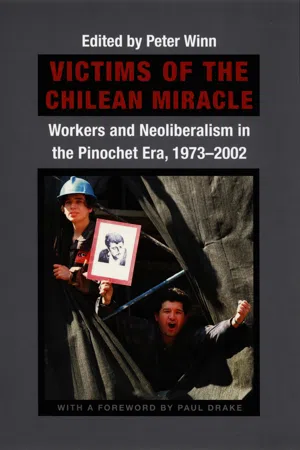
Victims of the Chilean Miracle
Workers and Neoliberalism in the Pinochet Era, 1973–2002
- 443 pages
- English
- PDF
- Available on iOS & Android
eBook - PDF
About this book
Chile was the first major Latin American nation to carry out a complete neoliberal transformation. Its policies—encouraging foreign investment, privatizing public sector companies and services, lowering trade barriers, reducing the size of the state, and embracing the market as a regulator of both the economy and society—produced an economic boom that some have hailed as a "miracle" to be emulated by other Latin American countries. But how have Chile's millions of workers, whose hard labor and long hours have made the miracle possible, fared under this program? Through empirically grounded historical case studies, this volume examines the human underside of the Chilean economy over the past three decades, delineating the harsh inequities that persist in spite of growth, low inflation, and some decrease in poverty and unemployment.
Information
Publisher
Duke University Press BooksYear
2004Print ISBN
9780822333210
9780822333098
eBook ISBN
9780822385851
Table of contents
- Contents
- Paul W. Drake / Foreword
- Acknowledgments
- Peter Winn / Introduction
- Peter Winn / The Pinochet Era
- Volker Frank / Politics without Policy: The Failure of Social Concertation in Democratic Chile, 1990–2000
- Peter Winn / ‘‘No Miracle for Us’’: The Textile Industry in the Pinochet Era, 1973–1998
- Joel Stillerman / Disciplined Workers and Avid Consumers: Neoliberal Policy and the Transformation of Work and Identity among Chilean Metalworkers
- Thomas Miller Klubock / Class, Community, and Neoliberalism in Chile: Copper Workers and the Labor Movement During the Military Dictatorship and the Restoration of Democracy
- Heidi Tinsman / More Than Victims: Women Agricultural Workers and Social Change in Rural Chile
- Rachel Schurman / Shuckers, Sorters, Headers, and Gutters: Labor in the Fisheries Sector
- Thomas Miller Klubock / Labor, Land, and Environmental Change in the Forestry Sector in Chile, 1973–1998
- Bibliography
- Contributors
- Index
Trusted by 375,005 students
Access to over 1.5 million titles for a fair monthly price.
Study more efficiently using our study tools.
Frequently asked questions
Yes, you can cancel anytime from the Subscription tab in your account settings on the Perlego website. Your subscription will stay active until the end of your current billing period. Learn how to cancel your subscription
No, books cannot be downloaded as external files, such as PDFs, for use outside of Perlego. However, you can download books within the Perlego app for offline reading on mobile or tablet. Learn how to download books offline
Perlego offers two plans: Essential and Complete
- Essential is ideal for learners and professionals who enjoy exploring a wide range of subjects. Access the Essential Library with 800,000+ trusted titles and best-sellers across business, personal growth, and the humanities. Includes unlimited reading time and Standard Read Aloud voice.
- Complete: Perfect for advanced learners and researchers needing full, unrestricted access. Unlock 1.5M+ books across hundreds of subjects, including academic and specialized titles. The Complete Plan also includes advanced features like Premium Read Aloud and Research Assistant.
We are an online textbook subscription service, where you can get access to an entire online library for less than the price of a single book per month. With over 1.5 million books across 990+ topics, we’ve got you covered! Learn about our mission
Look out for the read-aloud symbol on your next book to see if you can listen to it. The read-aloud tool reads text aloud for you, highlighting the text as it is being read. You can pause it, speed it up and slow it down. Learn more about Read Aloud
Yes! You can use the Perlego app on both iOS and Android devices to read anytime, anywhere — even offline. Perfect for commutes or when you’re on the go.
Please note we cannot support devices running on iOS 13 and Android 7 or earlier. Learn more about using the app
Please note we cannot support devices running on iOS 13 and Android 7 or earlier. Learn more about using the app
Yes, you can access Victims of the Chilean Miracle by Peter Winn in PDF and/or ePUB format, as well as other popular books in History & Latin American & Caribbean History. We have over 1.5 million books available in our catalogue for you to explore.