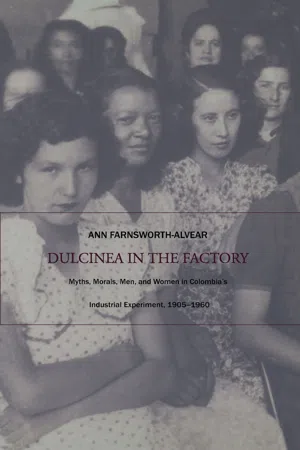
Dulcinea in the Factory
Myths, Morals, Men, and Women in Colombia’s Industrial Experiment, 1905–1960
- English
- PDF
- Available on iOS & Android
Dulcinea in the Factory
Myths, Morals, Men, and Women in Colombia’s Industrial Experiment, 1905–1960
About this book
Ann Farnsworth-Alvear's analyses of archived personnel records, internal factory correspondence, printed regulations, and company magazines are combined with illuminating interviews with retired workers to allow a detailed reconstruction of the world behind the mill gate. In a place where the distinction between virgins and nonvirgins organized the labor market for women, the distance between chaste and unchaste behavior underlay a moral code that shaped working women's self-perceptions. Farnsworth-Alvear challenges the reader to understand gender not as an opposition between female and male but rather as a normative field, marked by "proper" and "improper" ways of being female or male. Disputing the idea that the shift in the mills' workforce over several decades from mainly women to almost exclusively men was based solely on economic factors, the author shows how gender and class, as social practices, converged to shape industrial development itself.
Innovative in its creative employment of subtle and complex material, Dulcinea in the Factory addresses long-standing debates within labor history about proletarianization and work culture. This book's focus on Colombia will make it valuable to Latin Americanists, but it will also appeal to a wide readership beyond Latin American and labor studies, including historians and sociologists, as well as students of women's studies, social movements, and anthropology.
Frequently asked questions
- Essential is ideal for learners and professionals who enjoy exploring a wide range of subjects. Access the Essential Library with 800,000+ trusted titles and best-sellers across business, personal growth, and the humanities. Includes unlimited reading time and Standard Read Aloud voice.
- Complete: Perfect for advanced learners and researchers needing full, unrestricted access. Unlock 1.4M+ books across hundreds of subjects, including academic and specialized titles. The Complete Plan also includes advanced features like Premium Read Aloud and Research Assistant.
Please note we cannot support devices running on iOS 13 and Android 7 or earlier. Learn more about using the app.
Information
Table of contents
- CONTENTS
- List of Illustrations
- Preface
- Acknowledgments
- Introduction
- PART I. THE PLACE OF FEMALE FACTORY LABOR IN MEDELLÍN
- ONE. Medellín, 1900–1960
- TWO. The Making of La Mujer Obrera, 1910–20
- THREE. New Workers, New Workplaces, 1905–35
- PART II. THE MAKING AND UNMAKING OF LA MORAL
- FOUR. Strikes, 1935–36
- FIVE. Gender by the Rules: Anticommunism and La Moral, 1936–53
- SIX. La Moral in Practice, 1936–53
- SEVEN. Masculinization and El Control, 1953–60
- Conclusion
- Appendix: Persons Interviewed
- Notes
- Bibliography
- Index