Alongside the young rebel, the contemporary concept of identity emerged in the 1950s. It was in that decade that "identity" was first used to define collective selves in the politicized manner that is recognizable today: in terms such as "national identity" and "racial identity." Medovoi traces the rapid absorption of identity themes across many facets of postwar American culture, including beat literature, the young adult novel, the Hollywood teen film, early rock 'n' roll, black drama, and "bad girl" narratives. He demonstrates that youth culture especially began to exhibit telltale motifs of teen, racial, sexual, gender, and generational revolt that would burst into political prominence during the ensuing decades, bequeathing to the progressive wing of contemporary American political culture a potent but ambiguous legacy of identity politics.
- 399 pages
- English
- PDF
- Available on iOS & Android
eBook - PDF
About this book
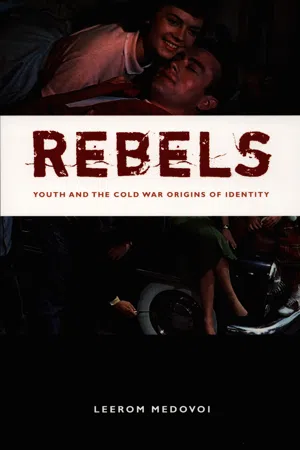
Holden Caulfield, the beat writers, Elvis Presley, Chuck Berry, and James Dean—these and other avatars of youthful rebellion were much more than entertainment. As Leerom Medovoi shows, they were often embraced and hotly debated at the dawn of the Cold War era because they stood for dissent and defiance at a time when the ideological production of the United States as leader of the "free world" required emancipatory figures who could represent America's geopolitical claims. Medovoi argues that the "bad boy" became a guarantor of the country's anti-authoritarian, democratic self-image: a kindred spirit to the freedom-seeking nations of the rapidly decolonizing third world and a counterpoint to the repressive conformity attributed to both the Soviet Union abroad and America's burgeoning suburbs at home.
Information
Publisher
Duke University Press BooksYear
2005Print ISBN
9780822336921
9780822336808
eBook ISBN
9780822387299
Table of contents
- CONTENTS
- Acknowledgments
- 1. Identitarian Thought and the Cold War World
- 2. Cold War Literature and the National Allegory: The Identity Canon of Holden Caulfield
- 3. Transcommodification: Rock ’n’ Roll and the Suburban Counterimaginary
- 4. Identity Hits the Screen: Teenpics and the Boying of Rebellion
- 5. Oedipus in Suburbia: Bad Boys and the Fordist Family Drama
- 6. Beat Fraternity and the Generation of Identity
- 7. Where the Girls Were: Figuring the Female Rebel
- Conclusion: The Rise and Fall of Identity
- Notes
- Works Cited
- Index
Trusted by 375,005 students
Access to over 1.5 million titles for a fair monthly price.
Study more efficiently using our study tools.
Frequently asked questions
Yes, you can cancel anytime from the Subscription tab in your account settings on the Perlego website. Your subscription will stay active until the end of your current billing period. Learn how to cancel your subscription
No, books cannot be downloaded as external files, such as PDFs, for use outside of Perlego. However, you can download books within the Perlego app for offline reading on mobile or tablet. Learn how to download books offline
Perlego offers two plans: Essential and Complete
- Essential is ideal for learners and professionals who enjoy exploring a wide range of subjects. Access the Essential Library with 800,000+ trusted titles and best-sellers across business, personal growth, and the humanities. Includes unlimited reading time and Standard Read Aloud voice.
- Complete: Perfect for advanced learners and researchers needing full, unrestricted access. Unlock 1.5M+ books across hundreds of subjects, including academic and specialized titles. The Complete Plan also includes advanced features like Premium Read Aloud and Research Assistant.
We are an online textbook subscription service, where you can get access to an entire online library for less than the price of a single book per month. With over 1.5 million books across 990+ topics, we’ve got you covered! Learn about our mission
Look out for the read-aloud symbol on your next book to see if you can listen to it. The read-aloud tool reads text aloud for you, highlighting the text as it is being read. You can pause it, speed it up and slow it down. Learn more about Read Aloud
Yes! You can use the Perlego app on both iOS and Android devices to read anytime, anywhere — even offline. Perfect for commutes or when you’re on the go.
Please note we cannot support devices running on iOS 13 and Android 7 or earlier. Learn more about using the app
Please note we cannot support devices running on iOS 13 and Android 7 or earlier. Learn more about using the app
Yes, you can access Rebels by Leerom Medovoi, Donald E. Pease in PDF and/or ePUB format, as well as other popular books in Literature & Literary Criticism Theory. We have over 1.5 million books available in our catalogue for you to explore.