What it was like and how it felt to be an Egyptian woman revolutionary during the eighteen days that changed Egypt forever
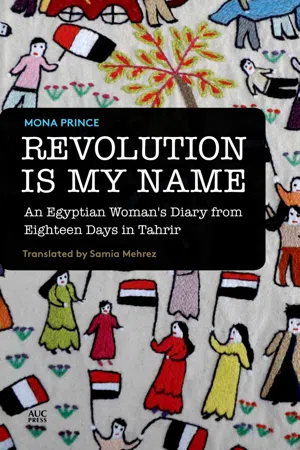
Mona Prince's humorous and insightful memoir tells of one woman's journey as a hesitant revolutionary through the eighteen days of the Egyptian uprising that toppled Hosni Mubarak in 2011.
Alongside the brutal violence of the security forces, the daily battles of resistance, and the author's own abduction and beating at the hands of the police, this is a story of exceptional solidarity, perseverance, and humanity. Juggling humor and horror, hope and fear, certitude and anxiety, Prince immerses us in the details of each unpredictable and fateful day. She mixes the political and the personal, the public and the private to expose and confront divisions within her family, as well as her own social prejudices, which she discovers through encounters with diverse sectors of society, from police conscripts to street children.
Revolution Is My Name is a testimony not only of women's participation in the Egyptian uprising and their courage in confronting constrictive gender divides at home and on the street, but equally of their important contribution as chroniclers of the momentous events of January and February 2011.
eBook - ePub
Revolution Is My Name
An Egyptian Woman's Diary from Eighteen Days in Tahrir
- English
- ePUB (mobile friendly)
- Available on iOS & Android
eBook - ePub
Revolution Is My Name
An Egyptian Woman's Diary from Eighteen Days in Tahrir
About this book
Information
1
Tuesday, January 25, 2011
I am not one of the hungry or the downtrodden, nor do I belong to a political party or a particular intellectual movement. I believe in freedom of expression, but I do not believe that demonstrations that end with violence and detentions are necessarily the solution. I do not have suggestions to change the status quo and I do not see a better or worse future on the horizon. I see a dead end.
I finished grading some of my students’ exam booklets that routinely cause me depression because of the mediocre quality of the answers as well as their low intellectual and linguistic levels. But, as one of our deans once told me, students should not be blocked at the university level for more than four years. So, they must succeed and graduate. In other words, I have to pass them no matter what. I kept leafing through the booklets, browsing through the answers, in search of one sentence that might make sense in order to justify the grades I was dishing out left and right. I felt bad because I knew that if I read their answers carefully, most of them would fail.
I looked at the clock; it was almost 1 p.m. According to posts on the “We Are All Khaled Said” Facebook page, the demonstrations would begin at 2 p.m that afternoon. I chose something casual and comfortable to wear and put on walking shoes fit for running, if necessary.
“Mama, I’m going to the demonstration in Shubra.”
“Since when do demonstrations take place in Shubra? Aren’t they always at the lawyers’ and journalists’ syndicates in Downtown?”
“Today, they are expected to be in all public squares in Egypt. The demonstrations in Downtown only draw some fifty or sixty people. They chant for two or three hours, they get surrounded by five thousand riot police conscripts, then they all get beaten up and some get detained. I want to go to Shubra to see what will happen there.”
“Okay. Don’t be late.”
“I’ll only be an hour. I have to come back and finish grading.”
“Okay. Take care.”
Dawaran Shubra
I had never been to Dawaran Shubra before. I called up one of my Christian friends who lived there to ask for directions. He helped me but advised me not to go. I insisted: “No, I’m going.”
I took the bus to Shubra. At Midan Ramsis, I noticed a large number of riot police vehicles. I asked the driver to let me know when we got to Dawaran Shubra.
“It’s the next stop.”
Another young woman behind me asked for the same stop. She got the same answer. I turned around and found a young, veiled woman behind me. She may have been a student or a recent graduate.
“Are you going to the demonstration?”
“Yes.”
“How did you find out about the demonstration?”
“There was an event posted on Facebook.”
“‘Event’? This is not a Mohamed Mounir concert you know. It’s a demonstration!”
“I know.”
We smiled at each other, and then I asked her, “Are you a member of a political party?”
“No,” she replied.
We got off the bus together and walked for a short while until we reached Shubra Street, the area’s main artery. A huge billboard in celebration of Police Day had been set up. We took a look around us; nothing looked like there would be a demonstration. A few police officers were standing at street corners; they kept looking at their watches. It was 1:45 p.m. Nearby a woman in her late forties stood alone on the sidewalk. She walked toward one of the officers and began talking to him. I overheard a few words like demonstrations, justice, dignity, and the high costs of living.
“It looks like this woman is here for the demonstration. Let’s go and stand with her instead of standing alone.”
“Are you here for the demonstration?”
“I have come all the way from Heliopolis behind my husband’s back to participate in this demonstration. I parked my car on a nearby street and walked here.”
I was a bit surprised, so I asked her, “But why do you want to demonstrate?”
“Because the situation in the country has become unbearable!”
The police officers overheard our conversation. They started laughing.
It was now exactly 2 p.m. The first group of demonstrators appeared on the scene. They may have arrived through one of the exits to the metro station across the street. There were around twenty people in the group. You couldn’t really call them “youth” since some were in their forties and fifties. They stood side by side with younger men and women. The chants were quite familiar—the same ones I used to hear at the demonstrations during the late eighties:
“People, people come and join us! Brothers and sisters, together, for all of us!”
“Freedom, freedom, come, embrace us! State Security stands between us!”
The older woman and the younger one thrust themselves in the middle of the group and started chanting fervently. I stood nearby and watched.
More groups emerged from the side streets carrying Egyptian flags and banners that read: “Say No to Poverty,” “I Want a Job, Big Man,” “You Have Stolen Our Daily Bread,” “Lentils Cost Ten per Kilo.” The riot police conscripts started surrounding the demonstrators and tried to separate them. However, the officers continued to make way for those who wanted to join the demonstration, opening up the area that the policemen had closed off. I moved closer to the center to take photos of the slogans and to better hear the lyrics of the chants:
“What does Mubarak want from us?
People to kiss his feet no less?
No, Mubarak we won’t bend!
The people will squash you in the end!”
One of the officers asked me sarcastically, pointing with one hand to the area that had been cordoned off and feeling my arm with the other, “Do you want to join them?”
I looked at him angrily and shouted, “Are you feeling me up?”
He quickly withdrew his hand.
“Okay, no problem. Please walk in.”
“I’m not going in,” I answered defiantly.
I stood at a safe distance, because I don’t like crowds and I don’t like shouting, nor do I like vulgar chants or the stench of the riot police who surrounded the demonstrators, pressing against them, so that they would remain on the sidewalk and not occupy the street.
In less than a few minutes, other groups of demonstrators began to appear. The riot police were somewhat at a loss. The different groups succeeded in joining each other; they were now in the hundreds. Some chanted:
“We either get a decent life! Or we will fall in strife!”
I liked the chant, so I started humming it to myself. The riot police closed off Shubra Street on both ends with roadblocks. More riot police began to arrive; they stood side by side, completely blocking the street. I turned around and noticed an officer looking at his watch in exasperation. I smiled at him and said jokingly, “It’s still early. We are just getting going.”
“But we’ve been here since this morning.”
“Sorry to hear that, but this is your job!”
When the police officer saw that I wasn’t joining the demonstrators, he said:
“So, do you support what’s happening?”
“I actually don’t like demonstrations, but are you happy with your life?”
“No, I’m not. But do you believe that this is the solution?”
“Maybe.”
The demonstrators and the riot police conscripts started chasing each other. The police blocked off both ends of the street, so the demonstrators ran to one end and then back again in the opposite direction. This went on for more than a quarter of an hour. Actually, the whole scene was quite funny, not just for me and others like me who were watching, but also for the riot police conscripts themselves, who were laughing despite their visible exhaustion. Maybe it was better to run and move around instead of standing still. I started to move with the crowds; not quite with them, but near them. They were in the middle of the street and I was on the side, near the sidewalk, listening to the protestors calling out to each other from amid the crowds:
“Ya Michael . . . . Ya Adel . . . . Ya Guirguis.”
I thought to myself: “Hmmm, the Christians are demonstrating too. Very good! They are on the street despite warnings a day before from all three churches.”
I was happy to see two elderly Christian ladies, wearing necklaces adorned with crosses, in the midst of the scurrying demonstrators. We were in Shubra where a high proportion of the population is Christian. Only a few steps away, I saw a large group of demonstrators marching our way. At a distance, I could see my Christian friend. I was delighted and ran toward him and hugged him.
“Where are you coming from?”
“We walked all the way from Tahrir.”
“You marched all that distance? And the riot police let you?”
“So far, they’ve been quite nice.”
“What news from Tahrir?”
“People are there in the thousands.”
“No way!”
We laughed as we marched along with the crowds.
I was happy that something was happening: I was happy that more than four thousand people from different social classes and different generations were demonstrating in a residential area like Shubra, and that Christians were also on the street. This, in and of itself, was an unprecedented accomplishment.
The tolerant and well-mannered phase of the demonstration quickly came to an end. The police officers had run out of patience. It was hardly 3:30 p.m. when violence erupted.
A group of demonstrators tried to march down Khulousi Street, but were attacked by riot police thugs. They dragged the demonstrators to the ground, beat them, and then arrested them. I took pictures as quickly as I could without a proper focus. One of the thugs saw me. He slammed my arm violently and the camera fell to the ground a few steps away from where I stood. I can’t claim that I pushed him away from me, because he was massive, but I think I may have raised my arm in his direction in an unsuccessful attempt to steer clear of his huge body, if only for a couple of seconds. I jumped to grab the camera. He pounced upon me. He hit me in the arm again, even more violently, and the camera fell to the ground again. One of the policemen picked it up and handed it to the “basha,” as they routinely referred to the higher ranks of the riot police. It went into one of his trouser pockets. I found myself face to face with a thirty-year-old man wearing civilian clothes and sunglasses.
“Give me the camera, please.”
“You won’t get it back.”
I put my hand inside his pocket and tried to take the camera. He grabbed my hand.
“Let go of my hand. Don’t touch me,” I shouted.
He let go of my hand.
“I repeat: I want the camera. Who are you to take my camera?”
One of the thugs intervened: “The basha is with the Secret Service.”
“Secret Service!” I retorted in visible disgust. “Big deal! I am a university professor. And there’s no reason why I should believe that he’s with the Secret Service. Show me your ID.”
The young basha ignored me. He walked toward the more senior basha and handed him the camera.
“You can go to the basha later and ask him for it.”
But before I could start walking toward the so-called basha, the riot police had already started rounding up a number of people and shoving them into small buses. I suddenly realized that the whole scene was being aired live on Al Jazeera. People started chanting and demanding th...
Table of contents
- Cover
- Half Title Page
- Title Page
- Copyright Page
- Dedication
- A Necessary Introduction
- 1
- 2
- 3
- 4
- 5
- 6
- 7
- 8
- 9
- 10
- 11
- 12
- 13
- 14
Trusted by 375,005 students
Access to over 1.5 million titles for a fair monthly price.
Study more efficiently using our study tools.
Frequently asked questions
Yes, you can cancel anytime from the Subscription tab in your account settings on the Perlego website. Your subscription will stay active until the end of your current billing period. Learn how to cancel your subscription
No, books cannot be downloaded as external files, such as PDFs, for use outside of Perlego. However, you can download books within the Perlego app for offline reading on mobile or tablet. Learn how to download books offline
Perlego offers two plans: Essential and Complete
- Essential is ideal for learners and professionals who enjoy exploring a wide range of subjects. Access the Essential Library with 800,000+ trusted titles and best-sellers across business, personal growth, and the humanities. Includes unlimited reading time and Standard Read Aloud voice.
- Complete: Perfect for advanced learners and researchers needing full, unrestricted access. Unlock 1.5M+ books across hundreds of subjects, including academic and specialized titles. The Complete Plan also includes advanced features like Premium Read Aloud and Research Assistant.
We are an online textbook subscription service, where you can get access to an entire online library for less than the price of a single book per month. With over 1.5 million books across 990+ topics, we’ve got you covered! Learn about our mission
Look out for the read-aloud symbol on your next book to see if you can listen to it. The read-aloud tool reads text aloud for you, highlighting the text as it is being read. You can pause it, speed it up and slow it down. Learn more about Read Aloud
Yes! You can use the Perlego app on both iOS and Android devices to read anytime, anywhere — even offline. Perfect for commutes or when you’re on the go.
Please note we cannot support devices running on iOS 13 and Android 7 or earlier. Learn more about using the app
Please note we cannot support devices running on iOS 13 and Android 7 or earlier. Learn more about using the app
Yes, you can access Revolution Is My Name by Mona Prince,Samia Mehrez, Samia Mehrez in PDF and/or ePUB format, as well as other popular books in Politics & International Relations & Political Biographies. We have over 1.5 million books available in our catalogue for you to explore.