This study highlights the connections between power, cultural products, resistance, and the artistic strategies through which that resistance is voiced in the Middle East. Exploring cultural displays of dissent in the form of literary works, films, and music, the collection uses the concept of 'cultural resistance' to describe the way culture and cultural creations are used to resist or even change the dominant political, social, economic, and cultural discourses and structures either consciously or unconsciously. The contributors do not claim that these cultural products constitute organized resistance movements, but rather that they reflect instances of defiance that stem from their peculiar contexts. If culture can be used to consolidate and perpetuate power relations in societies, it can also be used as the site of resistance to oppression in its various forms: gender, class, ethnicity, and sexuality, subverting existing dominant social and political hegemonies in the Middle East.
eBook - ePub
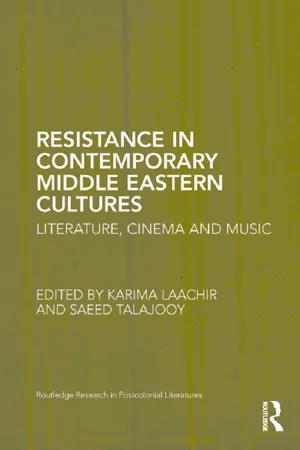
Resistance in Contemporary Middle Eastern Cultures
Literature, Cinema and Music
- 286 pages
- English
- ePUB (mobile friendly)
- Available on iOS & Android
eBook - ePub
Resistance in Contemporary Middle Eastern Cultures
Literature, Cinema and Music
About this book
Information
Part I
Literature and the Seeds of Dissent
1 Alaa Al-Aswany and the Desire for Revolution
“Al-sha’b yurīd isqāṭ al-niẓām” (The people want the downfall of the regime). This was the brave battle cry with which the Egyptian people brought down the corrupt, oppressive regime of Hosni Mubarak. Any reading of the extraordinary events that shook Egypt and the Arab world since 2011 must take stock of the central place of desire as an irruptive, revolutionary force that pervades the social, by turns producing and altering the real. In this chapter I will propose a reading of the work of Alaa Al-Aswany as a means of investigating the operation of desire as an unpredictable political force.1 Al-Aswany’s complex fictions return repeatedly to the nexus between the intimate and the public to underline the subversive character of the personal within the political: the world changes one relationship at a time. One constant in his complex urban fables is the use of desire as a means of opposing oppression, of throwing a spanner in the works of a brutal state apparatus.
Al-Aswany continues to publish scathing articles highly critical of the powers that be in Egypt, each of them closing with his trademark phrase, “Democracy is the solution”. This signature is a calque on one of the mottos of the Egyptian Brotherhood, “Islam is the solution”. Al-Aswany thus actively redirects the critical oppositional force of politics towards democracy. “Democracy is the solution” quickly became one of the rallying cries of the Egyptian revolution of 2011. What, however, does it mean to posit democracy as a desirable solution for Egypt’s ills? Adam Phillips has written eloquently on the relationship between democracy and desire. Through an incisive reading of Freud’s 1908 paper, “‘Civilised’ Sexual Morality and Modern Nervous Illness”, Phillips carefully tracks Freud’s claims regarding the antagonism between desire and culture. Freud argues against the belief that abstinence produces healthy individuals capable of furthering the species:
In general I have not gained the impression that sexual abstinence helps to bring about energetic and self-reliant men of action or original thinkers or bold emancipators and reformers. Far more often it goes to produce well-behaved weaklings who later become lost in the great mass of people that tends to follow, unwillingly, the leads given by strong individuals.2
This leads Phillips to speculate that it were as though “democracy is only for those who can bear their sexual aliveness”.3 Democracy depends on a desiring openness to unknown, and potentially unknowable, others. The idea of “sexual aliveness” can be linked to the ineffable, unpredictable and very messy nature of desire, which Phillips describes thus:
Desire, as a keyword, is indeed a queer species of prediction … predicting, as it does at its most glib, unpredictability, and, at its most ironic, predicting hope. In talking about desire, at least from a psychoanalytic point of view, we are talking about the genealogy, the provenance of hope; even when that hope is hoping for death. We are talking about the unpredictability of aliveness in the human subject.4
It will be seen that much of this description of desire is very much at stake in Al-Aswany’s novels.
This strong correlation between desire and unpredictability dissolves another. Following Freud and Lacan, Phillips emphasizes the epistemological unreliability of desire. Desire is neither demand nor need: the latter two can be formulated like contracts or exchange systems where everything is known and knowable. Desire, on the other hand, “asks us to mind the gap between our wanting and our knowing”.5 The dimensions of this gap are such that the notion of knowing exactly what one wants is reduced to perversion:
When I claim to know what I want—and I would claim this with inflexible rigour in what psychoanalysis would call a perverse state of mind; my so-called perversion is knowing exactly what I want and need; when I claim to know what I want I have already constituted an “I” that I recognize by its predictive talents, and by its familiar and looked-forward-to states of satisfaction; this “I” has a repertoire of relatively formulable wants, formulable in a medium deemed to be an effective tool for want-gratification.6
The axis of certainty and gratification leads away from, not towards, desire. The vector of desire, on the other hand, points towards fantasy and the unknown: “‘It’ comes from a wholly other outside and/or a wholly other inside; the so-called I is a middle man in a no man’s land”.7 These “wholly other” spaces between which desire moves are precisely the ones that feed its uncontrollable and, ultimately, unknowable character. This opposition between what is knowable and what is not, what is controllable and what is not, and what is desirable and what is not, returns repeatedly in Al-Aswany’s plots. Indeed one would not be far wrong in reading his novels as complex accounts of what occurs when those who insist on controlled, and controllable, desires encounter those who “mind the gap” between wanting and knowing.
Phillips’s linking of democracy to desire and hope recalls Derrida’s repeated pronouncements on the futurity of democracy. Derrida was relentless in reminding us that democracy is always “à venir”,8 always yet to come, which I read to mean that we can never be democratic enough, hopeful enough, alive enough, that even in ostensibly established democracies, the struggle for human rights always finds new obstacles and renewed calls for revolution. Democracy depends, therefore, on an openness to unknown others, undecidable and unknowable possibilities and outcomes: to use another Derridean phrase, an unconditional hospitality to the other, towards that which is coming, towards that which is “à venir” without condition.
Of all the institutions caught up in this vortex of future unknowns, literature is perhaps the most important. On this point, Derrida offers the typically all-encompassing maxim, “No democracy without literature; no literature without democracy”.9 Literature has the right to say everything, with the following results:
The possibility of literature, the legitimation that a society gives it, the allaying of suspicion or terror with regard to it, all that goes together—politically—with the unlimited right to ask any question, to suspect all dogmatism, to analyze every presupposition, even those of the ethics or politics of responsibility.10
Literature and democracy share a common fate and shared characteristics. Both make an appeal to universality—literature has the right to say everything, democracy the right to include everyone—and a consequent impossibility of certain prediction, or indeed of predictability.
Nor is this all. A further paradox in the secretive character of literature arises from the question of the responsibility of the author, or lack thereof. Literature, which has the right to say everything, is, in a fundamental sense, irresponsible: the author, according to Derrida, is stripped of all responsibility for what his characters say and do:
This non-response is more original and more secret than the modalities of power and duty because it is fundamentally heterogeneous to them. We find there a hyperbolic condition of democracy which seems to contradict a certain determined and historically delimited concept of such a democracy, a concept which links it to that of a subject that is calculable, accountable, imputable and responsible … This contradiction also indicates the task (task of thought, also theoretical-practical task) for any democracy to come.11
The author is one thing, the characters wholly another. The abyss dividing these two entities makes it impossible to impute a political responsibility to a given author for the behaviour of his or her characters. Moreover, as Derek Attridge points out, “It is not just that the literary author is allowed not to answer for his statements and his characters’ statements; it is that he cannot answer for them. A writer who attempts to justify what he has said in the literary mode is treating his work as something other than literature”.12
This bond between universality, unpredictability and unknowability resonates with Alaa Al-Aswany’s claims for a realist aesthetic that openly claims the right to say anything and everything. In his 2008 preface to his collection of stories, Nīrān Ṣadīqa (Friendly Fire), Al-Aswany relates the trouble he had in getting his work published in Egypt. Although his experience was by no means atypical, Al-Aswany’s response to the censors pleads for the operation of the undecidable at the heart of the supposedly transparent representation of reality. Having been taken to task for creating a character, Mahmoud Triple, who (justifiably) questions Mustafa Kamel’s statement, “If I were not Egyptian, I would have wanted to be Egyptian”, Al-Aswany was obliged to produce a statement declaring that he “disagrees” with his character and actually “respects” Mustafa Kamel.13 As Al-Aswany reports, this satisfied the censor in the case of Nīrān Ṣadīqa, but the whole process raises a number of questions about the nature of literature, democracy and censorship. What, after all, does it mean to say that an author disagrees with his character? Is this disagreement literal or literary? It would seem that, if anything, the joke is on the censor who cannot distinguish between art and reality, and is all too willing to be taken in by an author treating his work as something other than literature.
Now, this distinction is itself a key part of Al-Aswany’s preface to Nrnadqa. Taking his cue from the Italian impresario Dell’Astrologo, who advised early cinema audiences in Egypt (c. November 1896) that watching a film is no more than watching an image on a screen, Al-Aswany claims a similar position for his stories and novels:
This screen is no more than a piece of cloth on which pictures are projected … Shortly you will see a train moving rapidly. Remember, ladies and gentlemen, that this is merely an image of a train, and therefore there is no danger to you.14
Be that as it may, earlier in the same preface Al-Aswany had delineated the difference between literature and other forms of writing (specifically sociology) by arguing that the former depends on what he calls īhām: simulation, make-believe, the creation and manipulation of awhām or illusions.15 The impact of these illusions, however, is far from predictable or, arguably, desirable:
Consequently the confusion that occurs in the minds of some between the imaginary and the real [al-wāqi’] is an indicator of the artist’s skill; for he has succeeded in realizing īhām for the reader. In this case, however, īhām might be exaggerated, thereby mixing up image and reality [al-ḥaqīqa].16
It is precisely this sort of confusion between image and reality that got Al-Aswany into trouble with his audience. The mistake conflates particular characters with the universal reach of literary discourse. One confused reader, and a good friend of Al-Aswany’s, confused a particular Coptic character, namely the repugnant Malak in The Yacoubian Building, for all of Egypt’s Copts. This reader interpreted the presence of a character like Malak in the novel to be a statement by Al-Aswany on all of Egypt’s Copts. Other readers take the character of Shaymaa in Chicago—a young, veiled woman from rural Egypt who ends up going to Chicago to pursue her higher education, dating a fellow Egyptian, conceiving a child and havin...
Table of contents
- Cover
- Halftitle
- Title
- Copyright
- Contents
- List of Figures
- Introduction
- PART 1. Literature and the Seeds of Dissent
- PART 2. Cinema between Creativity and Censorship
- PART 3. Musical Interventions
- Contributors
- Index
Trusted by 375,005 students
Access to over 1.5 million titles for a fair monthly price.
Study more efficiently using our study tools.
Frequently asked questions
Yes, you can cancel anytime from the Subscription tab in your account settings on the Perlego website. Your subscription will stay active until the end of your current billing period. Learn how to cancel your subscription
No, books cannot be downloaded as external files, such as PDFs, for use outside of Perlego. However, you can download books within the Perlego app for offline reading on mobile or tablet. Learn how to download books offline
Perlego offers two plans: Essential and Complete
- Essential is ideal for learners and professionals who enjoy exploring a wide range of subjects. Access the Essential Library with 800,000+ trusted titles and best-sellers across business, personal growth, and the humanities. Includes unlimited reading time and Standard Read Aloud voice.
- Complete: Perfect for advanced learners and researchers needing full, unrestricted access. Unlock 1.5M+ books across hundreds of subjects, including academic and specialized titles. The Complete Plan also includes advanced features like Premium Read Aloud and Research Assistant.
We are an online textbook subscription service, where you can get access to an entire online library for less than the price of a single book per month. With over 1.5 million books across 990+ topics, we’ve got you covered! Learn about our mission
Look out for the read-aloud symbol on your next book to see if you can listen to it. The read-aloud tool reads text aloud for you, highlighting the text as it is being read. You can pause it, speed it up and slow it down. Learn more about Read Aloud
Yes! You can use the Perlego app on both iOS and Android devices to read anytime, anywhere — even offline. Perfect for commutes or when you’re on the go.
Please note we cannot support devices running on iOS 13 and Android 7 or earlier. Learn more about using the app
Please note we cannot support devices running on iOS 13 and Android 7 or earlier. Learn more about using the app
Yes, you can access Resistance in Contemporary Middle Eastern Cultures by Karima Laachir,Saeed Talajooy in PDF and/or ePUB format, as well as other popular books in Letteratura & Critica letteraria. We have over 1.5 million books available in our catalogue for you to explore.