Analyzes food and biological samples of phytosterols and discusses plant sterol analysis with respect to functional foods. Investigates the safety of phytosterols and phytosterol esters and associated health risks, including potential impact on cancer development and the lowering of cholesterol levels. Details the chemistry, occurrence, and biological effects of phytosterol oxides.
- 450 pages
- English
- ePUB (mobile friendly)
- Available on iOS & Android
eBook - ePub
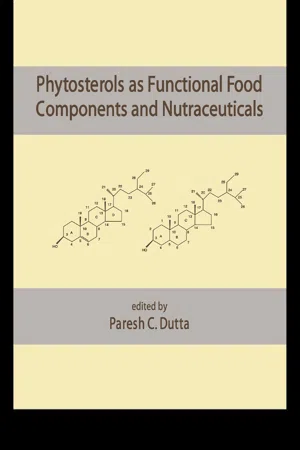
Phytosterols as Functional Food Components and Nutraceuticals
About this book
Information
1
Occurrence and Levels of Phytosterols in Foods
Vieno Piironen and Anna-Maija Lampi University of Helsinki, Helsinki, Finland
I. INTRODUCTION
Phytosterols are present in all plants and in foods containing plant-based raw materials. In normal diets vegetable oils and products based on them are generally acknowledged to be the richest sources of phytosterols (1,2). However, the significance of other foods, especially cereal products and vegetables, depends on dietary patterns. Some foods generally consumed only in low quantities but containing considerable amounts of sterols, such as nuts, may contribute significantly to the dietary phytosterol intakes of some individuals or population groups. On the other hand, food items with rather low levels of phytosterols but consumed as major food items may become significant sources.
When various foods are evaluated as phytosterol sources, the main interest is generally in the levels of individual sterols, particularly different desmethyl sterols such as sitosterol, campesterol, stigmasterol, avenasterols, and stanols, which comprise the majority of phytosterols in normal foods (2,3). More rarely, monomethyl and dimethyl sterols are also determined. In addition to the parent sterol composition, the distribution of the various steryl conjugates is also of interest. These conjugates, i.e., esters with fatty acids (SEs), esters with phenolic acids (SPHEs), glycosides (SGs), and acylated glycosides (ASGs), may have different chemical, technological, and nutritional properties. Cholesterol often accounts for 1–2% of the total sterols in plants and may comprise 5% or more in certain plant families, species, organs, or tissues (3). However, cholesterol levels of plants are not discussed further in this chapter.
The serum cholesterol-lowering effect of phytosterols, when consumed at levels of 1.5–2g/day, has led to great interest in phytosterol-enriched foods and their development. However, little is known about the effects of phytosterol intake from nonenriched foods. Phytosterols were suggested to be at least partially responsible for the differences in plasma cholesterol levels and synthesis observed when 16 normolipidemic subjects were given experimental diets with corn or olive oil (4). Ågren et al. (5) showed that both serum total and low-density lipoprotein (LDL) cholesterol levels of patients with rheumatoid arthritis were significantly decreased by a vegan diet containing on average 732mg/day of total phytosterols. Furthermore, Ellegard et al. (6) concluded that the effect of the current dietary recommendation to reduce saturated fat and increase dietary fiber may partly be explained by the phytosterol content of the diet. Later, Otslund (7) compared corn oil and corn oil purified free from sterols, and reported that cholesterol absorption was significantly increased when the oil was purified from phytosterols. In a case-control study of De Stefani et al. (8), there was a strong inverse relationship between the total phytosterol intake and stomach cancer; the relationship remained after control for antioxidants, such as vitamin C. On the other hand, a higher dietary intake of phytosterols was not associated with a lower risk of colon or rectal cancer in a prospective epidemiological study (9). More research is clearly needed to clarify the potential role of phytosterols in nonenriched diets. For this task, reliable food composition data based on phytosterol levels in foods are needed (9–12).
Recent estimates of phytosterol intake from nonenriched foods range from 138 to 358mg/day (9,12–16). However, lower estimates have also been published; analysis of 3- day composite diets gave intakes of 78mg (general U.S. population), 89mg (Seventh Day Adventists, pure vegetarians), 344mg (Seventh Day Adventists, lacto-ovo-vegetarians), and 230mg (Seventh Day Adventists, nonvegetarians) (17). The significance of different food groups as phytosterol sources varies in different populations. Cereal products were the main contributors (38–43%), followed by margarines and oils both in the Netherlands and in Finland (9,12). The contribution of vegetables, fruits, and berries was also significant, i.e., 20–25%. In Uruguay fruits were calculated to contribute as much as 36.4%, followed by vegetables (15.9%) and tubers (11.3%) (8). On the other hand, in the United Kingdom oils and fats were calculated to contribute 87mg/day cereals 62mg/day and vegetables 15mg/day (13). Sitosterol is the main dietary phytosterol, with a reported proportion of 56–79% of the total dietary phytosterol intake (9,13,14). Campesterol and stigmasterol contributed 18% and 9% and stanols 9% to the total phytosterols (9).
II. PHYTOSTEROLS IN VEGETABLE OILS AND FATS
Vegetable oils are in general rich in free phytosterols and their fatty acid esters, although some differences between oils as dietary phytosterol sources are evident. Furthermore, effects of various processes applied in vegetable oil refining and in producing oil-based products must also be taken into account.
A. Phytosterol Contents and Compositions of Vegetable Oils
Most crude vegetable oils contain 1–5g kg-1 of total phytosterols (1,2,18). For example, crude soybean oil contains 3.0–4.4g kg-1 of phytosterols (Table 1). Among the most commonly used oils, corn and rapeseed oils are exceptions. In recent studies, crude corn oil was reported to contain 7.8–11.1 g kg-1 and rapeseed oil 6.8–8.8g kg-1 of total sterols (20–22) (Table 1). Earlier, corn oil was reported to contain as much as 13.9g kg-1 of total phytosterols (1). In addition, some special oils used in lower quantities are still richer in sterols; wheat germ and corn germ oils were reported to contain 17–26g kg-1 (1,20) and 10.7g kg-1 of phytosterols, respectively (20). On the other hand, lower amounts of sterols are found in palm oil (0.7–0.8g kg-1) (20,22) and coconut oil (0.7g kg-1) (22).
Refining of oils leads to somewhat lower phytosterol levels (Table 1). As an example, the recently reported total sterol contents in refined rapeseed and corn oils, available commonly for consumers, are 6.4–7.7 and 6.9–7.7g kg-1, whereas the corresponding values for crude oils are 6.8–8.8 and 7.8–11.1g kg-1, as described above. Effects of different refining steps are discussed in more detail below in section C.
The most important desmethyl sterol in vegetable oils is sitosterol, which in two recent comprehensive studies accounted for 38% (borage oil) to 91% (avocado oil) (24) and 51% (rapeseed oil) to 95% (walnut oil) of phytosterols (22). The range for rapeseed and soybean oils is rather similar, 51–60% (22–24,27,28) and 52–61% (22,24,28), respectively, whereas higher proportions have been reported for various olive oils, 66– 89% (22–25,28– 30). Other desmethyl sterols occurring in significant amounts include stigmasterol, campesterol, and Δ5-avenasterol. Borage, sesame, and evening primrose oils contained substantially more Δ5-avenasterol than the other analyzed oils (24). The same authors also measured low concentrations of stanols (<50mg kg-1) in all oils, but a relatively higher concentration occurred in corn and crude evening primrose oils. Brassicasterol is typical for rapeseed oil, occurring in amounts of 7–13% of total phytosterols (22,24,25). In plants belonging to the family Cucurbitaceae, Δ7-sterols predominate (see Sec. IV). Therefore, pumpkin seed oil is rich in Δ7-sterols and its sterol compostion can be used to detect adulteration (31).
Table 1 Phytosterols in Crude and Refined Vegetable Oils (g kg-1)
Monomethyl and dimethyl sterols are found in lower amounts in oils (18,32,33). However, they have been of interest in rice bran oil (see Sec. III below). Among the more commonly used oils, the proportion of dimethyl sterols was substantial in olive and linseed oils (18). Cycloartenol and 24-methylene cycloartanol were the main components (18,32). Among the monomethyl sterols of virgin olive oils, obtusifoliol, gramisterol, cycloeucalenol, and citrostadienol were identified (32). They were also the main monomethyl sterols in linseed and sesame oils (18,33). Desmethyl, monomethyl, and dimethyl sterols contributed 75–93%, 3–20%, and 2–5% of total phytosterols in the oil of four Sesamum species (33).
Both heredity and growing conditions affect phytosterol contents and compositions. The total sterols ranged from 1.76 to 3.48g kg-1 and sitosterol from 0.93 to 1.71g kg-1 of oil in genetically modified soybeans differing in their fatty acid compositions (34). Among soybean, sunflower, and canola cultivars total sterols varied twofold, although the composition was consistent within a crop (35). Furthermore, the total phytosterol levels of canola were markedly affected by genetic modification (36). In oils derived from genetically modified varieties of one canola line, brassicasterol, campesterol and sitosterol levels were consistently decreased but no systematic trend was found in five modified varieties of the other studied line. Brassicasterol in the analyzed varieties ranged from 0.85 to 3.60g kg-1 of oil, campesterol from 2.05 to 4.79g kg-1 and sitosterol from 4.57 to 8.79g kg-1. In another study, the total phytosterol contents of 9 canola lines varied between 4.59 and 8.07g kg-1 of oil, and those in 12 sunflower and 11 soybean lines between 2.10 and 4.54g kg-1 ...
Table of contents
- COVER PAGE
- TITLE PAGE
- COPYRIGHT PAGE
- SERIES INTRODUCTION
- PREFACE
- CONTRIBUTORS
- 1. OCCURRENCE AND LEVELS OF PHYTOSTEROLS IN FOODS
- 2. ANALYSIS OF PHYTOSTEROLS IN FOODS
- 3. PLANT STEROL ANALYSIS IN RELATION TO FUNCTIONAL FOODS
- 4. ANALYSIS OF PHYTOSTEROLS IN BIOLOGICAL SAMPLES
- 5. DOES PHYTOSTEROL INTAKE AFFECT THE DEVELOPMENT OF CANCER?
- 6. ROLE OF PLANT STEROLS IN CHOLESTEROL LOWERING
- 7. PLANT STEROLS IN FUNCTIONAL FOODS
- 8. SAFETY OF PHYTOSTEROLS AND PHYTOSTEROL ESTERS AS FUNCTIONAL FOOD COMPONENTS
- 9. POTENTIAL HEALTH RISKS ASSOCIATED WITH LARGE INTAKES OF PLANT STEROLS
- 10. CHEMISTRY, ANALYSIS, AND OCCURRENCE OF PHYTOSTEROL OXIDATION PRODUCTS IN FOODS
- 11. BIOLOGLCAL EFFECTS AND SAFETY ASPECTS OF PHYTOSTEROL OXIDES
- 12. PROSPECTS OF INCREASING NUTRITIONAL PHYTOSTEROL LEVELS IN PLANTS
Trusted by 375,005 students
Access to over 1.5 million titles for a fair monthly price.
Study more efficiently using our study tools.
Frequently asked questions
Yes, you can cancel anytime from the Subscription tab in your account settings on the Perlego website. Your subscription will stay active until the end of your current billing period. Learn how to cancel your subscription
No, books cannot be downloaded as external files, such as PDFs, for use outside of Perlego. However, you can download books within the Perlego app for offline reading on mobile or tablet. Learn how to download books offline
Perlego offers two plans: Essential and Complete
- Essential is ideal for learners and professionals who enjoy exploring a wide range of subjects. Access the Essential Library with 800,000+ trusted titles and best-sellers across business, personal growth, and the humanities. Includes unlimited reading time and Standard Read Aloud voice.
- Complete: Perfect for advanced learners and researchers needing full, unrestricted access. Unlock 1.5M+ books across hundreds of subjects, including academic and specialized titles. The Complete Plan also includes advanced features like Premium Read Aloud and Research Assistant.
We are an online textbook subscription service, where you can get access to an entire online library for less than the price of a single book per month. With over 1.5 million books across 990+ topics, we’ve got you covered! Learn about our mission
Look out for the read-aloud symbol on your next book to see if you can listen to it. The read-aloud tool reads text aloud for you, highlighting the text as it is being read. You can pause it, speed it up and slow it down. Learn more about Read Aloud
Yes! You can use the Perlego app on both iOS and Android devices to read anytime, anywhere — even offline. Perfect for commutes or when you’re on the go.
Please note we cannot support devices running on iOS 13 and Android 7 or earlier. Learn more about using the app
Please note we cannot support devices running on iOS 13 and Android 7 or earlier. Learn more about using the app
Yes, you can access Phytosterols as Functional Food Components and Nutraceuticals by Paresh C. Dutta in PDF and/or ePUB format, as well as other popular books in Medicine & Nutrition, Dietics & Bariatrics. We have over 1.5 million books available in our catalogue for you to explore.