Originally published in 1981 and now re-issued with a new Preface, this book contains contributions on key issues such as the origins of the First World War, the psychological impact of that war on the Germans, the enigmatic personality of Walter Rathenau, anti-semitism and paramilitarism, as well as German Ostpolitik during the Weimar period. The collapse of the Weimar Republic is re-examined and this is followed by an analysis of the social basis of the SS leadership corps, German reactions to the defeat in 1945 as observed by the British authorities and finally a wide-ranging comparatiste essay on why Germany did not experience a 20th century revolution in spite of the tremendous upheavals it suffered.
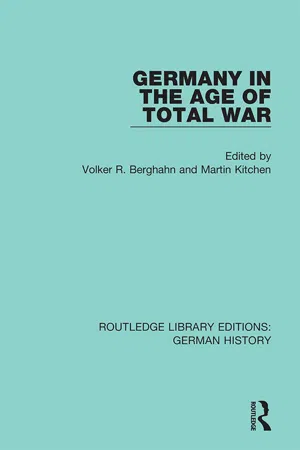
- 276 pages
- English
- ePUB (mobile friendly)
- Available on iOS & Android
eBook - ePub
Germany in the Age of Total War
1 FRANCIS CARSTEN: POLITICS AND HISTORY IN TWO CULTURES
Volker R. Berghahn*
The essays in this volume were written by friends and pupils of Francis Carsten in honour of his seventieth birthday this year. In these seven decades he has personally witnessed the upheavals which resulted from two total wars and revolutionary crises. These events have had a profound effect on both his personal life and his scholarly development. His biography, as recounted below, is thus of considerable interest in itself.
However, the introduction to this volume also seemed to be the appropriate place to set Francis Carsten’s work into the broader context of what might be called the Anglo-German historiographical relationship. Although his biography reflects the upheavals which German society experienced in the period up to 1945, he was among those British historians who wrote widely about Germany after the defeat of the Third Reich and who, through his books, articles and lectures, tried to contribute to the inevitable reappraisal of German history. The second part of this introduction will therefore examine how Francis Carsten’s writings were received by his colleagues in the Federal Republic in the 1950s and 1960s. Although this would seem to be a worthwhile exercise in itself, it also raises, indirectly at least, broader questions concerning differences between the historiographical traditions and academic cultures of Britain and the Federal Republic.
Francis Carsten was born on 25 June 1911. On his mother’s side, his family belonged to the Jewish upper middle class of Berlin with many connections to the commercial and academic world. His father was a well known eye specialist at the Charité Hospital and an honorary professor at the Humboldt University. His family originated from Silesia. Both parents strongly identified with German culture and the two sons were barely aware of their Jewish background. The atmosphere at home was staunchly conservative and monarchist. There was a picture of the Kaiser on the wall in the lounge and Francis’s father was deeply grieved not merely by the sight of horrifyingly mutilated soldiers who were sent to his hospital for treatment, but also by the course of the war.
* The evaluation of Francis Carsten’s work on the early modern period was written by Henry Cohn.
After primary school, his second son moved to the Königliches Wilhelms-Gymnasium and later to the Mommsen-Gymnasium which he remembers as having been scarcely less ‘horrible’ than the KWG. The political atmosphere at both schools was firmly deutschnational, though not anti-Semitic. Francis Carsten’s reaction to this kind of upbringing was a ‘classic’ one: he rebelled against it. At the age of fourteen, he proclaimed himself an atheist and refused to participate in religious instruction. A year later he joined one of the youth organisations of the Communist Party, the Sozialistischer Schülerbund; his parents were, predictably, appalled. With a number of like-minded fellow pupils he edited a magazine, Der Schulkampf, which published, inter alia, anonymous reports on the political views of the teachers. Not surprisingly, these activities did not go down very well, and there was trouble when Francis Carsten took his Abitur (A levels) in 1929. In History, for example, his examiners awarded a ‘B’, although his History teacher thought the performance had been genuinely first-class.
In the autumn of 1929, he began to study law at Geneva University. At the beginning of his second term he was back in Berlin. He moved to Heidelberg in the following year and back again to Berlin where he passed his Referendar examination early in 1933. At Berlin and Heidelberg he attended lectures by famous lawyers like Gustav Radbruch, Hermann Heller and Martin Wolff. But legal studies occupied barely more than half of his time. For much of the rest, he was active in politics. It must, of course, be remembered that these were the years of a disintegrating Weimar Republic and the rise of National Socialism. After 1930, the universities became centres of Nazi agitation and fights between political opponents among the student body became a daily occurrence. Several times Francis Carsten found himself in the midst of such brawls and on one occasion had to have several stitches.
During his schooldays he had been a faithful adherent of Communist orthodoxy. But with the Stalinisation of German Communism progressing and under the influence of Richard Löwenthal who, three years his elder, was a well known student leader, he became increasingly critical of the Thälmann course. Above all, his group disagreed with the ‘Social Fascist’ strategy of the Party; to Francis Carsten and his friends the real enemies were the Nazis, not the Social Democrats. By 1931 he found himself involved in the creation of cadres which, operating secretly inside the SPD and the KPD, simply called themselves Die Organisation, later known as Neubeginnen.1 It is through this underground work that he met a number of young Social Democrats, among them Fritz Erler.
None of this hectic political activity was, of course, able to change the course of history. The split between the two working-class movements remained unbridged and in January 1933 the Nazis finally came to power. Neubeginnen never shared the illusions of the KPD leadership that Hitler would only last for a short while. On the other hand, as Leninists they did believe that Fascism – that product, as they saw it, of the crisis of capitalism – would collapse eventually and that this would be the hour of Die Organisation. While continuing to be involved in conspiratorial work, Francis Carsten, having passed his first law exams early in 1933, outwardly maintained the life of an ordinary citizen. Having passed his law examination at the Berlin District Court (Kammergericht), but unable to find a Referendar position because of the anti-Semitic policies of the new regime, he joined the Bleichroeder Bank for a year. In 1934, he opened a bookshop together with Norbert Elias. At the same time he acted as an occasional courier between Berlin and Prague. By 1935, the Nazis began to introduce economic discrimination against Jews and the bookshop on Kurfürstendamm was closed. For Francis Carsten it was high time to leave the country. He received a tip-off that the Gestapo were after him. Basle was his next stop, then London and finally Amsterdam.
His career as a lawyer lay in ruins, but there had always been his interest in history, now intensified by the fact that so much had obviously ‘gone wrong’ in his native Germany. At Amsterdam he became a serious scholar of early modern Prussian history, as his three articles in Tijdschrift voor Geschiedenis and International Review of Social History, all of them published in 1938, testify. Yet Holland was not a safe place to stay and in April 1939 Francis Carsten sailed to Britain. In October he was accepted at Wadham College, Oxford, to do his doctorate which, interrupted by internment in 1940, he completed in June 1942. At Oxford he became instrumental in establishing the Social Democratic Club, a student society of moderate left-wingers, and he also met Ruth, later his wife, fellow historian and collaborator. He spent the rest of the war at the Political Warfare Executive, first with Sefton Delmer’s propaganda unit and, subsequently, with Duncan Wilson, when he was involved in the preparation of handbooks on various aspects of German life for use by the Allied Occupation authorities in Germany after VE-Day.
When that day finally arrived, Francis Carsten’s interest in German history was undiminished. In 1947 he obtained a post as lecturer at Westfield College, London, and thus launched himself into a university career which ultimately took him to the Masaryk Chair of Central European History at the School of Slavonic and East European Studies. Nor did his attitudes towards Germany undergo a marked change. He was, it is true, no longer a Marxist. On the other hand, he always saw himself as a refugee for political rather than racial reasons, and his experiences before 1933 and later in the underground never led him to adopt the kind of indiscriminate anti-Germanism which could be found, for perfectly plausible reasons, among other refugees after 1945. As a young activist he had met too many anti-Nazis and as a trained social historian he had learned to differentiate sociologically when looking at the basis of Nazi support in Germany. Above all, it appears he had never lost a belief in the positive force of enlightenment. Accordingly we find Francis Carsten travelling to Germany soon after the end of the war to give lectures on German history under the auspices of the British re-education programme.
Not all his encounters with German audiences were encouraging. In 1947, for example, he found himself locked in a violent argument with middle-aged Germans during a residential course at Rendsburg. Evidently few of the students liked his views and interpretations of German history and at one point he was even branded a ‘Bolshevik’. Although it is not altogether easy to reconstruct the political atmosphere in early post-war Germany, the tenacity with which many people continued to adhere to certain notions of the course of German history can hardly be exaggerated. Barbara Marshall’s article below2 deals with these problems as seen by the British Occupation authorities and, at least indirectly, also with the emotional obstacles which Francis Carsten encountered during his lecture tours through North Germany. In a more subdued way it was much the same with the reception of his books by the older generation of German historians in the 1950s. As one of the most prominent among them once remarked, these writings did not belong to the ‘mainstream of German historiography’. In what ways, then, did Francis Carsten’s books diverge from the mainstream? It was this question that made it tempting to take a closer look at his reception among the West German historical Establishment.
The first twenty-five years of his historical scholarship were largely devoted to the social and political history of the German principalities in the medieval and early modern periods. Norbert Elias, then preparing his own seminal study on The Civilising Process, had not only influenced him to become an historian, but suggested that it would be worth his while to find out what had gone wrong in earlier centuries of Prussian and German history. Intensive work on Prussian history also allowed him to purge his own Prussian background. A dozen articles published between 1938 and 1951 paved the way for a major study of The Origins of Prussia, based on the thesis for which he had received his Oxford doctorate. It broke new ground in eschewing narrative political history for a structure carefully designed ‘to describe the growth and the decline of the classes and the institutions which formed the basis of the later Prussian state’.3 Because the Hohenzollern state remained unaltered in its fundamentals during the eighteenth century, as a later article on Prussian despotism at its height was to show, The Origins of Prussia was restricted to the period up to the end of the seventeenth century. The colonisation of Brandenburg, Pomerania and Prussia in the thirteenth and fourteenth centuries had resulted in a society in which the nobles enjoyed no overwhelming advantages over the peasantry and towns. This balance gave place to the ascendancy of the Junkers in the fifteenth and sixteenth centuries, as the towns declined economically and politically and the peasants gradually lost the legal safeguards of their position. After the Thirty Years War, when the majority of these territories as well as Cleves and Mark in the Rhineland were consolidated in the possession of the Hohenzollerns, Frederick William the Great Elector largely eliminated the political power which the nobles had exercised through the Estates. The introduction of the excise and stricter administrative control further weakened both the economy of the towns and their self-government. The Great Elector launched the process whereby the Junkers became by the mid-eighteenth century a service nobility forming the backbone of the Army and the civil service. The price of their co-operation was heightened control over the peasant serfs. Thus the baneful influence of the Junkers over the Prussian state was established which lasted until the early nineteenth century and beyond. In this Prussian variant of a common Eastern European development, the monarch worked closely with the nobles to place insuperable barriers in the way of the growth of a strong middle class, such as emerged in most Western European states.
Francis Carsten’s broad perspective on Prussian history was too novel to win immediate acceptance from traditionally-minded German historians. The few academic reviews which appeared at the time, while recognising the thoroughness of his research, regretted the deliberate neglect of political history and insisted that developments in the separate Hohenzollern territories were more differentiated than he had allowed.4 Gerhard Oestreich’s contributions to Prussian history in successive revisions of Gebhardt’s handbook of German history until 1963 took no account of The Origins of Prussia, although this omission was partly remedied in the 1970 edition.5 No German publisher was prepared to back a translation until 1968, when the author was already well known for his book in the Reichswehr. Only then did The Origins of Prussia receive general acclaim in German-language daily newspapers, weeklies, radio reviews and academic journals,6 although Gerd Heinrich still rejected the whole approach outright for thinking in terms of classes and placing too much blame on the Junkers for the course taken by Prussian history.7 Otto Büsch was exceptional among German historians when he adopted Francis Carsten’s methodology for his searching analysis of the Army’s place in eighteenth-century Prussian society.8
Reviewers had criticised Francis Carsten’s first book for failing to draw on comparative material from other German principalities. In fact post-war German historical writing on the origins o...
Table of contents
- Cover
- Half Title
- Title Page
- Copyright Page
- Original Title Page
- Original Copyright Page
- Dedication
- Contents
- Preface to New Edition
- 1. Francis Carsten: Politics and History in Two Cultures
- 2. The Topos of Inevitable War in Germany in the Decade before 1914
- 3. Walther Rathenau – Intellectual or Industrialist?
- 4. Poles, Czechoslovaks and the ‘Jewish Question’, 1914–1921: A Comparative Study
- 5. War and the Appropriation of Nature
- 6. Rapallo – Strategy in Preventive Diplomacy: New Sources and New Interpretations
- 7. The ‘Baltic Problem’ in Weimar’s Ostpolitik, 1923–1932
- 8. Paramilitarism and Social Democracy: Theodor Körner and the Schutzbund
- 9. Democracy and the Power Vacuum: The Problem of the Party State during the Disintegration of the Weimar Republic
- 10. The Third Reich and the Problem of ‘Social Revolution’: German Officers and the SS
- 11. German Reactions to Military Defeat, 1945–1947: The British View
- 12. The ‘Missing Revolution’ in Industrial Societies: Comparative Reflections on a German Problem
- Appendix: F. L. Carsten’s Writings
- Notes on Contributors
- Index
Trusted by 375,005 students
Access to over 1.5 million titles for a fair monthly price.
Study more efficiently using our study tools.
Frequently asked questions
Yes, you can cancel anytime from the Subscription tab in your account settings on the Perlego website. Your subscription will stay active until the end of your current billing period. Learn how to cancel your subscription
No, books cannot be downloaded as external files, such as PDFs, for use outside of Perlego. However, you can download books within the Perlego app for offline reading on mobile or tablet. Learn how to download books offline
Perlego offers two plans: Essential and Complete
- Essential is ideal for learners and professionals who enjoy exploring a wide range of subjects. Access the Essential Library with 800,000+ trusted titles and best-sellers across business, personal growth, and the humanities. Includes unlimited reading time and Standard Read Aloud voice.
- Complete: Perfect for advanced learners and researchers needing full, unrestricted access. Unlock 1.5M+ books across hundreds of subjects, including academic and specialized titles. The Complete Plan also includes advanced features like Premium Read Aloud and Research Assistant.
We are an online textbook subscription service, where you can get access to an entire online library for less than the price of a single book per month. With over 1.5 million books across 990+ topics, we’ve got you covered! Learn about our mission
Look out for the read-aloud symbol on your next book to see if you can listen to it. The read-aloud tool reads text aloud for you, highlighting the text as it is being read. You can pause it, speed it up and slow it down. Learn more about Read Aloud
Yes! You can use the Perlego app on both iOS and Android devices to read anytime, anywhere — even offline. Perfect for commutes or when you’re on the go.
Please note we cannot support devices running on iOS 13 and Android 7 or earlier. Learn more about using the app
Please note we cannot support devices running on iOS 13 and Android 7 or earlier. Learn more about using the app
Yes, you can access Germany in the Age of Total War by Volker R. Berghahn,Martin Kitchen in PDF and/or ePUB format, as well as other popular books in History & Business General. We have over 1.5 million books available in our catalogue for you to explore.