Using newly available material from both sides of the Iron Curtain, William Glenn Gray explores West Germany’s efforts to prevent international acceptance of East Germany as a legitimate state following World War II.
Unwilling to accept the division of their country, West German leaders regarded the German Democratic Republic (GDR) as an illegitimate upstart — a puppet of the occupying Soviet forces. Together with France, Britain, and the United States, West Germany applied political and financial pressure around the globe to ensure that the GDR remain unrecognized by all countries outside the communist camp. Proclamations of ideological solidarity and narrowly targeted bursts of aid gave the GDR momentary leverage in such diverse countries as Egypt, Iraq, Ghana, and Indonesia; yet West Germany’s intimidation tactics, coupled with its vastly superior economic resources, blocked any decisive East German breakthrough.
Gray argues that Bonn’s isolation campaign was dropped not for want of success, but as a result of changes in West German priorities as the struggle against East Germany came to hamper efforts at reconciliation with Israel, Poland, and Yugoslavia — all countries of special relevance to Germany’s recent past. Interest in a morally grounded diplomacy, together with the growing conviction that the GDR could no longer be ignored, led to the abandonment of Bonn’s effective but outdated efforts to hinder worldwide recognition of the East German regime.
eBook - ePub
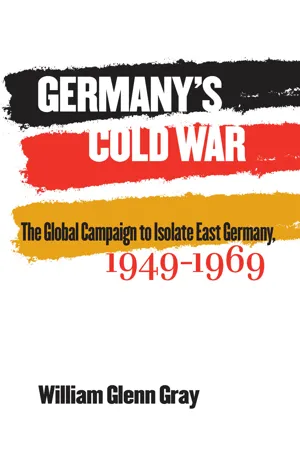
Germany's Cold War
The Global Campaign to Isolate East Germany, 1949-1969
- 368 pages
- English
- ePUB (mobile friendly)
- Available on iOS & Android
eBook - ePub
About this book
Information
Chapter 1
Containing East Germany in the Early 1950s
Konrad Adenauer, the newly elected chancellor of the newly created Federal Republic of Germany, faced a challenge to his position and to his very government on October 7, 1949. Four and a half months earlier the states of the three western occupation zones had adopted a provisional constitution, the Basic Law, providing the framework for a reconstituted German state.1 Elections in the three zones in August 1949 yielded only the slimmest majority for the so-called bourgeois parties in the West German Bundestag: Adenauer’s own centrist CDU, the right-liberal FDP, the nationalist German Party, and a smattering of other splinter groups. By a majority of just one vote, the Bundestag designated Adenauer as chancellor on September 15, 1949.2 Adding to the instability of Adenauer’s domestic position were the cantankerous dynamism of Kurt Schumacher, head of the opposition SPD, and the polemics of the small but vocal Communist Party (KPD). The communists never tired of depicting the chancellor as a mere client of the Western Allies—Britain, France, and the United States.3 The charge was not entirely false. Although Adenauer was anything but subservient in his dealings with the Allies, the Occupation Statute of May 1949 left the final authority in West Germany squarely in the hands of the Allied High Commission. Adenauer’s fledgling regime, housed in temporary quarters in a provincial town on the Rhine, was a decidedly humble successor to the German Reich of Otto von Bismarck and Adolf Hitler.
The proclamation of a rival government in Berlin on October 7, 1949, thus posed a threat to the institutions in Bonn. That was precisely the point of the hastily founded German Democratic Republic: it was intended to destabilize and delegitimize Adenauer’s government and the Federal Republic as a whole.4 Neither the Soviet Union nor its client regime in East Berlin had abandoned the goal of a unified Germany; the newly fashioned GDR was merely a platform for consolidating the strength of the SED so that it could win the allegiance of the working classes in western Germany. The SED-led regime, disguised as a “national front” of diverse political parties, claimed to speak not just for eastern Germany but for the German people as a whole; it saw itself as “the first independent all-German government.”5 Soviet and SED propaganda derided Adenauer as a separatist and a traitor to his nation. Meanwhile, to foster the illusion that the East German state was truly independent, the Soviets allowed the GDR to establish a Ministry of Foreign Affairs and to exchange ambassadors with the socialist states of Eastern Europe. On the surface, then, the authorities in East Berlin appeared to enjoy far more maneuvering room than their counterparts in Bonn.6
Politically aware Germans were not impressed. “Responsible Germans in the Western Zones, though somewhat disturbed at the establishment of this new ‘government,’ regard it with contempt,” observed the Foreign Office in London.7 If the cabinet members in Bonn lacked substance and authority, the credentials of their counterparts in East Berlin were no more appealing. Wilhelm Pieck, the GDR’s president, and Walter Ulbricht, first secretary of the SED, had spent World War II exiled in the Soviet Union; this marked them as Moscow’s puppets in West German eyes. Otto Grotewohl, the prime minister, had betrayed his Social Democratic colleagues in April 1946 by acceding to the creation of the SED in a “shotgun wedding” between the SPD and the KPD within the Soviet Zone that had led to the jailing and persecution of thousands of Social Democrats.8 Three and a half years later the West German SPD still faced persistent East German efforts to infiltrate labor unions in the Ruhr industrial district.9 All of this ensured that Kurt Schumacher, however blistering in his assessment of Adenauer, would reserve his sharpest barbs for the newly established SED administration. Among the broader public, too, the government in East Berlin had little credibility. Of those Germans in the American Zone who had heard of the GDR in November 1949, fully 76 percent regarded it as a tool of the Soviet authorities in Germany.10
Konrad Adenauer was thus squarely echoing the sentiments of the new West German political class when he dismissed the GDR as a product of Soviet fiat, created “with the participation of a small minority of subordinate Germans.” The regime in East Berlin was no legitimate government, intoned the chancellor; in fact, the GDR was not even a genuine state. In making this argument to the Bundestag on October 21, 1949, Adenauer articulated what would remain the Federal Republic’s basic statement of identity for the next two decades: Germany was a unique entity. There could be only one. Until that one Germany was restored as a unified state, the government of the Federal Republic—which alone had been elected in a free and democratic manner—would act as the sole legitimate representative of the German people.11
Adenauer’s classic position linked two fundamental assertions: nonrecognition of the GDR, on one hand, and Bonn’s exclusive representation of Germany, on the other. Neither was controversial in 1949. Indeed, with the GDR proclaiming its status as the only valid German government, there was nothing peculiar about Adenauer arrogating the same right for his administration. What did furrow the brows of some contemporaries was the highly abstract quality of the chancellor’s standpoint. He was behaving as if the GDR did not exist—as if the Bundestag really did directly represent the 18 million Germans living in the Soviet Zone. Consequently, Adenauer refused to have any dealings whatsoever with the SED regime. Prominent Social Democrats and even members of Adenauer’s cabinet quickly perceived that some interaction with the East German authorities would be necessary to coordinate everyday matters like exchanging mail. Trade might prove even more problematic: What if the GDR insisted on a formal treaty to regulate the exchange of goods between East and West Germany?12 It was characteristic of Adenauer, with his unambiguous orientation toward Western Europe, that he did not lose much sleep over the problem of contact with Germans in the Soviet Zone. Just as characteristically, it was his nationalist critics, ever sensitive to the plight of their co-nationals in the East, who would later press for a greater openness between Bonn and East Berlin.13
Such questions did not invite passionate controversies at the height of the Cold War, however. Newspaper jargon faithfully reflected the dismissive attitudes of the West German mainstream. Rather than writing of a German Democratic Republic centered in Berlin, journalists referred to the “‘so-called’ GDR” or the “Soviet Zone” headquartered in “Pankow.” Use of the term “Pankow”—a district of Berlin where many East German organs were in fact housed—served to deny any geographic coincidence with the historic seat of German government along Unter den Linden. “Soviet Zone” implied that the GDR was a fiction propagated by the Soviet occupiers of central Germany, not an independent regime with German nationals in charge. This Cold War cliché contained more than a whiff of truth in the early 1950s. The GDR remained under the direct sovereignty of the Soviet Union, just as the Federal Republic answered to the Allied powers at every turn. Adenauer would scarcely have had the authority to recognize the SEDregime, even had he wanted to. West Germans, save a small and diminishing circle of communists, despised the upstart East German government and hoped to discourage its consolidation and international recognition, but they were powerless to influence such decisions.
Constructing the Diplomatic Blockade
Like Adenauer, the foreign ministers of France, Britain, and the United States quickly resolved to ignore the SED and to continue regarding the Soviet military administration as the authoritative voice in East Berlin. According to this view the proclamation of the GDR had not altered the legal situation in the slightest. “The existence of the eastern German government is not recognized as legitimate,” observed one American official. “Therefore, the situation is as if it did not exist.”14 Meeting in Paris in November 1949, the three Western Allies agreed on a common line toward the GDR: they would neither recognize the SED regime de jure nor take any actions that might imply a de facto recognition. Moreover, they would encourage other countries to adopt a similar stance.15 This uniform approach toward the GDR was all the more significant in light of the contrasting Western responses to the victory of Mao Tse-Tung’s communist forces in mainland China. Chiang-kai Shek’s Nationalists, banished to the island of Formosa, claimed still to represent the legal government of all China; the Truman administration chose to back this claim, at least for the time being, in order to work against worldwide recognition of Mao’s government in Beijing. For the United States, the policy of “containment” offered a consistent rationale for disputing the legitimacy of communist gains around the globe, whether in China or eastern Germany. In London, Clement Attlee’s government judged that British economic interests would be better served by acknowledging the reality of communist rule in China. It was also hoped that Mao’s abrasive anti-imperialist rhetoric would mellow following Red China’s integration into the international system. On January 5, 1950, the United Kingdom consequently recognized the People’s Republic of China.16 Similar arguments would one day be advanced to support recognition of the GDR. It was a political reality and an important market, and its international behavior might be modified by greater interaction with the West. In the winter of 1949–50, however, these considerations did not apply to the situation in the Soviet Zone of Germany. Paris, London, and Washington—themselves founders of a “client” state in Germany—perceived the emergence of a Soviet-backed regime in East Berlin as an unwelcome complication in their efforts to steer the fate of postwar Europe.
Although international law offered few hard and fast rules on questions of recognition, standards of conduct toward unrecognized regimes had been continuously refined in the nineteenth and twentieth centuries. Many precedents dated from the decade after 1917, when the countries of the League of Nations had contested the legitimacy of the Bolshevik revolution in Russia.17 Little advance preparation was needed in late 1949 for the Western Allies, in consultation with Belgium, Luxembourg, and the Netherlands, to compose a list of acceptable and unacceptable forms of interaction with the regime in East Berlin.18 Diplomatic relations were, of course, entirely out of the question; according to standard international practice, only governments that recognized one another could maintain diplomatic relations. Consular relations, too, were held to imply recognition. Also off-limits was the signing of any official agreement by cabinet-level ministers of the Western powers and the SED regime.19 Instead, the Allies recommended that informal trade arrangements be worked out between nongovernmental bodies—by chambers of commerce, for example. Such measures had an artificial quality: for a country like the GDR, where economic decisions were increasingly subject to the will of the SED, the distinction between commercial and state representatives was often inconsequential. Nevertheless, contacts on the level of chambers of commerce allowed Western governments to maintain the formal requirements of nonrecognition without provoking an outcry from business interests.20
The Allies did not overtly publicize these resolutions, but they did undertake to inform countries outside the Western alliance about the terms of the diplomatic blockade. With an East German team en route to South America in December 1949, the United States hastened to spread the word in the Western Hemisphere; the United Kingdom took the nations of the Commonwealth into its confidence. European members of the Organization for Economic Cooperation and Development (Marshall Plan), such as Sweden, were also notified.21 As the Allies had hoped, countries outside the Soviet bloc heeded the Western standpoint and refrained from establishing political relations with the regime in East Berlin. The one partial exception was Finland, which—after months of hesitation—signed a government-level trade agreement with the GDR. Yet the Finnish decision was hardly an unqualified triumph for the Soviet bloc, for Helsinki disavowed any intention of recognizing the SED government.22
Dilettantism and a lack of realism in East Berlin contributed to the effectiveness of the Allied blockade. Virtually all of the German Rei...
Table of contents
- Cover Page
- Germany’s Cold War
- Copyright Page
- Contents
- Maps
- Acknowledgments
- Abbreviations
- Introduction
- Chapter 1. Containing East Germany in the Early 1950s
- Chapter 2. Staving Off Collapse
- Chapter 3. Yugoslavia Crosses the Line
- Chapter 4. Scrambling for Africa
- Chapter 5. Development Aid and the Hallstein Doctrine
- Chapter 6. The Perils of Détente
- Chapter 7. The Peculiar Longevity of a Discredited Doctrine
- Chapter 8. Of Two Minds
- Conclusion
- Notes
- Bibliography
- Index
Trusted by 375,005 students
Access to over 1.5 million titles for a fair monthly price.
Study more efficiently using our study tools.
Frequently asked questions
Yes, you can cancel anytime from the Subscription tab in your account settings on the Perlego website. Your subscription will stay active until the end of your current billing period. Learn how to cancel your subscription
No, books cannot be downloaded as external files, such as PDFs, for use outside of Perlego. However, you can download books within the Perlego app for offline reading on mobile or tablet. Learn how to download books offline
Perlego offers two plans: Essential and Complete
- Essential is ideal for learners and professionals who enjoy exploring a wide range of subjects. Access the Essential Library with 800,000+ trusted titles and best-sellers across business, personal growth, and the humanities. Includes unlimited reading time and Standard Read Aloud voice.
- Complete: Perfect for advanced learners and researchers needing full, unrestricted access. Unlock 1.5M+ books across hundreds of subjects, including academic and specialized titles. The Complete Plan also includes advanced features like Premium Read Aloud and Research Assistant.
We are an online textbook subscription service, where you can get access to an entire online library for less than the price of a single book per month. With over 1.5 million books across 990+ topics, we’ve got you covered! Learn about our mission
Look out for the read-aloud symbol on your next book to see if you can listen to it. The read-aloud tool reads text aloud for you, highlighting the text as it is being read. You can pause it, speed it up and slow it down. Learn more about Read Aloud
Yes! You can use the Perlego app on both iOS and Android devices to read anytime, anywhere — even offline. Perfect for commutes or when you’re on the go.
Please note we cannot support devices running on iOS 13 and Android 7 or earlier. Learn more about using the app
Please note we cannot support devices running on iOS 13 and Android 7 or earlier. Learn more about using the app
Yes, you can access Germany's Cold War by William Glenn Gray in PDF and/or ePUB format, as well as other popular books in History & German History. We have over 1.5 million books available in our catalogue for you to explore.