- Enables Non-scientific officers to understand the science they use on a daily basis
- Multi-disciplinary approach covering fields as diverse as biology, microbiology, chemistry, physics, oceanography and toxicology
- Covers the science of oil spills from risk analysis to cleanup and through the effects on the environment
- Includes case studies examining and analyzing spills, such as Tasman Spirit oil spill on the Karachi Coast, and provides lessons to prevent these in the future
- English
- ePUB (mobile friendly)
- Available on iOS & Android
eBook - ePub
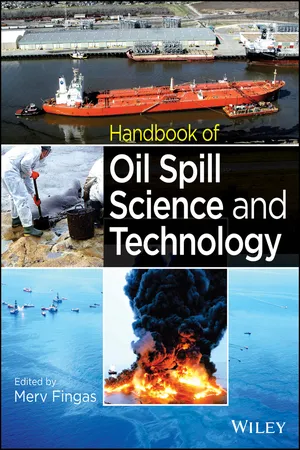
Handbook of Oil Spill Science and Technology
About this book
Provides a scientific basis for the cleanup and for the assessment of oil spills
Information
Part I
Risk Analysis
1
Risk Analysis and Prevention
Dagmar Schmidt Etkin
Environmental Research Consulting, Cortlandt Manor, NYUSA
- 1.1 Introduction
- 1.2 Executive Summary
- 1.3 Oil Spill Risk Analysis
- 1.3.1 Defining “Oil Spill Risk”
- 1.3.2 Factors That Determine the Probability of Spill Occurrence
- 1.3.3 Probability Distributions of Spill Volume
- 1.3.4 Determining the Probable Locations and Timing of Spills
- 1.3.5 Factors That Determine the Consequences/ Impacts of a Spill
- 1.3.6 Spill Impacts: The Effects of Spill Location Type
- 1.3.7 Measuring Oil Spill Impacts
- 1.3.8 Interpreting Risk for Policy-Making
- 1.4 Overview of Oil Spill Prevention
- 1.4.1 Basic Strategies for Spill Prevention
- 1.4.2 Implementation of Spill Prevention Measures
- 1.4.3 Effectiveness of Spill Prevention
- 1.4.4 Spill Fines and Penalties as Deterrents
1.1 Introduction
Understanding oil spill risk is at the heart of the entire study of oil spills because it encompasses both the likelihood of spills occurring and the nature of those spills, as well as the complex factors that determine the fate and effects of oil in the environments into which it spills. Risk mitigation—reducing risk—is the purpose of spill prevention measures and spill response. Studies of oil behavior, toxicity, ecosystem effects, and organism impacts are related to the consequences side of risk. Studies of spill rates, causes, and prevention strategies are related to the probability side of risk.
1.2 Executive Summary
Risk is the probability that an event will occur multiplied by consequences of the event. With regard to oil spills, risk is a combination of the probability that a spill will occur and the consequences or impacts of that spill. Because oil spills can have such different environmental and socioeconomic impacts based on the specific circumstances of each incident, it is important to consider the type of spill event that occurs with regard to oil type, volume, source, location, and season and the impacts that that kind of spill is likely to have in a given location and season based on the spillage volume and type of oil.
Spill risk analysis involves studying both the probability of occurrence and the impacts that may occur. Event tree analysis or fault tree analysis (FTA) is often used to evaluate the sequences of events that contribute to a spill occurring. In the event that a spill does occur, the spill volume, oil type, geographic location, resources at risk, and spill response effectiveness will determine the degree of impact. State-of-the-art modeling techniques and qualitative evaluations on impacts incorporating knowledge about oil behavior, toxicity, persistence, and adherence along with knowledge on the sensitivities of species, habitats, and shoreline types can provide data on the consequences side of the risk equation. Socioeconomic impacts and the cost of spill response should also be factored into any analysis.
There are many practical applications for spill risk assessments, including contingency planning for response and preparedness, protection of sensitive resources, risk allocation for insurance or taxation, response trade-off evaluation, cost–benefit analyses of oil exploration, production, storage, or transport; developing spill prevention measures; and evaluating alternative courses of action for oil exploration, production, storage, or transport. A scientifically based risk assessment removes much of the subjectivity in the process.
Evaluating and developing spill prevention measures is arguably the most important application of risk assessments. With significant reductions in spill rates over the last two decades, there have clearly been positive effects of spill prevention programs and measures, such as double hulls on tankers and legislation such as the Oil Pollution Act of 1990 (OPA 90). A greater appreciation and understanding of the consequences of spills, including environmental and socioeconomic impacts and costs, ha...
Table of contents
- Cover
- Title page
- Copyright page
- Contributors
- Author Biographies
- Preface
- Part I: Risk Analysis
- Part II: Oil Properties
- Part III: Oil Composition and Properties
- Part IV: Oil Analysis
- Part V: Oil Behavior
- Part VI: Modeling
- Part VII: Detection, Tracking, and Remote Sensing
- Part VIII: Oil Spills on Land
- Part IX: Effects of Oil
- Part X: Natural Dispersion
- Part XI: Cold Region Spills
- Part XII: Case Studies
- Part XIII: Appendices
- Index
- End User License Agreement
Trusted by 375,005 students
Access to over 1.5 million titles for a fair monthly price.
Study more efficiently using our study tools.
Frequently asked questions
Yes, you can cancel anytime from the Subscription tab in your account settings on the Perlego website. Your subscription will stay active until the end of your current billing period. Learn how to cancel your subscription
No, books cannot be downloaded as external files, such as PDFs, for use outside of Perlego. However, you can download books within the Perlego app for offline reading on mobile or tablet. Learn how to download books offline
Perlego offers two plans: Essential and Complete
- Essential is ideal for learners and professionals who enjoy exploring a wide range of subjects. Access the Essential Library with 800,000+ trusted titles and best-sellers across business, personal growth, and the humanities. Includes unlimited reading time and Standard Read Aloud voice.
- Complete: Perfect for advanced learners and researchers needing full, unrestricted access. Unlock 1.5M+ books across hundreds of subjects, including academic and specialized titles. The Complete Plan also includes advanced features like Premium Read Aloud and Research Assistant.
We are an online textbook subscription service, where you can get access to an entire online library for less than the price of a single book per month. With over 1.5 million books across 990+ topics, we’ve got you covered! Learn about our mission
Look out for the read-aloud symbol on your next book to see if you can listen to it. The read-aloud tool reads text aloud for you, highlighting the text as it is being read. You can pause it, speed it up and slow it down. Learn more about Read Aloud
Yes! You can use the Perlego app on both iOS and Android devices to read anytime, anywhere — even offline. Perfect for commutes or when you’re on the go.
Please note we cannot support devices running on iOS 13 and Android 7 or earlier. Learn more about using the app
Please note we cannot support devices running on iOS 13 and Android 7 or earlier. Learn more about using the app
Yes, you can access Handbook of Oil Spill Science and Technology by Merv Fingas in PDF and/or ePUB format, as well as other popular books in Technology & Engineering & Environmental Management. We have over 1.5 million books available in our catalogue for you to explore.