eBook - ePub
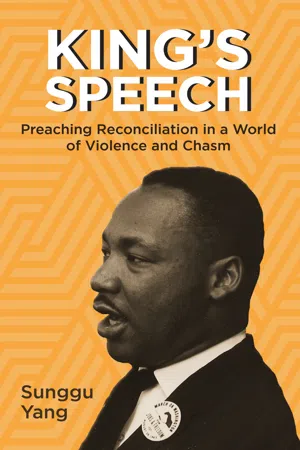
King’s Speech
Preaching Reconciliation in a World of Violence and Chasm
- 116 pages
- English
- ePUB (mobile friendly)
- Available on iOS & Android
eBook - ePub
About this book
"In the quiet recesses of my heart," Dr. Martin Luther King, Jr. often said, "I am fundamentally a clergyman, a Baptist preacher." No other statement could identify King better than this. Thus, the statement is the launching point for this work on preacher King's timeless messages on violence and reconciliation rooted in his theological foundation of the universal yet personal, loving God. Yang shows how King, based on that theological idea, vitalizes a pastoral and prophetic preaching voice, hoping to create reconciliation in the context of a violent reality. This concise piece is easily accessible, yet rich enough to see the continuing impact and applicability of preacher King's reconciliatory ideas in the present violent, torn-apart world that desperately awaits reconciliation.
Information
Topic
Theology & ReligionSubtopic
Christian Ministry1
Backgrounds of King’s Preaching Theology
The Influence of the Black Church Tradition
From birth, King was surrounded and influenced by the black faith community. Both his maternal grandfather and his father were successful African-American Baptist preachers in Atlanta, Georgia. Put simply, “King was a product of the black church in America.”1 How exactly, then, did the black Baptist church—or the black church in general—influence King’s reconciliatory preaching theology? There are at least three significant elements of the black church tradition that influenced King: the freedom tradition, open-ended Christian practices, and the particular interpretative tools of allegory and typology.
First is the black church’s “freedom tradition.” Long before the birth of King, black people had been singing hymns such as the one below:
Children, we all shall be free
When the Lord shall appear!2
And,
Oh Freedom, Oh Freedom, Oh Freedom over me!
Before I’ll be a slave
I’ll be buried in my grave,
And go home to my Lord
And be free.3
And,
In Christ now meet both east and west,
In Him meet south and north:
All Christly souls are one in Him
Throughout the whole wide earth.4
As seen in the songs above, a fundamental motif of freedom and liberation permeated black Christians’ lives from their first exposure to Christianity in America. They found both spiritual enhancement for their oppressed lives and eschatological hope by singing and dreaming of their own liberation from oppression. In fact, it was none other than this spiritual enhancement and eschatological hope that propelled early African-American Christians to walk out of the churches of white slave owners and start black churches. The African Methodist Episcopal Church (A.M.E.) in 1787 was the first example of such a walkout. Richard Allen, founder and first consecrated bishop of the A.M.E. church, departed from St. George’s Methodist Church in Philadelphia, Pennsylvania, and started the first African-American denomination.5
By the time of King’s birth, black Christians in America had already been actively engaging in social movements to improve black lives and, therefore, most black churches in America functioned as both spiritual homes and social-movement base camps.6 So, it comes as no surprise that King was surrounded and influenced by this spiritual and social ethos while being raised as a pastor’s son. Consequently, it was deeply rooted in King’s mind, theological thoughts, and preaching from his childhood. When King was led to public service, that ethos was evidently present in his preaching and various speeches, as we can see in the following excerpt:
It seemed as though I could hear the quiet assurance of an inner voice, saying, “Stand up for righteousness, stand up for truth. God will be at your side forever.” . . . Let this affirmation be our ringing cry. It will give us courage to face the uncertainties of the future. It will give our tired feet new strength as we continue our forward stride toward the city of freedom. When our days become dreary with low-hovering clouds and our nights become darker than a thousand midnights, let us remember that there is a great benign Power in the universe whose name is God, and he is able to make a way out of no way, and transform dark yesterdays into bright tomorrows.7
These words sound almost like the lyrics of an old-time black spiritual, which evidently proves King’s inheritance of the black church’s freedom and liberation tradition.
The second influential element on King’s preaching is that of the black church’s open-ended Christian practices. These practices include extending biblical narratives into the church’s own worldly experience, performing Scripture in its music, its rhythmic pattern of call and response, and rhetorical adornments.8 Richard Lischer observes that all of these are techniques that King “exported from the church’s Sunday worship to political mass meetings around the country.”9 Quite understandably, these practices enabled King to find God revealed and speaking through the whole universe, that is, both sacred and secular realms. Above all, extending the Bible into the church’s own worldly experience affirms God’s universal reign in the world. Performing the Scripture in music creates the Scripture’s common virtue in the secular world thanks to the universality of music itself. And black worship’s pattern of call and response enables people’s active engagement with divinity, whether the listeners are Christian or not (therefore, universal engagement!), by appealing to human beings’ most common desire for communication with each other and with the divine. Lastly, various rhetorical adornments help King inflate “local conflicts into the titanic battle of universals.”10 With the underlying influence of the black church’s open-ended practices, King was able to transform “the Judeo-Christian themes of love, suffering, deliverance, and justice from the sacred shelter of the pulpit into the arena of public policy.”11
Thirdly, King’s theology was informed by the black church’s interpretative tools of allegory and typology. Regarding this matter, Lischer says:
[T]hey [allegory and typology] allowed his congregations a greater opportunity to identify their struggles with those portrayed in the Bible. The black church not only sought to locate truth in the Bible, in order to derive lessons from it, but also extended the Bible its own experience. King found the ancient methods of interpretation useful in his effort to enroll the Civil Rights Movement in the saga of divine revelation.12
What is evident in Lischer’s observation is that by utilizing the interpretative tools of the black church’s tradition, King succeeded in intertwining the realm of divine revelation with the secular realm, wherein the civil rights movement is perceived as a divine claim. In doing so, King eventually came to confront the God revealed through the whole universe again and again.
King was a product of the black church, and his own theological identity was deeply influenced by the black church tradition. Specifically, King found his God revealed through the whole universe as a result of the three major influences of the tradition that we discussed above. However, the influence from the black church was not enough for King to develop his own homiletic theology, which he needed in order to confront the cruel reality of the America in which he lived. He needed more than influence itself. He needed a deeper articulation of the human condition, a broad and comprehensive understanding of God, and his own homiletic voice to confront this violent reality. As one can guess, all of these higher disciplines came from his advanced theological studies. Therefore, it is now time to turn to King’s theological background and how it deepened his understanding of theology and preaching of reconciliation.
The Influence from Contemporary Theologies
King went through three influential academic institutions: Morehouse, Crozer Seminary, and Boston University (where he wrote his dissertation in theology). These...
Table of contents
- Title Page
- Preface
- Introduction
- Chapter 1: Backgrounds of King’s Preaching Theology
- Chapter 2: King’s God Manifested through the Universe and Violent Reality
- Chapter 3: Invention of Other-Typological Illustration: An Analysis of King’s Sermon on Exodus 14:30
- Chapter 4: Application of King’s Homiletic Theology to the Present World
- Conclusion
- Appendix
- Bibliography
Trusted by 375,005 students
Access to over 1.5 million titles for a fair monthly price.
Study more efficiently using our study tools.
Frequently asked questions
Yes, you can cancel anytime from the Subscription tab in your account settings on the Perlego website. Your subscription will stay active until the end of your current billing period. Learn how to cancel your subscription
No, books cannot be downloaded as external files, such as PDFs, for use outside of Perlego. However, you can download books within the Perlego app for offline reading on mobile or tablet. Learn how to download books offline
Perlego offers two plans: Essential and Complete
- Essential is ideal for learners and professionals who enjoy exploring a wide range of subjects. Access the Essential Library with 800,000+ trusted titles and best-sellers across business, personal growth, and the humanities. Includes unlimited reading time and Standard Read Aloud voice.
- Complete: Perfect for advanced learners and researchers needing full, unrestricted access. Unlock 1.5M+ books across hundreds of subjects, including academic and specialized titles. The Complete Plan also includes advanced features like Premium Read Aloud and Research Assistant.
We are an online textbook subscription service, where you can get access to an entire online library for less than the price of a single book per month. With over 1.5 million books across 990+ topics, we’ve got you covered! Learn about our mission
Look out for the read-aloud symbol on your next book to see if you can listen to it. The read-aloud tool reads text aloud for you, highlighting the text as it is being read. You can pause it, speed it up and slow it down. Learn more about Read Aloud
Yes! You can use the Perlego app on both iOS and Android devices to read anytime, anywhere — even offline. Perfect for commutes or when you’re on the go.
Please note we cannot support devices running on iOS 13 and Android 7 or earlier. Learn more about using the app
Please note we cannot support devices running on iOS 13 and Android 7 or earlier. Learn more about using the app
Yes, you can access King’s Speech by Sunggu Yang,Sunggu A. Yang in PDF and/or ePUB format, as well as other popular books in Theology & Religion & Christian Ministry. We have over 1.5 million books available in our catalogue for you to explore.