An accessible introduction to ethics through engaging dialogues
Talking About Ethics provides the reader with all of the tools necessary to develop a coherent approach to ethical decision making. Using the tools of ethical theory, the authors show how these theories play out in relation to a wide variety of ethical questions using an accessible dialogue format. The chapters follow three college students as they discuss today's most important ethical issues with their families and friends, including:
• Immigration
• Capital punishment
• Legalization of narcotics
• Abortion
• Premarital sex
• Reproductive technologies
• Gender identity
• The environment, and many more
The engaging dialogue format illustrates how these topics often take shape in the real world, and model critical thinking and Christian ethical decision making. Study aids in each chapter include overviews, sidebars, reflection questions, glossaries, and recommended reading. Ideal as a textbook for undergraduate ethics courses, it is also accessible enough for high school classes and personal study.
eBook - ePub
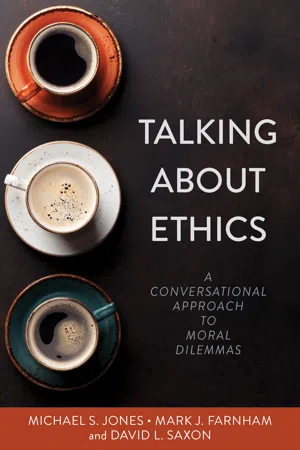
Talking About Ethics
A Conversational Approach to Moral Dilemmas
- 400 pages
- English
- ePUB (mobile friendly)
- Available on iOS & Android
eBook - ePub
Talking About Ethics
A Conversational Approach to Moral Dilemmas
About this book
Information
Topic
PhilosophySubtopic
Ethics & Moral Philosophy6
LEGALIZING NARCOTICS
Synopsis: Bianca just returned from Colorado, where recreational use of marijuana is legal. She was quite surprised at the casual nature of pot use among the people she met there, both young and old. She wasn’t sure how she felt about it, so she asks Micah and Lauren what they think over a cup of tea at The Grey Earl.

“I just returned from Denver, and let me tell you there are cannabis stores everywhere!” Bianca was sharing the details of her recent ski trip to Colorado. “They were more common than regular pharmacies in some places, and it just seemed so natural, like it was no big deal. That seems so odd to me.”
“It’s not a big deal,” replied Lauren. “At least it shouldn’t be. Marijuana is not addictive, doesn’t cause any serious health problems, and is no more destructive than alcohol. There are bars and liquor stores everywhere, and we don’t think twice about it. I wouldn’t be surprised if more states don’t legalize recreational use in the next few years.”
Bianca looked surprised at Lauren’s response, but Micah wasn’t. “I’m not sure I disagree with Lauren. It seems that the war on drugs in America that began in the 1970s has failed and that other countries that legalize drugs seem to have much lower rates of addiction. I don’t think I would ever smoke pot, but it seems that prison time for marijuana is a waste of our law-enforcement resources. Maybe we ought to legalize pot and see what happens as a test case to legalizing other drugs too.”
Bianca’s surprise morphed into shock. “Micah! I am so surprised to hear you say that. I thought that as a Christian you would be dead set against legalizing drugs.”
Micah crinkled his nose and had a pained expression on his face. “Yeah, I surprise myself sometimes. I guess I am looking at it from a Utilitarian point of view. What good has it done to criminalize soft drugs like marijuana? I don’t see much difference between pot and alcohol. I know it can be abused, like alcohol, but we don’t criminalize alcohol. We only arrest people who abuse it.”
Bianca looked slightly agitated. “I hear what you both are saying, but I am not sure all your facts are straight. I have heard statistics that indicate recreational marijuana can be addictive and does have serious health consequences. I think we ought to look into this topic more carefully before we arrive at conclusions. I know there are passionate defenders and detractors of marijuana, so the more factual information we can get, the more confident we can be that our conclusions are not merely based on what we want to be true but on what is actually true.”
They decided to bring up the topic in the next class with Dr. Platt.
“That’s a great question,” Dr. Platt said a couple of days later. He seemed amused at Bianca’s request for his opinion on the topic. He turned to the class. “Just out of curiosity, how many of you approve of medical marijuana for people with seizures, chronic pain, and other such ailments?” About two-thirds of the class raised their hands. “What about recreational use?” About half the hands went down. “I am somewhat surprised that there was such a drop-off with that second question,” said Dr. Platt. “For those of you who support the medical use of marijuana but not recreational use, would you be willing to share your reasons?”
Summer’s hand shot up. “I’m against recreational use because I saw how it ruined my cousin. He received a full ride scholarship to the University of Illinois, but in his senior year of high school he got into the pot scene and decided not to go to college. He lost all drive to do anything with his life and now just works at a restaurant washing dishes. All he does in his spare time is smoke pot. I hate what it did to him! He had so much potential and just wasted it.” Summer was visibly upset, and her cheeks flushed bright red.
Tyrone raised his hand. Dr. Platt called on him. “I agree with Summer. I have seen how pot has affected my family and friends, and it hasn’t been good. My concern as a business student, however, is about the regulation of the market. The demand for pot is skyrocketing, and I wonder how well the whole industry is being handled. How do we know quality control is being practiced? Will the tax benefits be worth the medical problems of users if that becomes an issue? There seem to be all kinds of unanswered questions from a business and regulatory standpoint. I’m not even sure this is being managed in the medical marijuana scenario.”
Micah’s ears perked up at this. He hadn’t thought too much about the business side of marijuana legalization, but Tyrone’s statement suddenly flooded his mind with questions.
“On the other hand, since marijuana has been illegal all these years, yet people use it, maybe legalizing recreational use would result in huge tax revenue.” Several heads turned as other students looked at Micah with surprise. His commitment as a Christian was well known. He blushed a bit at all the attention but continued. “I’m not saying that I agree with smoking pot, but since it is going to happen anyway, shouldn’t the government regulate it and benefit from it? I mean, we already do that with gambling and alcohol.”
“You have jumped ahead, Micah,” commented Dr. Platt. “We will get there eventually. But I want to stay focused on the difference between medical use and recreational use for right now.”
Weston chipped in. “I’ve heard that in places where medical marijuana is legalized, sometimes there’s been a marked increase in cases of unspecified ‘severe pain’ that allows a person to get a doctor’s prescription. In his TEDx talk, one of the largest marijuana growers in Colorado, Josh Stanley, talked about the epidemic of back pain that swept through college campuses when medical marijuana was legalized in Colorado.”1
The class gave a collective groan.
“On the other hand,” continued Weston, “Josh Stanley and his brother developed a nonpsychotropic strain of cannabis for epileptics that has been shown to greatly reduce seizures.”
“Ooh, I heard about that little girl, Charlotte Figi, who was having hundreds of seizures a week and was not expected to live long,” jumped in Marta. “Her condition was so bad that her parents signed a DNR—Do Not Resuscitate order—and took her home from the hospital with the expectation that she would die. This strain, which was high in CBD and low in THC, was turned into oil, and after the first application she went from having four hundred seizures a week to only zero or one per week. It was so effective that Stanley renamed the strain from the Hippie’s Disappointment to Charlotte’s Web. So for some people the medical use is life-saving.”
“Yes,” said Dr. Platt, “Charlotte Figi is one of the most well-known beneficiaries of CBD, or cannabinoids, which are compounds found in cannabis. THC is the most well-known compound because it is what makes people high when they smoke pot. Because the Charlotte’s Web strain is low in THC it is not desirable for people wanting to get high. So there certainly can be a difference between the medical use of marijuana and recreational use. Of course as Weston pointed out, that is abused quite a bit. Some people are willing to claim pain and other medical needs to get pot when it is illegal otherwise, and plenty of doctors are willing to write a prescription for those who ask.”
“Are we going to discuss why smoking pot recreationally is an issue to begin with?” Ralph looked impatient. “We keep talking as if we are assuming everyone agrees that getting high is wrong, but I don’t see what the big deal is.” Several students murmured their agreement.
Ralph continued. “I mean, how many people on this campus get wasted every weekend, and the college does nothing about it. Every weekend people get rushed to the hospital for alcohol poisoning, and sometimes they die. I would think getting stoned in a dorm room or off-campus apartment would be far preferable.”
Dr. Platt tried to be fair without communicating sympathy for Ralph’s position. “You are certainly correct that light pot smoking can have fewer health consequences in the short run than binge drinking. Chronic use of either, however, has serious implications for long-term health. Besides health consequences, there are a number of serious social and intellectual consequences that come with regular pot smoking. The fact that we are not handling the alcohol issue well in our society makes me wonder why we would remove obstacles to marijuana use on top of that. What if by legalizing recreational use we create another major health crisis like alcohol abuse? Once we legalize recreational use, it will not be easy to reverse course and make it illegal again if it develops into a health crisis.”
Dr. Platt continued. “There is also a great amount of misinformation spread about the health implications of marijuana use. Like gambling and pornography, the industry is so profitable that those involved are more than willing to spread disinformation about consequences to keep the money rolling in. That may sound jaded, but it has been seen many times before, most notably by cigarette manufacturers. Look how long it took for them to admit that smoking cigarettes had any serious health implications. So if anyone wants to do some investigative digging into the real science of the health impact of cannabis, I would be happy to see it.”
Dr. Platt began to hear the low rustling of laptops closing and notebooks being stowed in backpacks. He glanced at the clock and noticed the class was about to end, so he waved his hand and said, “Have a great day!”
Lauren, Micah, and Bianca gathered as the class let out, as was their usual custom.
“Let’s take Dr. Platt up on his challenge,” said Lauren excitedly. “I’ve already thought this out. I’ll take the medical and scientific side of the health consequences. Bianca, you study the financial and social impact of legalization. And Micah, why don’t you figure out the religious angle, since you are getting us all concerned with your unusual lack of clarity on ethical issues as a Christian.”
Lauren smiled, knowing she was walking a fine line between being bossy and taking initiative. Micah and Bianca both laughed, because they could see Lauren walking that line and found it amusing rather than annoying.
“Well, okay,” replied Micah with a grin. “That will save us time getting organized. One quick question, though. Why did you assign Bianca the financial side of the issue when I am the business major?”
Lauren was ready. “I did it because you are usually very decided on the ethical issues we study. I think that comes from your belief in the authority of the Bible for all of life. I admire that, even though sometimes it seems a little closed-minded to me. I am coming to see that in regard to many ethical issues, people often seem to hold their views with little rational justification for what they believe. Many seem to just pick a side of an issue because they like it or want it to be so, without solid reasons. That doesn’t seem to be very reasonable for me. So I respect your usual conviction because I know you are trying to be consistent and provide good reasons for your positions. The fact that you seem to be unsure on the topic of legalization of drugs amuses me, and I want to see where it goes.”
Micah looked a little chagrined at Lauren’s words but tried not to...
Table of contents
- Cover
- Title Page
- Copyright
- Dedication
- Contents
- Preface
- Introduction
- Theoretical Considerations
- Humanitarian Issues
- Medical Ethics
- Marriage and Sex
- International Issues
- Conclusion
- Select Bibliography
Trusted by 375,005 students
Access to over 1.5 million titles for a fair monthly price.
Study more efficiently using our study tools.
Frequently asked questions
Yes, you can cancel anytime from the Subscription tab in your account settings on the Perlego website. Your subscription will stay active until the end of your current billing period. Learn how to cancel your subscription
No, books cannot be downloaded as external files, such as PDFs, for use outside of Perlego. However, you can download books within the Perlego app for offline reading on mobile or tablet. Learn how to download books offline
Perlego offers two plans: Essential and Complete
- Essential is ideal for learners and professionals who enjoy exploring a wide range of subjects. Access the Essential Library with 800,000+ trusted titles and best-sellers across business, personal growth, and the humanities. Includes unlimited reading time and Standard Read Aloud voice.
- Complete: Perfect for advanced learners and researchers needing full, unrestricted access. Unlock 1.5M+ books across hundreds of subjects, including academic and specialized titles. The Complete Plan also includes advanced features like Premium Read Aloud and Research Assistant.
We are an online textbook subscription service, where you can get access to an entire online library for less than the price of a single book per month. With over 1.5 million books across 990+ topics, we’ve got you covered! Learn about our mission
Look out for the read-aloud symbol on your next book to see if you can listen to it. The read-aloud tool reads text aloud for you, highlighting the text as it is being read. You can pause it, speed it up and slow it down. Learn more about Read Aloud
Yes! You can use the Perlego app on both iOS and Android devices to read anytime, anywhere — even offline. Perfect for commutes or when you’re on the go.
Please note we cannot support devices running on iOS 13 and Android 7 or earlier. Learn more about using the app
Please note we cannot support devices running on iOS 13 and Android 7 or earlier. Learn more about using the app
Yes, you can access Talking About Ethics by Michael S. Jones,Mark J. Farnham,David L. Saxon in PDF and/or ePUB format, as well as other popular books in Philosophy & Ethics & Moral Philosophy. We have over 1.5 million books available in our catalogue for you to explore.