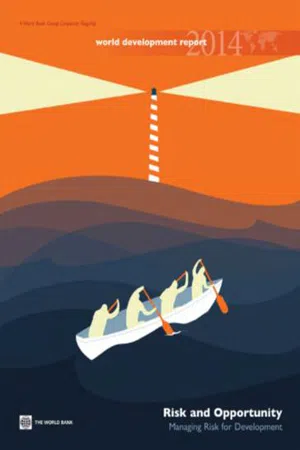
The past 25 years have witnessed unprecedented changes around the world—many of them for the better. Across the continents, many countries have embarked on a path of international integration, economic reform, technological modernization, and democratic participation. As a result, economies that had been stagnant for decades are growing, people whose families had suffered deprivation for generations are escaping poverty, and hundreds of millions are enjoying the benefits of improved living standards and scientific and cultural sharing across nations. As the world changes, a host of opportunities arise constantly. With them, however, appear old and new risks, from the possibility of job loss and disease to the potential for social unrest and environmental damage. If ignored, these risks can turn into crises that reverse hard-won gains and endanger the social and economic reforms that produced these gains. The World Development Report 2014 (WDR 2014), Risk and Opportunity: Managing Risk for Development, contends that the solution is not to reject change in order to avoid risk but to prepare for the opportunities and risks that change entails. Managing risks responsibly and effectively has the potential to bring about security and a means of progress for people in developing countries and beyond. Although individuals' own efforts, initiative, and responsibility are essential for managing risk, their success will be limited without a supportive social environment—especially when risks are large or systemic in nature. The WDR 2014 argues that people can successfully confront risks that are beyond their means by sharing their risk management with others. This can be done through naturally occurring social and economic systems that enable people to overcome the obstacles that individuals and groups face, including lack of resources and information, cognitive and behavioral failures, missing markets and public goods, and social externalities and exclusion. These systems—from the household and the community to the state and the international community—have the potential to support people's risk management in different yet complementary ways. The Report focuses on some of the most pressing questions policy makers are asking. What role should the state take in helping people manage risks? When should this role consist of direct interventions, and when should it consist of providing an enabling environment? How can governments improve their own risk management, and what happens when they fail or lack capacity, as in many fragile and conflict-affected states? Through what mechanisms can risk management be mainstreamed into the development agenda? And how can collective action failures to manage systemic risks be addressed, especially those with irreversible consequences? The WDR 2014 provides policy makers with insights and recommendations to address these difficult questions. It should serve to guide the dialogue, operations, and contributions from key development actors—from civil society and national governments to the donor community and international development organizations.
eBook - PDF
World Development Report 2014
Risk and Opportunity—Managing Risk for Development
- 363 pages
- English
- PDF
- Available on iOS & Android
eBook - PDF
About this book
Information
Subtopic
Development EconomicsIndex
EconomicsTable of contents
- Cover
- Contents
- Foreword
- Acknowledgments
- Overview Risk and Opportunity
- Overview
- Part 1 Fundamentals of risk management
- Part 2 The role of key social systems
- Appendixes
- Abbreviations and data notes
- Background papers
- Selected indicators
- Index
- Boxes
- Diagrams
- Figures
- Glossaries
- Maps
- Profile
- Tables
Trusted by 375,005 students
Access to over 1.5 million titles for a fair monthly price.
Study more efficiently using our study tools.
Frequently asked questions
Yes, you can cancel anytime from the Subscription tab in your account settings on the Perlego website. Your subscription will stay active until the end of your current billing period. Learn how to cancel your subscription
No, books cannot be downloaded as external files, such as PDFs, for use outside of Perlego. However, you can download books within the Perlego app for offline reading on mobile or tablet. Learn how to download books offline
Perlego offers two plans: Essential and Complete
- Essential is ideal for learners and professionals who enjoy exploring a wide range of subjects. Access the Essential Library with 800,000+ trusted titles and best-sellers across business, personal growth, and the humanities. Includes unlimited reading time and Standard Read Aloud voice.
- Complete: Perfect for advanced learners and researchers needing full, unrestricted access. Unlock 1.5M+ books across hundreds of subjects, including academic and specialized titles. The Complete Plan also includes advanced features like Premium Read Aloud and Research Assistant.
We are an online textbook subscription service, where you can get access to an entire online library for less than the price of a single book per month. With over 1.5 million books across 990+ topics, we’ve got you covered! Learn about our mission
Look out for the read-aloud symbol on your next book to see if you can listen to it. The read-aloud tool reads text aloud for you, highlighting the text as it is being read. You can pause it, speed it up and slow it down. Learn more about Read Aloud
Yes! You can use the Perlego app on both iOS and Android devices to read anytime, anywhere — even offline. Perfect for commutes or when you’re on the go.
Please note we cannot support devices running on iOS 13 and Android 7 or earlier. Learn more about using the app
Please note we cannot support devices running on iOS 13 and Android 7 or earlier. Learn more about using the app
Yes, you can access World Development Report 2014 by World Bank in PDF and/or ePUB format, as well as other popular books in Economics & Development Economics. We have over 1.5 million books available in our catalogue for you to explore.