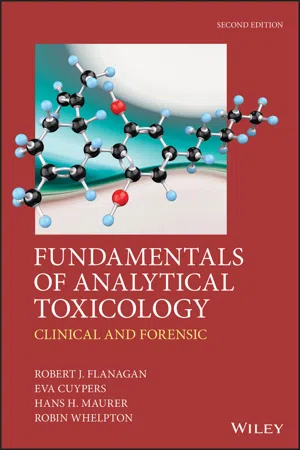
Fundamentals of Analytical Toxicology
eBook - ePub

Fundamentals of Analytical Toxicology

Clinical and Forensic

  1. English
  2. ePUB (mobile friendly)
  3. Available on iOS & Android
eBook - ePub

Fundamentals of Analytical Toxicology

Clinical and Forensic

About this book

Fundamentals of Analytical Toxicology is an integrated introduction to the analysis of drugs, poisons, and other foreign compounds in biological and related specimens. Assuming only basic knowledge of analytical chemistry, this invaluable guide helps trainee analytical toxicologists understand the principles and practical skills involved in detecting, identifying, and measuring a broad range of compounds in various biological samples. Clear, easy-to-read chapters provide detailed information on topics including sample collection and preparation, spectrophotometric and luminescence techniques, liquid and gas-liquid chromatography, and mass spectrometry including hyphenated techniques.

This new edition contains thoroughly revised content that reflects contemporary practices and advances in analytical methods. Expanding the scope of the 1995 World Health Organization (WHO) basic analytical toxicology manual, the text includes coverage of separation science, essential pharmacokinetics, xenobiotic absorption, distribution and metabolism, clinical toxicological and substance misuse testing, therapeutic drug monitoring, trace elements and toxic metals analysis, and importantly the clinical interpretation of analytical results.

Written by a prominent team of experienced practitioners, this volume:
  • Focuses on analytical, statistical, and pharmacokinetic principles
  • Describes basic methodology, including colour tests and immunoassay and enzyme-based assays
  • Outlines laboratory operations, such as method validation, quality assessment, staff training, and laboratory accreditation
  • Follows IUPAC nomenclature for chemical names and recommended International Non-proprietary Name (rINN) for drugs and pesticides
  • Includes discussion of 'designer drugs' (novel pharmaceutical substances NPS)

Fundamentals of Analytical Toxicology: Clinical and Forensic, 2nd Edition is an indispensable resource for advanced students and trainee analytical toxicologists across disciplines, such as clinical science, analytical chemistry, forensic science, pathology, applied biology, food safety, and pharmaceutical and pesticide development.

Frequently asked questions

Yes, you can cancel anytime from the Subscription tab in your account settings on the Perlego website. Your subscription will stay active until the end of your current billing period. Learn how to cancel your subscription.
At the moment all of our mobile-responsive ePub books are available to download via the app. Most of our PDFs are also available to download and we're working on making the final remaining ones downloadable now. Learn more here.
Perlego offers two plans: Essential and Complete
  • Essential is ideal for learners and professionals who enjoy exploring a wide range of subjects. Access the Essential Library with 800,000+ trusted titles and best-sellers across business, personal growth, and the humanities. Includes unlimited reading time and Standard Read Aloud voice.
  • Complete: Perfect for advanced learners and researchers needing full, unrestricted access. Unlock 1.4M+ books across hundreds of subjects, including academic and specialized titles. The Complete Plan also includes advanced features like Premium Read Aloud and Research Assistant.
Both plans are available with monthly, semester, or annual billing cycles.
We are an online textbook subscription service, where you can get access to an entire online library for less than the price of a single book per month. With over 1 million books across 1000+ topics, weโ€™ve got you covered! Learn more here.
Look out for the read-aloud symbol on your next book to see if you can listen to it. The read-aloud tool reads text aloud for you, highlighting the text as it is being read. You can pause it, speed it up and slow it down. Learn more here.
Yes! You can use the Perlego app on both iOS or Android devices to read anytime, anywhere โ€” even offline. Perfect for commutes or when youโ€™re on the go.
Please note we cannot support devices running on iOS 13 and Android 7 or earlier. Learn more about using the app.
Yes, you can access Fundamentals of Analytical Toxicology by Robert J. Flanagan,Eva Cuypers,Hans H. Maurer,Robin Whelpton in PDF and/or ePUB format, as well as other popular books in Physical Sciences & Chemistry. We have over one million books available in our catalogue for you to explore.

Information

Publisher
Wiley
Year
2020
Print ISBN
9781119122340
eBook ISBN
9781119122371
Edition
2
Subtopic
Chemistry

Section D
Analytical Toxicology

17
Toxicology Testing at the Point of Contact

17.1 Introduction

Point of contact testing (point of care testing, POCT), as its name implies, refers to testing carried out in close proximity to the subject, usually with the aim of providing an almost immediate result. It can be considered as any testing performed outside of a central laboratory and may also be referred to as point of care laboratory testing (POCLT), rapid oral fluid testing (ROFT), bedside testing, near patient testing (NPT), home testing, and patient self-management (Table 17.1).
Table 17.1 Examples of point of contact testing
Type of Monitoring Analyte Test sample
Emergency department, trauma clinic Blood gases, carbon monoxide, ethanol, paracetamol, salicylates, substance misuse, snake envenomation Blood, urine, oral fluid, breath
Therapeutic monitoring Lithium, theophylline Blood, plasma
Roadside testing Cannabis, cocaine, ethanol Breath, oral fluid
Workplace testing
  1. Pre-employment
Substance misuse Urine, oral fluid
  1. On-site
Ethanol, substance misuse Breath, oral fluid, sweat
Detention centres Substance misuse Urine, oral fluid, sweat
Drug treatment clinics Buprenorphine, ethanol, methadone, substance misuse Urine, oral fluid, sweat
Self-management Warfarin Blood
With the use of POCT systems for testing for driving under the influence (DUI) of drugs (including ethanol) or screening for possible impairment in the workplace, roadside, and employment and pre-employment testing can be added to the list. Consideration of issues such as staff training, QA, and the interpretation of results are inherent in any decision to implement testing (Shephard, 2016; Nichols & Petersmann, 2019).

17.2 Use of point of contact testing

The use of a POCT system should be given careful consideration before such a programme is initiated (Box 17.1). POCT may be performed to aid diagnosis of disease, guide therapy, or detect poisons. However, in the context of analytical toxicology the term is more generally applied to screening for, or assessing the concentration of, illicit or otherwise proscribed substances.

Box 17.1 Questions when deciding to implement point of contact testing

  • What are the reasons for testing?
    1. โ€“ Emergency department testing/drug treatment clinic
    2. โ€“ Law enforcement
    3. โ€“ Post-incident
    4. โ€“ Random or scheduled workplace testing/pre-employment screening
  • Why are immediate results required?
    1. โ€“ Initiate early treatment/alter treatment
    2. โ€“ Effect an arrest
    3. โ€“ Suspend from work
  • What is the window of detection to be?
    1. โ€“ May influence choice of fluid to be sampled
    2. โ€“ Currently under the influence
    3. โ€“ Detect a regular substance misuser
  • Which drugs should be detected?
    1. โ€“ Ethanol
    2. โ€“ Misused drugs
  • Where are the tests to be done?
    1. โ€“ Clinic
    2. โ€“ Roadside
    3. โ€“ Workplace
  • What tests are available?
    1. โ€“ Are the kits suitable for the task/venue?
    2. โ€“ Will the operators be able to use the system correctly?
    3. โ€“ Is storage/shelf-life a consideration?
  • Will it be cost effective?
    1. โ€“ Avoid need to transport samples to the laboratory for analysis
    2. โ€“ Avoid need for employee to visit the test laboratory
    3. โ€“ Reduce the number of samples to be assayed by the laboratory โ€“ only test putative positives
    4. โ€“ Cost of kits/numbers of samples
The nature of the tests performed will depend on where they are being carried out. An emergency department will have access to blood gas analyzers, and these may be able to perform COHb assay. On the other hand, roadside or point-of-entry testing kits for use by trained police or customs officials need to be portable, robust, and reliable, whilst POCT kits for workplace testing need t...

Table of contents

  1. Cover
  2. Table of Contents
  3. Preface
  4. Health and Safety
  5. Nomenclature, Symbols, and Conventions
  6. Uniform Resource Locators
  7. Amount Concentration and Mass Concentration
  8. Acknowledgements
  9. List of Abbreviations
  10. Section A: The Basics
  11. Section B: Separation Science
  12. Section C: Essential Pharmacokinetics
  13. Section D: Analytical Toxicology
  14. Index
  15. End User License Agreement