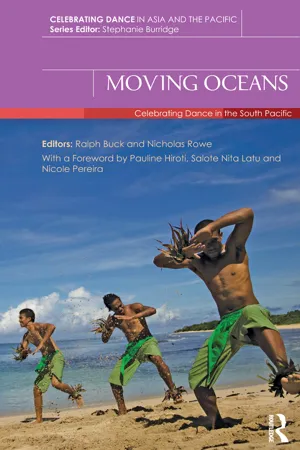
Celebrating the diversity of dance across the South Pacific, this volume studies the various experiences, motivations and aims for dance, emerging from the voices of dance professionals in the islands. In particular, it focuses on the interplay of cultures and pathways of migration as people move across the region discovering new routes and connections.
- 214 pages
- English
- ePUB (mobile friendly)
- Available on iOS & Android
eBook - ePub
About this book
Information
1
Godwits, Kuaka and the Returns of Ausdruckstanz in Aotearoa
Carol Brown
All that one can do is proceed inside this tear, vibrate at the borders of memory.1
Dunedin, 1979
I am standing on the bare wooden floorboards of the Studio for Modern Expressive Dance, Moray Place, dressed in shorts and a t-shirt. A large sepia poster on the wall reveals a younger version of my teacher, Shona Dunlop MacTavish, doing a dramatic jump and wearing Cossack-styled boots, a fur hat, peasant blouse, and knee-length breeches. her legs are in a deep flexion beneath her torso and her arms are raised strongly above her head in a moment of elation. She appears impossibly high off the ground. Another woman, with high cheekbones and wearing a long full-dress with mutton sleeves and a headscarf, is doing a high leg kick in the air with a flexed foot beneath her. The image captures their suspension at the height of vertically thrust movements. They are complicit and exalted. This highly ‘staged’ moment is set ‘outside’, against bush and sky and beneath towering gum trees. The overtly European motif suggestive of Central European folk dance is sited in a scene of bucolic Australian bush. The words read: ‘The Famous Bodenwieser Viennese Modern Expressive Ballet’ and ‘First N.Z. Tour’.
Aotearoa New Zealand is a collection of islands in the southern Pacific Ocean that has historically been peopled by waves of migration and influence beginning with the first peoples of this place, tangata whenua (Māori for ‘people of the land’), and subsequent European, Asian, Pacific Island, and other peoples. From where I write, Tāmaki Makaurau (Auckland), a volcano-strewn isthmus that lies between the Waitemata and Manukau harbours, I am surrounded by sea. Shorelines are places of contact and conflict and these shores resonate with the influence of distant and local bodies.
Tāmaki Makaurau, 2013
It is late February, nights are getting cooler and days shorter, nature’s signals are telling the wading kuaka, the bar-tailed godwit birds that fly from the Arctic tundra to spend summer in New Zealand, that it is nearly time to go. As migratory shorebirds their flight path, from the northern hemisphere Arctic tundra to the New Zealand coastline, is one of the longest migrations known amongst birds.2
Within the performing arts environment, the kuaka or godwit has become a metaphor for the migratory movement of New Zealand artists between hemispheres. The flight of dance artists from Aotearoa to the northern hemisphere is a long-haul migration that is as much about opportunities to perform, study and experience dance within metropolitan centres of Europe and America, as it is about gaining what is anecdotally termed overseas experience (OE). Movement between hemispheres and across oceans — the north and the south, the Pacific and the Atlantic — as well as what is carried between poles, has been formative in shaping New Zealand’s history and culture, both through the achievements of our self-imposed cultural exiles and through those who have returned to share and disseminate their knowledge and experience on these shores mixing and blending it with knowledge of this place.
In this writing I consider the continuing influence of European tanztheatre in Aotearoa, New Zealand, through a series of movement forms and patterns learnt in the studio of Shona Dunlop MacTavish that I recognize as persisting in my own choreography, dancing and teaching. In discovering my body-as-archive through a line of descent that tracks flight paths between Vienna, Sydney, Dunedin, London, and Auckland, I am interested in exploring the transmigration of an embodied legacy of ausdruckstanz. As the manifestation of a diasporic culture (the exodus of Central European Jewish artists and intellectuals from Europe before the Second World War), such a legacy can be seen to contribute in an ongoing way to the networks of relations, connections and dynamic patterns of flow between hemispheres, continuing to release movement potential for reimagining the present.
My earliest knowledge of dance as an art form was inscribed through a series of quotes from the past, for it was the Viennese ausdruckstanz choreographer, Gertrud Bodenwieser (1890–1959), whose words and movement principles animated my dancing. I came to know Gertrud Bodenwieser through the teachings of her former student and principal dancer, Shona Dunlop MacTavish, with whom I studied in New Zealand from 1972 to 1985.
Dunlop MacTavish occupies ‘a distinguished position in the history of Australian and New Zealand dance’.3 Born in Dunedin, godwit-like, she left in 1935 with her mother and brother to pursue the kind of arts education that was at the time perceived as only possible in the cultural capitals of Europe. Arriving at Bodenwieser’s private studio in Vienna she described feeling frightened, awkward and excited, however, ‘the energy and passion of those flailing bodies, quickly assured me that here was a sort of dance I had dreamed’.4
Individualism, unconscious expression and the communication of emotion underpinned ausdruckstanz, making this genre something of a challenge for shy schoolgirls raised in the Pakeha (non-Māori) suburbs of Dunedin where overt expression was not encouraged. The experience of Vienna and Shona’s encounter with Gertrud Bodenwieser proved to be transformational. As Bodenwieser’s position as an avant-garde Jewish artist in Vienna became untenable following the Anschluss in 1938, she contacted Shona and her friend Hilary Napier and invited them to join her company. In 1938, Shona boarded a train with the Tanzgruppe (dance group) Bodenwieser as part of an exit strategy out of Austria, into Colombia where the company toured for the best part of a year. So began the displacement of Bodenwieser’s work and teachings from its cultural milieu and the urgency of survival in exile. As the company looked for a new home, Shona and her family suggested New Zealand and arranged visas for the company. After a brief pause in Wellington, the company however chose the more cosmopolitan city of Sydney, and in 1939 joined some of Gertrud’s other dancers who had arrived there via New York with the J. C. Williamson revue. Following this migration, as J. W. Marshall explains, Gertrud Bodenwieser became ‘amongst the first expatriate European dance artists to establish ongoing dance companies within the region’.5 Shona continued to work with Gertrud in Sydney until 1948 when she married a Presbyterian minister, Donald MacTavish, whose first mission was to China. Although she continued to pursue her dance interests through their various postings in Taiwan and South Africa, as well as through the birth of three children, it was not until Donald’s death in South Africa in 1956 that she returned to Dunedin to establish her own school of modern expressive dance. out of this school grew the Dunedin Dance Theatre in 1963. This company, comprising Shona’s senior dancers, was a platform for her own choreographies, often with political themes such as Hunger (1970), Requiem for the Living (1980) and Bars (1983), as well as re-creations of some of Gertrud Bodenwieser’s repertoire, including Dämon Machine/Demon Machine (1923) and Joan of Arc (1947). It also became the crucible for the emergence of a number of dancers who would go on to have significant careers as innovative performers and choreographers in their right, including Michael Parmenter, Simon Ellis (UK/NZ), Matthew Smith (NZ/Europe), and Bronwyn Judge.
The wave of influence from Gertrud Bodenwieser and landlocked Vienna, Austria, 18,000 km away, was spread through Shona’s teaching and transmission of that legacy to hundreds of dance students who trained in her dance studio in Dunedin.
Though after leaving New Zealand in 1985, I subsequently learned from many other teachers through different genres and styles of practice, I have maintained a continuous connection with Shona and her teachings and continue to periodically return to Dunedin to dance with or for her. Alongside my studies with Shona, I have engaged in a sustained practice of archiving and re-enacting elements of Bodenwieser’s teachings and choreographies through research, writing and performance in dialogue with other former Bodenwieser dancers, including the late Bettina Vernon, Hilde Holger, Evelyn Ippen, and Hilary Napier.6
As a Pakeha artist–scholar of Irish descent, I recognize in this archival drive a resistance to historical amnesia and the erasures of historical events. As an Austrian Jew, Bodenwieser’s artistic legacy virtually disappeared from Europe after she was forced to flee from Vienna. The convulsions of Nazism, the holocaust and the Second World War eradicated much of the evidence of her work and reputation and led to the diasporic exile of both her and her surviving dancers. It is in Australia, where Bodenwieser settled with her remaining dancers in 1939, and to a certain extent New Zealand, that one finds most evidence of her choreography, teaching and life, and where she is still remembered in the works of those influenced by her. Shirley Mckechnie has described Gertrud Bodenwieser’s impact upon Australian dance as, ‘profound and long-lasting’.7 Yet her distance from Europe and North America made this legacy largely invisible outside of Australia. Shona Dunlop MacTavish, as one of the dancers who fled Vienna with Bodenwieser to Colombia and eventually Australia (via Wellington, New Zealand), described how the experience of exile and survival created an aura of protectiveness around Bodenwieser’s work, the reverberations of which were felt by her students and dancers. For instance, she recently expressed how the dancers would huddle around Bodenwieser whenever she received bad news such as the arrival of a cable confirming the death of her husband, the theatre director Friedrich Rosenthal at Auschwitz.8
To engage in genealogy involves recognizing the inscriptions and embodied legacies of the past in the present. The concept of the body, as an archive of memories and inter-corporeal presence, has a particular resonance within New Zealand where for a Māori the ability to position oneself through an order of relations generates a sense of the world centred on one’s whakapapa or genealogy. Through whakapapa, Māori trace their ancestry all the way back to the beginnings of the universe. By means of oral retellings of whakapapa both the seen and the unseen that shape the world and one’s position within it are understood, re-membered and evoked.9
Given this context, I am interested in how Pakeha New Zealanders negotiate their performance identities through embodied legacies of the past that extend beyond these shores. In particular, how movements and habits acquired in one cultural milieu (Vienna in the 1930s) become translated, adapted and reconfigured within another (Dunedin in the 1970s and Auckland now). This attention to the past and to acknowledging the diverse genealogies of presence in my own practice is in part a response to a post-colonial drive to acknowledge how we are here as situated and nomadic subjects with histories that affect our inhabitation of a multi-cultural present.
In this dancing-place, I connect with a genealogy that bridges the tanztheatre of Viennese ausdruckstanz choreographer, Gertrud Bodenwieser, with the dance theatre of Dunedin-based New Zealand dancer and choreographer, Shona Dunlop MacTavish, and my own practice as a choreographer and dancer now based in Tāmaki Makaurau, Auckland.
What happens to movement when it takes root in another place other than its origins? What is the generative force of memories, affects, and archives of feeling and gestures? What is the potential in creating an interweaving, a reconciling and a complicating of the past with the present, the distant and the near, the Antipodean and the European? This genealogy of practice, perhaps, resonates with that of many who experience their dancing as a form of inter-corporeal remembering that traces and tracks embodiment through multiple sites, languages and places, each with their distinct cultural histories. I would like to consider how a recovery of the terms of Bodenwieser’s teachings from Vienna might constitute an archival refraction, simultaneously transforming past, present and future and recreating the plenitude of the temporal i...
Table of contents
- Cover
- Half Title
- Title
- Copyright
- Contents
- Foreword
- Preface
- Acknowledgements
- Introduction
- 1. Godwits, Kuaka and the Returns of Ausdruckstanz in Aotearoa
- 2. The Role of Gunge Takwaku dance in Kraku-bandi Female Initiation of the Yangit of Papua New Guinea
- 3. Learning and Performing my Pacific Island Identity
- 4. Earthquakes and Aftershocks: Dance in Christchurch
- 5. Hip Hop Dance in New Zealand and Pacific Islands
- 6. Tracing the Steps of Modern and Contemporary Dance in Twentieth-century New Zealand
- 7. A Teacher's Story: He purakau na te kaiako
- 8. Dancing the Kolo under the Long White Cloud
- 9. Treasuring the Meke in a Modern Fiji
- 10. The Role of a Service Organization for Dance — DANZ, Dance Aotearoa New Zealand
- Artist Voices and Biographies
- Index
Trusted by 375,005 students
Access to over 1.5 million titles for a fair monthly price.
Study more efficiently using our study tools.
Frequently asked questions
Yes, you can cancel anytime from the Subscription tab in your account settings on the Perlego website. Your subscription will stay active until the end of your current billing period. Learn how to cancel your subscription
No, books cannot be downloaded as external files, such as PDFs, for use outside of Perlego. However, you can download books within the Perlego app for offline reading on mobile or tablet. Learn how to download books offline
Perlego offers two plans: Essential and Complete
- Essential is ideal for learners and professionals who enjoy exploring a wide range of subjects. Access the Essential Library with 800,000+ trusted titles and best-sellers across business, personal growth, and the humanities. Includes unlimited reading time and Standard Read Aloud voice.
- Complete: Perfect for advanced learners and researchers needing full, unrestricted access. Unlock 1.5M+ books across hundreds of subjects, including academic and specialized titles. The Complete Plan also includes advanced features like Premium Read Aloud and Research Assistant.
We are an online textbook subscription service, where you can get access to an entire online library for less than the price of a single book per month. With over 1.5 million books across 990+ topics, we’ve got you covered! Learn about our mission
Look out for the read-aloud symbol on your next book to see if you can listen to it. The read-aloud tool reads text aloud for you, highlighting the text as it is being read. You can pause it, speed it up and slow it down. Learn more about Read Aloud
Yes! You can use the Perlego app on both iOS and Android devices to read anytime, anywhere — even offline. Perfect for commutes or when you’re on the go.
Please note we cannot support devices running on iOS 13 and Android 7 or earlier. Learn more about using the app
Please note we cannot support devices running on iOS 13 and Android 7 or earlier. Learn more about using the app
Yes, you can access Moving Oceans by Ralph Buck,Nicholas Rowe in PDF and/or ePUB format, as well as other popular books in Media & Performing Arts & Dance. We have over 1.5 million books available in our catalogue for you to explore.