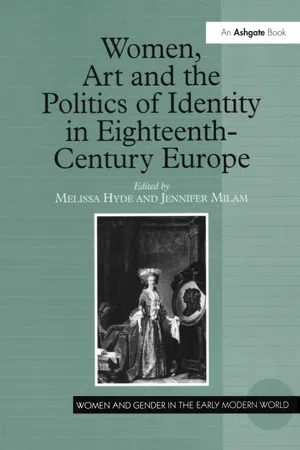
eBook - ePub
Women, Art and the Politics of Identity in Eighteenth-Century Europe
- 328 pages
- English
- ePUB (mobile friendly)
- Available on iOS & Android
eBook - ePub
Women, Art and the Politics of Identity in Eighteenth-Century Europe
About this book
The eighteenth century is recognized as a complex period of dramatic epistemic shifts that would have profound effects on the modern world. Paradoxically, the art of the era continues to be a relatively neglected field within art history. While women's private lives, their involvement with cultural production, the project of Enlightenment, and the public sphere have been the subjects of ground-breaking historical and literary studies in recent decades, women's engagement with the arts remains one of the richest and most under-explored areas for scholarly investigation. This collection of new essays by specialist authors addresses women's activities as patrons and as "patronized" artists over the course of the century. It provides a much needed examination, with admirable breadth and variety, of women's artistic production and patronage during the eighteenth century. By opening up the specific problems and conflicts inherent in women's artistic involvements from the perspective of what was at stake for the eighteenth-century women themselves, it also acts as a corrective to the generalizing and stereotyping about the prominence of those women, which is too often present in current day literature. Some essays are concerned with how women's involvement in the arts allowed them to fashion identities for themselves (whether national, political, religious, intellectual, artistic, or gender-based) and how such self-fashioning in turn enabled them to negotiate or intervene in the public domains of culture and politics where "The Woman Question" was so hotly debated. Other essays examine how men's patronage of women also served as a vehicle for self-fashioning for both artist and sponsor. Artists and patrons discussed include: Carriera; Queen Lovisa Ulrike and Chardin; the Bourbon Princesses Mlle Clermont, Mme Adélaïde and Nattier; the Duchess of Osuna and Goya; Marie-Antoinette and Vigée-Lebrun; Labille-Guiard; Queen Carolina of Naples, Prince Stanislaus Poniatowski of Poland and Kauffman; David and his students, Mesdames Benoist, Lavoisier and Mongez.
Trusted by 375,005 students
Access to over 1.5 million titles for a fair monthly price.
Study more efficiently using our study tools.
Information
Topic
ArtSubtopic
European ArtCHAPTER ONE
Introduction: Art, Cultural Politics and
the Woman Question
Woman in the eighteenth century is the principle that governs, the reason that directs, the voice that commands. She is the universal and fatal cause, the origin of events, the source of things … Nothing escapes her, she holds within her grasp the King, France, the will of the sovereign, and the authority of opinion – everything. She gives orders at court, she is mistress of the home. She holds the revolutions of alliances and political systems, peace and war, the literature, the arts and the fashions of the eighteenth century, as well as its destinies in the folds of her gown.
Jules and Edmond de Goncourt, The Woman of the Eighteenth Century, 1880
Being good Frenchmen, Jules and Edmond de Goncourt had their own country in mind when they wrote of the eighteenth century as ‘the century of woman and her caressing domination over manners and customs.’1 Nonetheless, their inspired confabulations concerning ‘the woman of the eighteenth century’ indelibly marked subsequent understandings of the subject with respect to the rest of Europe. The success of the Goncourts’ account must be ascribed partly to the vividness, immediacy and rhetorical authority of their poetic evocations, which are true in many particulars (the brothers were meticulous researchers and cullers of archives); but it is due also to the ways in which their interpretation of the period and the focus on its major female players addressed, though with a different inflection, themes sounded in debates about women, their nature and the relations between the sexes that were central to the Enlightenment’s investigation of human society. (These debates fell under the rubric of the so-called ‘woman question’, to which we shall return in due course.) Ultimately, however, the picture the Goncourts painted of the ‘century of Woman’ belongs to the realm of fiction. Their portrayal is at once highly selective, and highly embellished, most notably in its figuring of Woman as a generalized category rather than any specific individual, and in the ascendancy ascribed to her. The eighteenth century, the age of Enlightenment and revolution, was a deeply complex period of dramatic ruptures and epistemic shifts – that has long been acknowledged by historians, philosophers and political theorists. The place of women in this history, their relationship to its heroic narratives, to social, political and cultural institutions, the part they played in cultural production have more lately become the focus of study and lively debate.2
Much of the recent scholarship has been devoted to the critical analysis of eighteenth-century representations, textual and pictorial, of and by women. This line of inquiry has proved to be fruitful, for in recognizing representation as a form of cultural practice it has exposed the deep structural relationships between culture and the politics of gender during this period.3 Careful consideration of women’s participation in the Republic of Letters (and to a lesser extent, the art world) has established that their roles in shaping culture – whether through sponsorship or taking part in literary and philosophical salons,4 writing, patronage, painting or some other means – were multifold, and sometimes as paradoxical as the individual women themselves.
Valuable though these initiatives have been, women’s engagement with the visual arts is a topic about which a great deal remains to be said. Women’s private lives, their participation in the project of Enlightenment and the formation of the public sphere have been the subjects of historical and literary studies in recent decades, but their involvement with the arts is as yet one of the richest and most under-explored areas for scholarly investigation. It is true that there is a vital and developing body of work on women artists of the period,5 to which the chapters here on Rosalba Camera and others contribute, but less attention has been paid to the specific conditions of female patronage and collecting. Though a venerable and abiding feature of art-historical study, patronage has been concerned chiefly with the enterprises of men. Moreover, current interests in the politics of collection and display have not usually been attuned to issues of gender, but instead continue to privilege a masculinist model of ‘serious’ patronage and taste based on antiquated notions about artistic progress and aesthetic disinterestedness. Since the later nineteenth century there have been a few instances in which students of the early modern period have strayed from the disciplinary protocols of art history to consider women as patrons, but these are apt to consist of vague generalizations and hyperbole (d la Goncourt), while more recent examinations of the subject, with a few notable exceptions, seem to want to foreclose on the notion that in the eighteenth century women had a hand in the visual arts at all.6
Looking back to her glory days as the chosen portraitist of Marie-Antoinette and one of the most fashionable painters in Paris, Élisabeth Louise Vigée-Lebrun asserted in her memoirs that ‘women reigned then: the Revolution dethroned them.’7 This lofty claim about women’s ancien regime ascendancy, argued so seductively by the Goncourts, was wryly amended by Jean Starobinski in The Invention of Liberty (1964) when he wrote ‘Woman reigned (she was made to believe she reigned).’8 As recent historical scholarship attests, and the present volume confirms, the reality lay somewhere in between.9 Women’s influence over politics and culture, government and art, was rarely ever so complete or straightforward as writers of the past, for good or ill, would have us believe. Neither was it negligible, as others have more lately maintained.10
The woman/artist question and beyond
Before introducing some of the major themes and concerns of this book, a few words on our approach to the subject of women patrons and artists are called for. Convinced as we are that the history of women does not stand outside or even on the periphery of the Western tradition, but is integral to it, a central aim of this project is to advance the understanding of the significant role that women played in the visual culture of the Enlightenment. It is worth emphasizing, though, that the very subject of women and the arts is comparatively new to art history, and in taking it up, we are heir to the energetic spirit of critical re-examination and experimentation that characterizes this rapidly evolving field of inquiry.
The first sustained art-historical interest in women artists grew out of the feminist movement of the early 1970s. As these artists were rediscovered and returned to the historical record, one of the preoccupations of feminist art history from the 1970s and into the 1980s was to address the question, ‘Why have there been no great women artists?’ so provocatively posed by Linda Nochlin in her famous article of 1971.11 Nochlin’s question, which has become art history’s own ‘woman question’ (or better, ‘woman-artist question’12) generally inspired two varieties of response. There were those who sought out and made cases for lost female equivalents of canonical male artists – precisely the project Nochlin was cautioning against. Other scholars embraced the premise implied (if somewhat ironically) by Nochlin’s question: that there have been no great female artists, and elaborated on her own response to it by further demonstrating that social, cultural, institutional structures made it impossible for women to be great artists, no matter how great their native genius. More recent feminist art history, while still concerned to varying degrees with the search for forgotten equivalents, has tended to set aside questions about women’s genius or lack thereof in favor of interrogating traditional categories themselves (say, of genius or greatness), along with their organizing assumptions.13 And though critiquing the patriarchal structures that proscribed women artists’ lives continues to be important for much feminist art history, this current work is complemented by an interest in reading for what Griselda Pollock has termed ‘inscriptions in the feminine’, by which she means ‘being able to speak of the myths, figures and fantasies that might enable us to see what women artists have done … to provide, in our critical writings, representational support for feminine desires in a space which can also comprehend conflicting masculine desires …’14 Another aim of the present volume is to broaden the interest in the signs of difference in art made by artists who were women to include how inscriptions in the feminine are legible in the ‘works’ of female patrons, collectors and sitters – for example, through their of use of allegory, and/or identification with figures of literature and myth (for example Penelope, Minerva, Dibutadis, Cornelia, the Turkish sultana) as paradigms of artistic production and self-representation.15
This kind of ‘feminist intervention in art’s histories’ (to quote Pollock again), moves beyond the interpretative cul-de-sac of the woman-artist question in order to challenge the masculinist discourse that defines the discipline.16 Each of the studies included here furthers the interventionist project of critiquing and reconsidering established lines of inquiry, categories and presuppositions that have informed art history. Mary Sheriff, Angela Rosenthal, Jill Casid and Jennifer Milam grapple in different ways with issues of art-historical methodology and propose fresh interpretative approaches, while the other contributors shed new light on their subjects by taking up more traditional modes of analysis and recasting the questions that are brought to bear on the art-historical objects under consideration. All of the authors attend to how constructions of gender conditioned either the making and interpretation of images or the self-fashioning through art of the painter, patron or collector.
Many women, perhaps unprecedented numbers of them, participated in the activities of art-making, commissioning and collecting during this period, and as a number of essays here point out, they did so in ways that often contested or laid claim to identities or categories that were (or are now) conventionally assigned to the masculine. Yet from Rosalba Camera to the duchess of Osuna they usually did not transgress proprieties, or did not do so overtly. Indeed, as the chapters by Christopher Johns, Wendy Roworth, Paula Radisich and Andréw Schulz confirm, it was possible for women to embrace normative ideals of femininity (or appear to) and still function effectively in traditionally masculine domains such as the academy, history painting, art patronage or Enlightenment discourses about education. By contrast, Kate Nicholson, Melissa Hyde and Jennifer Milam offer instances in which prominent, unmarried women of the French court were able to fabricate identities for themselves that did not fit so neatly into the prevailing conventions; identities that were not defined purely by their relationships to fathers, brothers or husbands, but insist on the individual selfhood and importance of the sitter; that convey a sense of her own agency, and in some cases defined her in relation not to men, but to other women.
Acknowledging that women’s lives may indeed have been an ‘obstacle race’ in the eighteenth century,17 most of our studies make a case for how deftly, productively and variously women negotiated (or helped men to negotiate, in the case of Mary Vidal’s essay) the cultural institutions and restraints of the worlds in which they lived, whether as artists or as patrons. These essays point to a complexity if not pliancy in the norms that governed representations of femininity and some degree of latitude in maneuvering through the changing cultural structures of the period. Because of the long shadow cast over eighteenth-century gender studies by the philosophy of Jean-Jacques Rousseau and his influential vision of domesticized femininity within the emerging bourgeois social order, it has been all too easy to assume that there was one ideal of femininity in the eighteenth century, when it is clear that this was a period of competing or multiple femininities. (It worth recalling here that Rousseau’s influential vision of womanhood was developed as a reaction against the ideal of equality between women and men that had been embraced by Enlightenment Salons.) Meanwhile Mary Sheriff’s discussion of Vigée-Lebrun’s Marie-Antoinette and her Children explores how volatile and unmanageable the meanings of representations of women could be, particularly when the subject portrayed was the queen and the artist a woman. Sheriff highlights the instability and equivocation in the discourses – both visual and political – that Vigée-Lebrun’s portrait invoked. Her essay illustrates the high political stakes that were involved with the delicate balancing act performed by women in the public eye.
This volume, then, includes chapters that sally forth into the relatively uncharted terrain of women as patrons and collectors, as well as their critical reception, and brings these essays together with others that focus on female artists (who in some cases enjoyed the patronage of prominent women). Our consideration of female artists is broadly construed to include amateurs, usually an overlooked class of artists. In some cases patrons, too, fall into this category. As editors we have found striking resonances and thought-provoking contradictions in the accounts offered here, which we take to be an indication of the complex and vagarious nature of the specific histories that are being addressed, and a healthy effect of the variety of interpretative strategies that have been deployed to write them. However, before detailing further themes...
Table of contents
- Cover Page
- Title Page
- Copyright Page
- Women and Gender in the Early Modem World
- Table of Contents
- List of Figures
- Contributors
- Acknowledgements
- 1 Introduction: Art, Cultural Politics and the Woman Question
- 2 ‘An Ornament of Italy and the Premier Female Painter of Europe’: Rosalba Camera and the Roman Academy
- 3 Lovisa Ulrike of Sweden, Chardin and Enlightened Despotism
- 4 Practicing Portraiture: Mademoiselle de Clermont and J.-M. Nattier
- 5 Commerce in the Boudoir
- 6 Matronage and the Direction of Sisterhood: Portraits of Madame Adélaïde
- 7 Under the Sign of Minerva: Adélaïde Labille-Guiard’s Portrait of Madame Adélaïde
- 8 The Cradle is Empty: Elisabeth Vigée-Lebrun, Marie-Antoinette, and the Problem of Intention
- 9 Ancient Matrons and Modem Patrons: Angelica Kauffman as a Classical History Painter
- 10 Angelica’s Odyssey: Kauffman’s Paintings of Penelope and the Weaving of Narrative
- 11 The ‘Other Atelier’: Jacques-Louis David’s Female Students
- 12 Goya’s Portraits of the Duchess of Osuna: Fashioning Identity in Enlightenment Spain
- Bibliography
- Index
Frequently asked questions
Yes, you can cancel anytime from the Subscription tab in your account settings on the Perlego website. Your subscription will stay active until the end of your current billing period. Learn how to cancel your subscription
No, books cannot be downloaded as external files, such as PDFs, for use outside of Perlego. However, you can download books within the Perlego app for offline reading on mobile or tablet. Learn how to download books offline
Perlego offers two plans: Essential and Complete
- Essential is ideal for learners and professionals who enjoy exploring a wide range of subjects. Access the Essential Library with 800,000+ trusted titles and best-sellers across business, personal growth, and the humanities. Includes unlimited reading time and Standard Read Aloud voice.
- Complete: Perfect for advanced learners and researchers needing full, unrestricted access. Unlock 1.5M+ books across hundreds of subjects, including academic and specialized titles. The Complete Plan also includes advanced features like Premium Read Aloud and Research Assistant.
We are an online textbook subscription service, where you can get access to an entire online library for less than the price of a single book per month. With over 1.5 million books across 990+ topics, we’ve got you covered! Learn about our mission
Look out for the read-aloud symbol on your next book to see if you can listen to it. The read-aloud tool reads text aloud for you, highlighting the text as it is being read. You can pause it, speed it up and slow it down. Learn more about Read Aloud
Yes! You can use the Perlego app on both iOS and Android devices to read anytime, anywhere — even offline. Perfect for commutes or when you’re on the go.
Please note we cannot support devices running on iOS 13 and Android 7 or earlier. Learn more about using the app
Please note we cannot support devices running on iOS 13 and Android 7 or earlier. Learn more about using the app
Yes, you can access Women, Art and the Politics of Identity in Eighteenth-Century Europe by Melissa Hyde, Jennifer Milam, Melissa Hyde,Jennifer Milam in PDF and/or ePUB format, as well as other popular books in Art & European Art. We have over 1.5 million books available in our catalogue for you to explore.