- 224 pages
- English
- ePUB (mobile friendly)
- Available on iOS & Android
eBook - ePub
The Music of Mauricio Kagel
About this book
Mauricio Kagel was undoubtedly one of the major figures in the new music of the last fifty years. Growing up in the rich cultural atmosphere of Buenos Aires in the 1940s and '50s, where the writer Jorge Luis Borges was one of his teachers, he became a member of avant-garde circles as well as receiving a rigorous musical education. By 1957 Kagel had acted on the advice of Pierre Boulez to move to Europe to pursue a career as a composer. He quickly established himself at Cologne, the rallying point for young composers at the time, and became one of the leading, if controversial, figures at the famous Darmstadt summer courses. He embraced multiple serialism, aleatory technique and electronics, but he is best known for his pioneering explorations in music theatre, radio play, film and mixed media. Bj rn Heile charts Kagel's compositional development, considering the aesthetic and ideological issues the composer raises in his work. Focusing on Kagel's use of music as a means of intellectual inquiry, Heile shows Kagel to constantly question the nature of music and its role in society. Kagel's broadening of the concept of music to include theatre, film and other media, his disdain for purism as well as his subversive humour and sense of the absurd have challenged reified notions of music and art. Heile considers Kagel's background as Argentine immigrant to Europe (born to Russian-Jewish immigrants to Argentina) to situate the composer's aesthetic. What emerges is the breadth of Kagel's imagination and the multiplicity of contexts he drew from, which were both distinctive and, in the age of pluralist multiculturalism and globalization, exemplary. As Heile demonstrates, it was Kagel's enlarged notion of music as inherently multimedial that may be his most important contribution to new music, and on which his reputation ultimately rests.
Information
chapter 1
Buenos Aires
The story of Kagel’s birth could be taken from one of his own pieces: born on Christmas Eve (1931) in a Catholic hospital, the nurse insisted that the new-born child be christened Jesus. However, the mother was quick enough to avert the situation by promising that she would do so with her next son – she was in fact Jewish. Thus the child received the religiously neutral name Mauricio Raúl, and the mother never had to renege on her promise because he was her fourth and last child. Both parents had fled anti-semitic persecution in post-revolutionary Russia about nine years earlier, but only met in Argentina (Klüppelholz 2001: 226).1 The family name, meanwhile, derives from a village near Berlin from where one of Kagel’s grandparents hailed (Klüppelholz 1991c: 16). The polyglot nature of his parents’ household is particularly poignantly revealed in an anecdote of Kagel’s according to which his grandmother had the habit of talking back in Russian and Yiddish to the Spanish-speaking radio moderator. This cosmopolitanism was later to become one of Kagel’s most notable features, leaving a mark not least in his vocal compositions which frequently mix several languages, both real and imaginary.
The importance of Kagel’s Jewish background in particular has only recently become a topic of discussion (Klüppelholz 2001: 13-31, Reich 2001). Buenos Aires had and still has one of the largest Jewish communities of the diaspora, and so Kagel saw Shakespeare in Yiddish before experiencing his work in Spanish or English (Nyffeler 2000: no page).2 Moreover, he met his future wife, Ursula Burghardt, a visual artist from a German Jewish family, in a holiday camp organized by a teacher from the German Pestalozzi School for Argentine and German Jewish children.3 As has not been previously known, Kagel also wrote an article on the importance of preserving and fostering a distinctly Jewish music for the paper of a Zionist organization as late as in 1955 when he was already compositionally involved with the international avant-garde (Kagel 1955).4
Kagel’s father was a printer, and his prodigious inventiveness must have led to modest wealth enabling the young Mauricio to take instrumental lessons, first in piano, and later also in clarinet, cello and organ. Some years after this, music literally saved his life: having diagnosed TB, the family doctor ‘prescribed’ singing lessons (Klüppelholz 2001: 249). These not only cured the thirteen-year-old, but also instilled in him a lifelong fascination with the voice. The thriving immigrant culture in Buenos Aires brought Kagel into contact with some of the best music tutors imaginable. His first piano teacher was from St Petersburg, soon to be succeeded by Vincenzo Scaramuzza, the teacher of Martha Argerich and Bruno Leonardo Gelber, and a direct descendant of Liszt’s school (Klüppelholz 2001: 237). It was Scarramuzza who lent Kagel a score of Schoenberg’s First Chamber Symphony, music the Italian pianist did not personally approve of, but which he must have sensed would be of interest to his far too inquisitive pupil. Additionally, Kagel studied theory with Erwin Leuchter, a pupil of Anton Webern, and conducting with Theodor Fuchs who also introduced him to the Real – Lexikon der Musikinstrumente by his own teacher Curt Sachs (Sachs 1913), a book which made a tremendous impression on Kagel (Klüppelholz 1991c: 41). Given this pedigree, Kagel’s later remark that he was ‘educated by inadequate teachers to become an autodidact’ (Kagel 1975: 7) is somewhat astonishing.
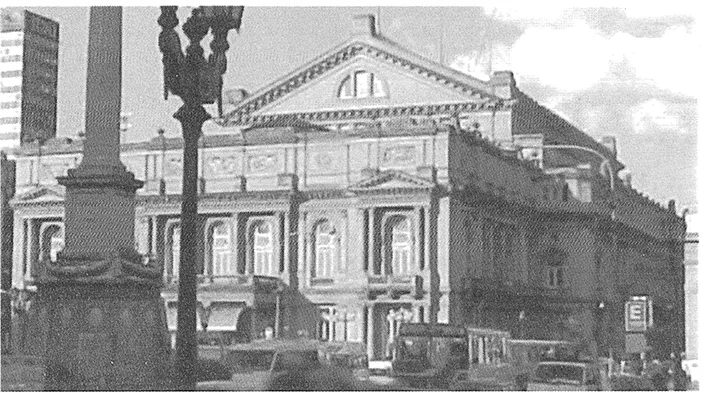
As these examples show, Buenos Aires in the 1940s and ‘50s was far from the musical backwater one might imagine it to be. On the contrary, the Teatro Colón had long established a reputation as the leading opera house in Latin America and one of the finest companies in the world (Béhague 1979: 105-10), and the Argentine National Symphony Orchestra could rival that of many European countries. The influx of refugees from Europe helped to transform Buenos Aires into one of the most vibrant cities in the world as far as its musical life was concerned. The Teatro Colón, for instance, was led by Fritz Busch from 1933 to 1936 and Erich Kleiber from 1936 to 1949, and practically all major soloists and conductors regularly performed in the city. Additionally, there were many private organizations led by members of the upper classes so that, according to Kagel, one could choose between six or seven classical concerts a day (Klüppelholz 2001: 228). Apart from classical music, Kagel also revelled in Argentina’s rich indigenous music, the tangos and malambos, as well as in the various immigrants’ musics – not least among them Yiddish klezmer which Kagel celebrated in his ‘Osten for Salon Orchestra’ more than thirty years later.
Like Verdi before him, Kagel failed the auditions to the local conservatoire. Plans to study with one of the greatest of autodidacts, Arnold Schoenberg, also came to nothing, since, apart from the financial constraints of the Kagel household, Schoenberg had already quit teaching and died soon afterwards (Klüppelholz 1991c: 46). Nevertheless, Kagel received a thorough grounding in musicianship and composition. Of decisive importance in this respect was his involvement with the Agrupación Nueva Música from 1947, which was often conducted by his teacher Theodor Fuchs, and for whom he later worked as pianist and artistic adviser (the group’s other pianist was Michael Gielen who would go on to become one of the most distinguished interpreters of new music and who still acts as an important propagator of Kagel’s work). The group also performed some of Kagel’s early works (Reich 2001: 1). The Agrupación’s founder was Juan Carlos Paz, a charismatic composer whose influence on Kagel can hardly be overestimated, although a rupture between the two meant that Kagel never credited Paz after his departure from Argentina (Rebstock, forthcoming). Although Kagel took only very few formal lessons with Paz as he found him less inspiring in one-to-one tuition than in his informal advice,5 Paz’s aesthetic beliefs formed the backbone of the Agrupación and were therefore instrumental in shaping Kagel’s compositional development. Paz is a unique figure in Latin-American music in that he fervently rejected nationalism, which reigned supreme in the musical life of practically all Latin-American countries, and instead advocated the most advanced compositional styles and techniques. The programme policy of the Agrupación, together with that of its more conservative and nationalist ‘rival’, the Grupo Renovación, present a picture of advanced contemporary music in Buenos Aires as diverse as that of any European or North-American city of the time. Whereas the Grupo favoured broadly speaking neo-classicist composers such as Stravinsky, Milhaud, Hindemith, Copland, and de Falla, the Agrupación supported avant-garde figures such as Schoenberg, Webern, Co well, Varèse, and, by the late 1940s, Cage and Messiaen (Béhague 1979: 272). Paz had adopted twelve-note technique as early as 1934 – a revolutionary position as far as Latin America was concerned (Béhague 1979: 273) – and moved on to more experimental techniques in the 1950s. He also wrote several books, the most influential of which is Introducción a la música de nuestro tiempo (Paz, 1955), which demonstrates his profound insights into practically all then current trends, as well as expressing his messianic passion for the avant-garde and disdain for nationalism. There can be little doubt that Kagel profited greatly from the involvement with Paz’s circle and his unique connections; a review by Kagel on a performance of one of Paz’s works is almost hagiographie (Kagel 1953a). An article from 1953 on Dallapiccola’s Canti di prigionia shows the twenty-one-year-old composer to be not only well aware of Dallapiccola’s work but also that of his younger compatriots Bruno Maderna and Luigi Nono, who were only then beginning to make an impact (curiously, though, he calls them dodecaphonic, being apparently unaware of integral serialism, which is consistent with Kagel’s own music of the time which is also dodecaphonic but not integrally serial). He also mentions musique concrète which was then still in its infancy (Kagel 1953b). There can be no doubt that he owes this knowledge to Paz (if possibly indirectly). His peers, such as Francisco Kröpfl (the director of the Agrupación Nueva Música from 1956), Gerardo Gandini, Mario Davidovsky, and (from a younger generation) Mariano Etkin and Horacio Vaggione – all sadly undervalued in Europe – also testify to the creative potency of Argentine music from the period, in which the Agrupación played a crucial part.
The cosmopolitanism and modernism of the Agrupación Nueva Música and to an extent the Grupo Renovación present a somewhat partial picture of the state of contemporary music in the Buenos Aires of the 1940s and ‘50s, however. ‘Official’ musical life was dominated by ‘folkloristic nationalism’, as typified by the most influential Argentine composer of the time, Alberto Ginastera (Béhague 1979: 212-20). Ginastera, too, however, fell foul of the regime of Juan Perón, who governed the country from 1946 to 1955 – if on account of his political convictions, not his aesthetic persuasion.
Although the regime was unable to formulate a coherent cultural policy, Perón’s autocratic rule had a paralyzing effect on Argentina’s arts scene – lavish support for work that was deemed propagandistically useful notwithstanding. There is no question of the contempt in which Kagel as well as his family and associates held the regime. Given such an oppressive ideology, the revolutionary nature of the Agrupación and the single-minded determination of Paz can hardly be overestimated. In this context, Kagel’s persistent opposition to nationalist aesthetics and fervent embrace of cosmopolitanism may be an even clearer indication of Paz’s influence than his adoption of dodecaphony.
On Fuchs’s recommendation (Reich 2001: 1), Kagel also gained a foothold in the more established musical life by becoming maestro interno, that is rehearsal pianist and assistant conductor, at the Teatro Colón in 1956, after having earlier worked freelance at the Chamber Opera of Buenos Aires, where he took part in productions of Britten’s The Little Sweep and some of Milhaud’s chamber operas (Klüppelholz 2001: 289). Through this work, Kagel gained more inside knowledge of the workings of an opera house and hands-on experience in practical musicianship than most composers of his generation can lay claim to. This would be of vital importance for his later career, particularly as regards his more experimental works, although or rather because they tend to resist convention.
Apart from his musical studies, Kagel read literature and philosophy at the university, also developing a penchant for anthropology and religious studies. He even had plans to graduate with a dissertation on Spinoza and Kierkegaard (Klüppelholz 2001: 30), but his developing musical career put an end to these. This slightly unusual route for a budding composer may lie at the heart of Kagel’s uncommon approach to music which emphasizes the meaning and communicative function of music and its role in society even more than the music’s structural make-up. His versatility, use of diverse media, and the wealth of extra-musical contexts in his work may also be related to his university education. One of the most decisive influences in this regard was his English lecturer at the private Colegio Libre de Estudios Superiores: Jorge Luis Borges, one of the greatest South-American writers, and also part-Jewish.6 One does not have to look long and hard to detect Borges’s influence in Kagel’s work in his preoccupations with labyrinths, encyclopaedias, cabbalistic concepts and techniques, and the idea of parallel realities governed by strange rules (Heile 2001b, Allende-Blin 1991). In this context, the association with surrealism which has become a commonplace in Kagel criticism reveals a Eurocentric perspective: the parallels with Borges as well as what has become known as South-American ‘magical realism’ (whose founding father, Alejo Carpentier, Kagel has also acquainted) are far more notable.7 Influenced by the formidable Victoria Ocampo and her acclaimed journal Sur, Borges also became a figurehead for the cosmopolitan ideas of the Argentine intelligentsia of the time, which were also embraced by Paz and the Agrupación Nueva Música (Rebstock, forthcoming). Borges formulated perhaps the most brilliant attack on (literary) nationalism: in his programmatically titled essay ‘The Argentine Writer and Tradition’ Borges argues that it is limiting and nonsensical to treat only Argentine themes in one’s work as the nationalists argued, since ‘either being Argentine is an inescapable act of fate – and in that case we shall be so in all events – or being Argentine is a mere affectation, a mask’ (Borges 1970: 219). The article culminates in the call that ‘we should feel that our patrimony is the universe’ (ibid.), a sentiment which resonates in a lot of Kagel’s works as well as his comments, and which Klüppelholz (2001: 28), for one, tentatively connects to a particularly Jewish sensibility (although this belief was shared by non-Jewish artists).
Figure 1.1
The Teatro Colón in Buenos Aires
Borges also fostered another distinctive feature of Kagel’s creative personality, his use of visual media, by employing him as photography and film editor of his journal nueva vision. Kagel’s passion for film and other visual arts goes back further though. Having grown up right next to one of Latin America’s premier film studios (SADE), the young Mauricio pestered staff long enough to be permitted entrance to observe the work and finally to work as an extra (Klüppelholz 2001: 168ff.). There he appeared alongside one of the principal actresses, who was picked up after work in a conspicuous limousine: Eva Duarte, later to be known as Ev(it)a Perón. During the shortages of WWII and its aftermath Kagel was also involved in restoring films which were destined for destruction for gaining raw material for the chemical industry. The films thus rescued were to act as the stock of the Cinemateca Argentina of which Kagel became a member. He also claims to have been the first to synchronize René Clair’s Entr’acte with Satie’s music for the film (Kagel 1982; Reich 2001: 4). In 1954 he wrote the music to Alejandro Sanderman’s Muertes de Buenos Aires on Borges’s poem of the same title (now in the Museum of Modern Art, New York); the film was duly banned by the censors for showing people scavenging for food on a landfill (that Borges was a dissident may also have played a role; Kagel 1982; Reich 2001, 4; Klüppelholz 2001: 179f.). Shortly after that, Kagel himself directed another film which featured empty buildings; this was accompanied by ‘acoustical loops’ from a chamber ensemble, thus introducing the deliberate non-synchronicity which would become a hallmark of his later films. Kagel’s interest in visual and mixed media can also be traced to the decisive influence the Bauhaus had in Buenos Aires at the time, after several influential artists had emigrated there, including the photographer Grete Stern, whom Kagel knew well (Klüppelholz 2001: 178f; Rebstock, forthcoming).
Besides Borges, Kagel was also introduced to another great writer then living in Argentina, the Polish novelist Witold Gombrowicz, who found himself in Argentina at the outbreak of the war and thought it best to stay. Kagel (in Klüppelholz 2001: 276) and Allende-Blin (1991) paint amusing portraits of Gombrowicz. A Rabelaisian character renowned for his irreverence and bitter sarcasm, he was the exact antipode to the cultured, bookish and monkish Borges. According to Allende-Blin, the near-blind Borges seemed never to have been young, whereas Gombrowicz refused to grow up (a dominant theme of his own writings); he acted every bit the badly behaved aristocrat. In order to have a chat with him, Kagel had to challenge him for a game of chess in the smoky atmosphere of the Café Rex, since playing chess was about the only thing Gombrowicz did apart from writing. Kagel’s scepticism towards lofty ideas and bourgeois high culture, his contempt for concert hall rituals, his sarcasm and surreal wit as well as his capacity for scandal owe a great deal to the Polish polemicist.
Literature was to remain one of Kagel’s greatest loves; in conversation and in his essays he comes across as unusually well-read. This erudition finds its way into his compositions in all imaginable ways except for the most conventional: text-setting, which Kagel avoids precisely because of his reverence for literature. As a well-read intellectual he is no exception among composers, but he has never allowed his intellectual insights to solidify into the ideological or aesthetic dogmatism which continues to blight the musical scene in his adopted country. Rather than assuming the messianic tone of the manifesto, Kagel’s writings are more akin to the Borgesian mould of essay-writing in that they draw on a multitude of sources and make all sorts of surprising and often witty connections between art forms, disciplines, cultures and periods.
Many of Kagel’s early works have been lost since his departure to Germany in 1957. Since he planned to stay only a year, he did not take all of his compositions with him. Little did he know that he was only to return home twice and for brief periods.8 The exceptions are his Variations for mixed quartet and the first version of what was to become his String Sextet (often referred to in its Spanish title Sexteto de cuerdas). Therefore, the little that is known about the other works is mostly due to his own accounts.9 Like most composers, Kag...
Table of contents
- Cover Page
- Title Page
- Copyright Page
- Contents
- List of Illustrations
- List of Music Examples
- Acknowledgements
- Introduction In Search of Kagel
- 1 Buenos Aires
- 2 Beginnings in Cologne: Serialism, Aleatory Technique and Electronics
- 3 The Instrumental Theatre
- 4 Experimentalism and Multimedia
- 5 Referentiality and Postmodernism
- 6 Apocrypha and Simulacra
- Notes
- Chronological List of Works
- Select Bibliography
- Index of Works
- Index of Names
Trusted by 375,005 students
Access to over 1.5 million titles for a fair monthly price.
Study more efficiently using our study tools.
Frequently asked questions
Yes, you can cancel anytime from the Subscription tab in your account settings on the Perlego website. Your subscription will stay active until the end of your current billing period. Learn how to cancel your subscription
No, books cannot be downloaded as external files, such as PDFs, for use outside of Perlego. However, you can download books within the Perlego app for offline reading on mobile or tablet. Learn how to download books offline
Perlego offers two plans: Essential and Complete
- Essential is ideal for learners and professionals who enjoy exploring a wide range of subjects. Access the Essential Library with 800,000+ trusted titles and best-sellers across business, personal growth, and the humanities. Includes unlimited reading time and Standard Read Aloud voice.
- Complete: Perfect for advanced learners and researchers needing full, unrestricted access. Unlock 1.5M+ books across hundreds of subjects, including academic and specialized titles. The Complete Plan also includes advanced features like Premium Read Aloud and Research Assistant.
We are an online textbook subscription service, where you can get access to an entire online library for less than the price of a single book per month. With over 1.5 million books across 990+ topics, we’ve got you covered! Learn about our mission
Look out for the read-aloud symbol on your next book to see if you can listen to it. The read-aloud tool reads text aloud for you, highlighting the text as it is being read. You can pause it, speed it up and slow it down. Learn more about Read Aloud
Yes! You can use the Perlego app on both iOS and Android devices to read anytime, anywhere — even offline. Perfect for commutes or when you’re on the go.
Please note we cannot support devices running on iOS 13 and Android 7 or earlier. Learn more about using the app
Please note we cannot support devices running on iOS 13 and Android 7 or earlier. Learn more about using the app
Yes, you can access The Music of Mauricio Kagel by Björn Heile,Bj�rn Heile in PDF and/or ePUB format, as well as other popular books in Medios de comunicación y artes escénicas & Música. We have over 1.5 million books available in our catalogue for you to explore.