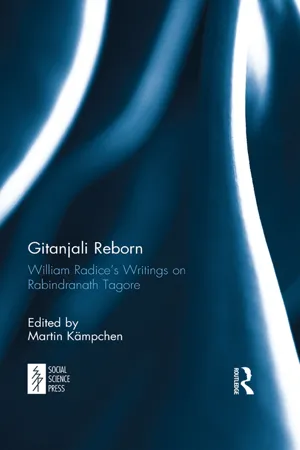
- 246 pages
- English
- ePUB (mobile friendly)
- Available on iOS & Android
eBook - ePub
About this book
Radice, himself a recognized English poet and erudite scholar, delved into the deeper meaning of Tagore's poems and songs, and discussed his ideas on education and the environment with an insight probably no other Westerner has. He also translated Tagore's short stories and short poems, and finally was able to make a complete breakthrough by translating Gitanjali afresh and restoring Tagore's original English manuscript. Martin Kämpchen lives in Santiniketan, West Bengal and Germany and is a reputed Tagore scholar and writer.
Information
Tagore and Christianity
Iam the proud custodian of a manuscript letter from Rabindranath Tagore, written in 1914. It was given to me by Tony and Jean Brown, who now live in Ludlow, Shropshire. From 1961 to 1967 they worked for the Baptist Missionary Society in East Pakistan (now Bangladesh). Tony became the administrator of the Arthington Mission Hospital in Chandraghona, Chittagong Hill Tracts. They both learnt Bengali well. Later, after returning to the UK, Tony became Senior Tutor and then Principal of Woodbrooke College in Selly Oak, Birmingham, the international Quaker College. A previous Senior Tutor of the College, Rendel Harris, had acquired a copy of Rabindranath Tagore’s Gitanjali (the reprint of January 1914) and had pasted into the book a letter from Tagore that was clearly a reply to a letter from him. Tagore wrote:
Shanti Niketan
Bolpur. Bengal
Feb. 16. 1914
Dear Sir,
Thank you for your kind letter of appreciation. The poem about the woman by the well, referred to in your letter, had been written when I was not acquainted with the story of the Samaritan woman. The expression “lash of lightning” has its obvious meaning.
Yours truly
Rabindranath Tagore
Mr Harris must have been alluding to Gitanjali no. 54, which begins, ‘I asked nothing from thee; I uttered not my name to thine ear.’ The reference to ‘lash of lightning’ is harder to place: the only comparable phrase in Gitanjali is in poem, no. 40: ‘Send thy angry storm, dark with death, if it is thy wish, and with lashes of lightning startle the sky from end to end.’ I do not know what, if any, biblical reference Mr Harris was making here, as in the Bible the normal phrase is ‘flash of lightning’.
Tagore’s polite dismissal of any connection between his poem and the encounter between Jesus and the Samaritan woman by the well, described in St John’s Gospel, ch. 4, is perfectly reasonable. Other than the fact that a thirsty traveller meets a woman at a well, there is really no connection between the Gospel story and Tagore’s poem. The Samaritan woman does not give Jesus any water, but gets immediately interested when he starts to talk about the water of everlasting life. The English style that Tagore adopted for his translation of Gitanjali and subsequent books and poems often seemed biblical to its readers, and it was natural for Rendel Harris and others to look for allusions to the Bible. But in the original Bengali this poem is written in ballad-like stanzas, and in my own new translation of Gitanjali, I have tried to capture the form and tone of the original:
I didn’t ask for anything,
I didn’t speak my name.
When you took your leave of me,
Bashful I became.
I sat alone beside the well,
Deep in the neem’s shade;
Others had with water-pots
Returned to where they stayed.
They had on leaving called to me,
‘Come, it’s noon, it’s late.’
Somehow I could not shake off
My silent, pensive state.
I didn’t hear your footsteps when
You hobbled close and said,
With weary voice and plaintive eyes,
‘I’m thirsty, nearly dead—’
At once I rose and rushed to fetch
Fresh water from the well
To pour into your outstretched hands,
Your thirstiness to quell.
Koels somewhere chirped amidst
The rustling of the trees;
Acacia-blooms along the paths
Scented the midday breeze.
When you asked me for my name,
I suddenly felt shy.
What had I done that you should want
A name to know me by?
I had simply given you
Some water from the well:
To ask my name rewarded me
More than I can tell.
It’s late and by the well-side still
Koels keep up their tune;
The neem still rustles; I just sit
And linger long past noon.1
From this translation, it will, I think, be clear that the poem does not allude to any text or tradition. It is a pure product of Tagore’s imagination, and is all the more poignant and beautiful for being so. Tagore’s letter reflects the kind of misunderstanding that frequently arose from his own translations, from their secondary translation into other languages, and from the extraordinary international fame he enjoyed after winning the Nobel Prize for Literature in November 1913. Tagore was not a Christian. Readers who thought his poems seemed Christian were wrong, and they would instantly have seen that they were wrong if they had been able to read the poems in the original Bengali.
This, among readers and critics who know Bengali, would be the standard view. In my reading, over the last four decades, of what has been written about Tagore, in Bengali or in English, I have very rarely encountered much reference to Christianity. Even the careful and scholarly researches of Jose Chunkapura S.D.B., whose book The God of Rabindranath Tagore, based on his doctoral thesis at the Pontifical Gregorian University in Rome, relegates connections between Tagore and Christianity to a nineteen-page section at the end, and concludes: ‘In our opinion, the influence of Christ and Christianity on Rabindranath’s understanding of God consisted primarily in deepening, strengthening and confirming the ideas that he already had.’2
Yet if one goes really deeply into the poems and songs of Gitanjali, as I have inevitably done through doing my new translation, and if one reads many other works by Tagore, including the six heartfelt and penetrating essays on Christianity that he delivered as Christmas Day sermons at Santiniketan, one is inclined to think hard about whether it is correct or fair to leave Christianity so firmly on the periphery of Tagore’s life and work. My purpose in this article is to make an initial and tentative survey of this ‘yet’, and to argue that among the many influences on Tagore’s sensibility and creative achievement Christianity deserves to be given serious and respectful attention.
It is a difficult topic, one that I myself have shirked for a long time. The reasons for shirking it are obvious. They go back to the many sensitivities that were aroused in India by Christian missionaries. In the early years of East India Company rule, the British authorities were well aware of the trouble that missionaries could cause, and did their best to keep them out. In Bengal, the famous Baptist missionary, William Carey (1761–1834) was obliged to base his activities as a scholar and printer of Bengali and other Indian languages at Serampore, a Danish trading station up the Hooghly from Calcutta and outside British control. Pressure from Charles Grant and the evangelical Clapham Sect on the Court of Directors of the East India Company eventually led to the insertion of a ‘pious clause’ in its renewed charter of 1813, allowing missionaries and churches to operate freely. From then on, Christian churches became significant threads in the complex tapestry of nineteenth century Calcutta, and their contribution to education remains influential to this day. But relations between Christianity and the predominantly Hindu culture of modern Bengal were never easy, and became even more strained with the growth of nationalism and Hindu revivalism at the end of the nineteenth century. Tagore’s stance on nationalism and revivalism was critical, and at times scathing, but as his oeuvre and standing grew, he came to be seen, and is still seen, as the powerful embodiment not only of modern Bengali culture but of the whole civilization of modern India. The Christian churches are now an established part of modern Indian life, and their rights and freedom are respected under India’s secular constitution. But it is fully understandable that in the Bengali and Indian context—a context to which I myself must be constantly sensitive—Tagore’s relationship to Christianity is not a topic on which his countrymen are inclined to put much stress. I doubt if it has featured at a single one of the numerous celebrations and symposia that have been organised in many parts of the world in 2011, the 150th anniversary of Tagore’s birth.
That Tagore himself was aware of the sensitivities is readily apparent from the first of his sermons on Christianity, dated 25 December 1910. Tagore gave regular sermons in the Kāñcher Mandir or ‘Glass Temple’ which continues to play a central role in the life of the Santiniketan community today. His Christmas Day sermons began as a result of a decision in 1910 to honour the birth or death anniversaries of great religious teachers with special festivals. His sermon of 1910 entitled Yisucharit (‘The character of Jesus’) was the longest and most wide-ranging of the essays that were later gathered into a book called Khrishta (1959). It was also published as an introduction to a book with the same title by Ajit Kumar Chakravarty, a young teacher at Santiniketan, who went to Britain in September 1910 to study at Harris Man...
Table of contents
- Cover
- Half Title
- Title Page
- Copyright Page
- Dedication
- Table of Contents
- Preface
- Bringing in the Harvest
- The Genius of the Poet Tagore
- Globetrotting with Rabindranath
- Gitanjali Reborn, One Undred Years Later: The Story of a Discovery
- Panting the Dust and the Sunlignt: Rabindranath Tagore and the Two Gitanjalis
- Transpanting the Songs of Tagore
- Master of Empathy Probing the Genius of Rabindranath
- On the Seashore of a Great Poem
- What I have Learnt from Tagore
- The Possibiities and Problems of Tagore Translation
- Rabindranath, Maker of Paths
- The Balance of Complexity and Simplicity
- Tagore before and After 1912
- Tagore’S Sense of Rhythm
- Tagore and Christianity
- The Wakening of Shiva Rabindranath Tagore’s Spanish Incarnation
- The Teacher of Poetry and Life
- Bengal’S Gifts to the World
- Rabindranath Tagore the Next Fifty Years
- Photo Essay by Martin Kämpchen
Trusted by 375,005 students
Access to over 1.5 million titles for a fair monthly price.
Study more efficiently using our study tools.
Frequently asked questions
Yes, you can cancel anytime from the Subscription tab in your account settings on the Perlego website. Your subscription will stay active until the end of your current billing period. Learn how to cancel your subscription
No, books cannot be downloaded as external files, such as PDFs, for use outside of Perlego. However, you can download books within the Perlego app for offline reading on mobile or tablet. Learn how to download books offline
Perlego offers two plans: Essential and Complete
- Essential is ideal for learners and professionals who enjoy exploring a wide range of subjects. Access the Essential Library with 800,000+ trusted titles and best-sellers across business, personal growth, and the humanities. Includes unlimited reading time and Standard Read Aloud voice.
- Complete: Perfect for advanced learners and researchers needing full, unrestricted access. Unlock 1.5M+ books across hundreds of subjects, including academic and specialized titles. The Complete Plan also includes advanced features like Premium Read Aloud and Research Assistant.
We are an online textbook subscription service, where you can get access to an entire online library for less than the price of a single book per month. With over 1.5 million books across 990+ topics, we’ve got you covered! Learn about our mission
Look out for the read-aloud symbol on your next book to see if you can listen to it. The read-aloud tool reads text aloud for you, highlighting the text as it is being read. You can pause it, speed it up and slow it down. Learn more about Read Aloud
Yes! You can use the Perlego app on both iOS and Android devices to read anytime, anywhere — even offline. Perfect for commutes or when you’re on the go.
Please note we cannot support devices running on iOS 13 and Android 7 or earlier. Learn more about using the app
Please note we cannot support devices running on iOS 13 and Android 7 or earlier. Learn more about using the app
Yes, you can access Gitanjali Reborn by Martin Kämpchen in PDF and/or ePUB format, as well as other popular books in Literature & Translating & Interpreting. We have over 1.5 million books available in our catalogue for you to explore.