eBook - ePub
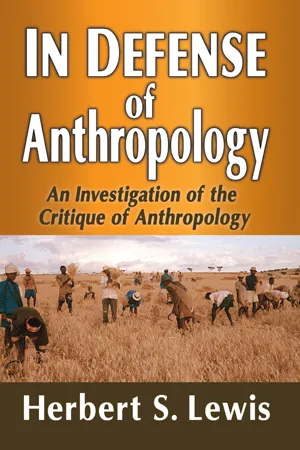
In Defense of Anthropology
An Investigation of the Critique of Anthropology
- 261 pages
- English
- ePUB (mobile friendly)
- Available on iOS & Android
eBook - ePub
About this book
This book argues that the history and character of modern anthropology has been egregiously distorted to the detriment of this intellectual pursuit and academic discipline. The "critique of anthropology" is a product of the momentous and tormented events of the 1960s when students and some of their elders cried, "Trust no one over thirty!" The Marxist, postmodern, and postcolonial waves that followed took aim at anthropology and the result has been a serious loss of confidence; both the reputation and the practice of anthropology has suffered greatly. The time has come to move past this damaging discourse. Herbert S. Lewis chronicles these developments, and subjects the "critique" to a long overdue interrogation based on wide-ranging knowledge of the field and its history, as well as the application of common sense. The book questions discourses about anthropology and colonialism, anthropologists and history, the problem of "exoticizing'the Other,'" anthropologists and the Cold War, and more. Written by a master of the profession, In Defense of Anthropology will require consideration by all anthropologists, historians, sociologists of science, and cultural theorists.
Information
1
The Misrepresentation of Anthropology and Its Consequences
Over the past four decades cultural anthropology has undergone a farreaching series of changes that have transformed the field drastically. In the view of many members of an older generation, educated before the 1960s, these changes have left the discipline in a state of severe crisis, its future seriously in doubt. Anthropology is not the only field in this situation: the study of literature and some forms of history have been going through similar changes, but it is different with anthropology because the majority of anthropologists for much of the twentieth century looked upon our field as a social science rather than one of the humanities. Insofar as it is a science, anthropologists generally believed that their methods and cumulative knowledge could build progressively, in a collective quest for more reliable understandings of the phenomena we study (cf. Wolf 1994: 227; for history see Berkhofer 1995; Coleman 1998, 2002; Evans 1999).
When Franz Boas and Robert Lowie criticized the evolutionary paradigm, they did so in the name and interest of improved science, as did Radcliffe-Brown and Malinowski when they, too, sought to replace evolutionism and diffusionism with their versions of functionalism. When Leslie White in his turn attacked Boas and Lowie, it was to advance his “science of culture.” Opponents of the personality and culture school or of structural-functionalism were critical of these approaches because they believed them to be inadequate to the problems they sought to solve. This is generally not true of the most influential critics of the field since the Sixties who are more likely to condemn the very notion that anthropology can or should claim to be scientific, if, indeed, they don’t condemn science itself as part of the so-called Enlightenment project, or claim that scientific theories are no more than socially constructed narratives that scientists tell themselves—in the interest of power and to disempower others. (The literature is vast. Two examples:, Latour and Woolgar 1979; Haraway 1989; see Nugent 1996: 442. For critical responses see: D’Andrade 1995, Gross and Levitt 1994, Reyna 1994, Sokal and Bricmont 1998, Spiro 1966.)
The Origins of the Post-1960S Critique of Anthropology
The roots of today’s attack on the discipline are exogenous in a way that the earlier ones were not, even though there may have been external dimensions to those debates as well. The origins of much of the current rebellion lie in the events of the late 1960s and the reaction of many Americans, young and older, to the Vietnam war and the international student movement of that period. (For a discussion of that period and its effects, see chapter 2.) These movements were originally associated with wide-ranging political and intellectual criticisms of US and Western colonialism and capitalism, with Marxist thought playing a crucial role (e.g., Asad 1973, Hymes 1969), but they were soon extended more broadly to an attack on the West, the Enlightenment, science, humanism, modernism, culture, and lots more.
Whereas many American and British anthropologists who grew up during the Great Depression were inclined toward socialism and Marxism, they still believed in anthropology as a science. But now even the truths of Marxism are in doubt. The hoped-for revolution has not come about, and the many governments that claimed inspiration and guidance from Marx and his heirs were admitted failures. Today, for many of those who counted on the imminent coming of the great socialist transformation, the hold of capitalism, neoliberalism, and patriarchal hegemony in the context of a pernicious globalization is seen as so great and so corrupting that they no longer hope for anything better. And the whole Enlightenment ideal, humanism and all that went with it, are condemned as nothing but lies—a system of domination through which European and American males control all Others.
For inspiration, some members of the generation now at the center of influence looked to sources outside anthropology, to such philosophers as Nietzsche and Heidegger, to the critical theory of the Frankfurt School, to Gramsci, and to more recent French writers: Foucault, Derrida, and Lacan.1 A common theme of the new anthropology, derived from these writers, is an obsession with power and domination that must be unmasked in all human discourse and intercourse. Many seem to agree with Nietzsche that “life itself is essentially appropriation, injury, overpowering of the strange and weaker, suppression, severity, imposition of one’s own forms, incorporation and, at the least and mildest, exploitation …” ([1886] 1973: 175; emphasis in original). The apparent positives such as love, altruism, justice, equality, consideration for others, order, harmony, peace, sanity, health, community, knowledge, science are but the tricky words used to befuddle and benumb the critical faculties of the dominated in order for the dominant to achieve and maintain control. They are elements in Nietzsche’s “slave morality” and “herd morality” ([1886] 1973: 178).
Here, for example, is a prominent anthropological example of this approach from Johannes Fabian’s widely cited Time and the Other (1983: 1). Speaking of “Anthropology’s claim to power” (which, he says, is part of its “essence” and “not a matter of accidental misuse”) and of its “alliance with the forces of oppression,” Fabian says, “Nowhere is [it] more clearly visible … than in the uses of Time anthropology makes when it strives to constitute its own object—the savage, the primitive, the Other. It is by diagnosing anthropology’s temporal discourse that one rediscovers the obvious, namely that there is no knowledge of the Other which is not also a temporal, a historical, a political act.”2 Why anthropologists would supinely accept and even gleefully cite such essentialized and essentially preposterous claims about their field and its “claim to power” [our power?]—without subjecting this work, page by page, to serious critical interrogation—I cannot imagine.
The postmodernist condemnation of the Enlightenment project has been harnessed to the dissatisfactions, the pain, the struggles of the oppressed and powerless. Anthropology, dealing as it does with the most intimate, as well as the most public, of behaviors—of all people in all parts of the world—lives on the front lines. By our very involvement with all peoples we are engaged with those folks that our critics call “the Other.” We are therefore vulnerable to criticism and attack on many grounds. As a result, an atmosphere of intolerance and generalized condemnation of anthropology and anthropologists has become more than fashionable; indeed, it is virtually obligatory among anthropologists themselves as well as among a widening group of critics outside the field. For example, the general complicity of anthropology and anthropologists with “the project of colonialism” seems now to be accepted as a fact rather than as a question requiring investigation and demonstration. On the other hand, the political and intellectual roots of this critique itself, originally a product of the Cold War, are unquestioned. (See chapters 4 and 5.)
But this mood must pass, because all intellectual fashions do—eventually. The problem is, where will anthropologists turn when the current conventions have been set aside? In such cases it is common practice to take another look at earlier ideas, but anthropologists who might want to do this will face unusual difficulties.
A terrible gap has opened up—an awesome chasm, in fact— separating this generation of students and younger anthropologists from the knowledge, data, theories, and understandings developed in the field up to about 1965. The current generation has been told many things about the anthropology of the past, things that cast doubt upon the writings produced by the practitioners of all older anthropology. These anthropologists were not only wrong; they were probably sinful as well. (Thus George Marcus speaks of “the positivist sins of the past” [the back cover, Taussig 1987].) It would seem that the only reason to read them is to produce devastating deconstructions and critical readings. That there may be ideas that could be of use today, or bodies of data that can be appreciated and built upon, seems out of the question. This is very troubling, because the intellectual problems that are at the heart of our field have not been solved by the hermeneuticists, the postmodernists, the poststructuralists, the postcolonialists. To quote Santayana’s warning once more, with dismaying pertinence: “Those who cannot remember the past are condemned to repeat it.” The basic questions that our predecessors struggled with a hundred years ago are still with us, but the hard-won lessons they taught us are being forgotten. (Roseberry makes a similar point [1995: 155, 173–74].) This is a potentially serious problem, and it is time for us to begin taking a new look at the realities of anthropology’s past before it is too late, before too much is forgotten.
The Aims and Procedure of This Paper
It is not my intention to criticize the creative work of post-1970s anthropologists, many of whom have produced valuable studies and introduced useful critical perspective into the debates over how to study and represent the peoples and cultures of the world. What I will do, however, is criticize the negative and exceedingly careless way in which the older anthropology has been represented in leading works and by leading figures of the new anthropology. I maintain that these inaccurate representations have become the conventional wisdom and have seriously affected the education of graduate students and the future of our field.
I will argue that the time has come to begin a reconsideration of the current conventional wisdom regarding the history and nature of anthropology, a view that has become hegemonic in today’s discourse. In effect I will be calling for us to begin the “spiral” process that George Marcus and Michael Fischer (1986: 10) speak of. “Rather than mere repetition [in intellectual history], there is a cumulative growth in knowledge, through the creative rediscovery of older and persistent questions in response to keenly experienced moments of dissatisfaction with the state of a discipline’s practice tied to perceptions of unprecedented changes in the world.” I believe it is both necessary and timely to attempt such a creative rediscovery, in this case a rediscovery of our ancestors and of their approaches to these old and persistent problems.
In this attempt to open up a reconsideration, I shall present and discuss three widely accepted criticisms of pre-1970s anthropology that have become part of the standard representation of our past. These claims, I shall argue, are highly questionable at best and relatively easily falsified by a look at the actual—rather than the imagined—history of the field. If it should be objected that the counterexamples I give were not typical, although I believe that to a considerable extent they were, I would respond that no one approach was ever typical—that pluralism was always the rule. One problem with the current critique of anthropology is the failure to recognize the normal, everyday extent of the variety within the field. There is a common tendency to funnel all of our past through a quick reference to (but only a reference, not an examination of) the work of several famous anthropologists—Radcliffe-Brown, Malinowski, Benedict, Levi-Strauss, and Geertz—and to pretend that these selected famous individuals represent the field. But the failure to consider both the range of variation and the ideas and works of a broad sample of professional anthropologists results in a serious distortion of our intellectual history. (In fact, the work of American anthropologists is usually ignored and its history elided with the tacit assumption that the representation of British anthropology can stand for American anthropology as well.) The critics have done unto anthropology what they claim anthropology does unto Others: essentialize, totalize, stereotype, “otherize.”
Three Representative Claims about Anthropology
The three claims I discuss can be found in concise and explicit form in an article by Roger M. Keesing (1994), published in a volume with contributions from many distinguished anthropologists. Roger Keesing was a major contributor to anthropology over the decades before his death at an early age and his writing could often serve as a weather vane. In this case he stated the new conventional wisdom very clearly.
1. According to Keesing’s critique: anthropology treats the peoples it studies as “radically alter,” not to be understood in the same ways that we understand ourselves. “If radical alterity did not exist, it would be anthropology’s project to invent it.” Radical alterity, he writes, “a culturally constructed Other radically different from Us—fills a need in European social thought. … I believe we continue to overstate Difference, in search for the exotic and for the radical Otherness Western philosophy, and Western cravings for alternatives, demand” (p. 301, emphasis added). Since Edward Said’s book Orientalism, this sort of critique has been widely accepted as true. Elsewhere Keesing (1990: 168) speaks of “anthropology’s Orientalist project of representing Otherness.” Said’s project seems to have succeeded remarkably well. It is not easy to disabuse graduate students of the notion that anthropologists study only the exotic, the Other, even by reading to them lists of PhD dissertations or titles of papers at AAA meetings that focus on peoples and topics very close to home.3
Here is another example, from Arturo Escobar’s summary of Lila Abu-Lughod’s position on culture (Abu-Lughod 1991):
To the extent that the culture concept has been the primary tool for making the other and for maintaining a hierarchical system of differences, we must direct our creative efforts against this concept, she prescribes, by “writing against culture.” We need to look at similarities, not only at differences; by emphasizing connections, we also undermine the idea of “total” cultures and peoples… . Can we emphasize not boundedness and separateness but connections? (Escobar 1993: 381, emphasis added)
I shall argue that claims like these indicate a lack of knowledge of the history and nature of our field and do great injustice to it.4
2. Keesing contends that anthropology has always been ahistorical. According to Keesing, “The world of timeless, endlessly self- reproducing structures, social and ideational, each representing a unique experiment in cultural possibility, has (we now know) been fashioned in terms of European philosophical quests and assumptions, superimposed on the peoples encountered and subjugated along colonial frontiers” (p. 301; cf. Dirks 1992: 3–4; Wallerstein 1996.) Johannes Fabian’s book Time and the Other: How Anthropology Makes Its Object (1983) is the text of choice here, with its claim that anthropologists dominate by denying “coevalness,” contemporaneity, to the exotic Others whom we study, our “Objects” (no longer our “Subjects”).
3. Roger Keesing claimed that anthropologists treated each culture as an isolated unit, unconnected to any others. “Their cultures are hermetically sealed, beyond the reaches of time and the world system,” he says (p. 306).
This is so much a part of the current discourse that Andre Gunder Frank (1990), scorning “traditional” anthropology at the 1990 Annual Meeting of the AAA, claimed that Boas’s study of the designs on Eskimo needle cases (Boas 1908) was designed to show the “separateness of cultures.” That Frank did not know what Boas’s paper is actually about is unimportant; what is disturbing is that he could make such a statement before a hall full of anthropologists and remain unchallenged.
Keesing goes on to decry those who “edit out Christianity, trade stores, labor migration, contemporary politics and cash economy” in accounts of his ethnographic area, Melanesia (p. 306).
Lest it be thought that these claims about anthropology are idiosyncratic and uncharacteristic, Terence Turner has enunciated a similar set of charges. Turner writes of (a) “the chronic anthropological tendency … to focus on cultures as discrete units in isolation;” (b) “the tendencies … to treat culture as an autonomous domain, e.g., as ‘systems of symbols and meanings’ essentially unconditioned by material, social, and political processes, and the concomitant abstraction of cultural change from political or social relations, particularly relations of inequality, domination, and exploitation” (Turner 1993: 415). Elsewhere (1991: 292) he speaks of anthropology as having “defined itself in abstraction from the ‘situation of contact,’ as the antithesis of ‘change’ and the enemy of ‘history.’”
These sorts of claims are by now so wid...
Table of contents
- Cover
- Half Title
- Title Page
- Copyright Page
- Dedication
- Table of Contents
- Acknowledgments
- Introduction
- 1 The Misrepresentation of Anthropology and Its Consequences
- 2 The Radical Transformation of Anthropology: History Seen through the Annual Meetings of the AAA, 1955–2005
- 3 Anthropology Then and Now
- 4 Was Anthropology the Child, the Tool, or the Handmaiden of Colonialism?
- 5 Imagining Anthropology’s History
- 6 The Passion of Franz Boas
- 7 Franz Boas: Boon or Bane?
- 8 American Anthropology and the Cold War
- 9 Anthropology or Cultural and Critical Theory?
- Epilogue
- References
- Index
Trusted by 375,005 students
Access to over 1.5 million titles for a fair monthly price.
Study more efficiently using our study tools.
Frequently asked questions
Yes, you can cancel anytime from the Subscription tab in your account settings on the Perlego website. Your subscription will stay active until the end of your current billing period. Learn how to cancel your subscription
No, books cannot be downloaded as external files, such as PDFs, for use outside of Perlego. However, you can download books within the Perlego app for offline reading on mobile or tablet. Learn how to download books offline
Perlego offers two plans: Essential and Complete
- Essential is ideal for learners and professionals who enjoy exploring a wide range of subjects. Access the Essential Library with 800,000+ trusted titles and best-sellers across business, personal growth, and the humanities. Includes unlimited reading time and Standard Read Aloud voice.
- Complete: Perfect for advanced learners and researchers needing full, unrestricted access. Unlock 1.5M+ books across hundreds of subjects, including academic and specialized titles. The Complete Plan also includes advanced features like Premium Read Aloud and Research Assistant.
We are an online textbook subscription service, where you can get access to an entire online library for less than the price of a single book per month. With over 1.5 million books across 990+ topics, we’ve got you covered! Learn about our mission
Look out for the read-aloud symbol on your next book to see if you can listen to it. The read-aloud tool reads text aloud for you, highlighting the text as it is being read. You can pause it, speed it up and slow it down. Learn more about Read Aloud
Yes! You can use the Perlego app on both iOS and Android devices to read anytime, anywhere — even offline. Perfect for commutes or when you’re on the go.
Please note we cannot support devices running on iOS 13 and Android 7 or earlier. Learn more about using the app
Please note we cannot support devices running on iOS 13 and Android 7 or earlier. Learn more about using the app
Yes, you can access In Defense of Anthropology by Herbert S. Lewis in PDF and/or ePUB format, as well as other popular books in Social Sciences & Anthropology. We have over 1.5 million books available in our catalogue for you to explore.