![]() Designing for/with food
Designing for/with food![]()
Design and development of a lunchbox to carry healthy meals
V. Duarte
Polytechnic Institute of Cávado and Ave, Barcelos, Portugal
ABSTRACT: Daily activities and the lack of alternatives often interfere in the preparation of healthy, balanced, hygienic, and delicious food. Therefore, the hypothesis discussed consists in presenting a lunchbox inserted in a healthy lifestyle context that naturally preserves food temperature. The bases of emotional design were taken into account in order to understand how the experience through emotion happens. The proposal that emerges in this work focuses a research done by different authors. Usability tests were carried out, and inquiries related to them, whose data collected were treated with the help of the SPSS statistical software and an Excel sheet, in order to obtain a qualitative and quantitative evaluation. In conclusion, it is hoped that it will be a contribution to future researches about the ways the product design can act with healthy eating.
1 INTRODUCTION
Lunchbox is a useful interface between food and consumers; its primary functions are to protect and store food, and its secondary functions are mainly related to the importance of getting the lunchbox to communicate with the users (Norman, 2004).
In this regard, the increased competition in the lunchbox and food packaging market is forcing companies and researchers to invest in a functional design that generates a positive emotional experience in the interaction between user and object, exploring, for example, the fact that materials with pleasant textures provide comfort through touch, the fact that balanced colours allow the product to convey pleasant sensations through sight, or of the fact that the shape of the product can trigger memories associated with other products or references to nature (Clarkson, 2008; Hekkert & Leder, 2008; Nefs, 2008; Schifferstein & Spence, 2008; Sonneveld & Schifferstein, 2008; Vink & De Looze, 2008).
All the factors that allow a product to trigger an experience are intended to add value to it, so that it can stand out and meet the consumers’ preferences (Meiselman, 2008; Mugge et al., 2008; Shin & Wang, 2015).
That said, an aesthetically appealing product was created to store, protect and carry meals, particularly healthy meals, to the workplace and while travelling, to be used either on a daily basis or occasionally. The term healthy means that there is an emphasis on the preservation of health, thus fostering healthy eating habits and raising people’s awareness to the type and amount of food they eat.
Currently, the food packaging and lunchbox market is missing a product that is simultaneously focused on the importance of choosing natural materials, on separating each food group by size in different modular containers, and on placing a hole in each container with the purpose of storing hot or frozen water to preserve the food at the desired temperature.
That said, the article consists of seven sections, namely introduction, short literature review, methods used, product description, results, discussion and conclusions and future prospects.
2 BRIEF REVIEW OF THE LITERATURE
2.1 Importance of emotional design
Emotional design is developed with the purpose of triggering positive emotions (Desmet & Hekkert, 2009; Ortony & Turner, 1990; Walter, 2011). It is related to three different cerebral processing levels: visceral, behavioural and reflective. The visceral level enables quick judgements of what is good and bad, safe and dangerous, being related to the initial impact of the product. The behavioural level is associated with usage, with the experience we have via the function, performance and usability of a given object. On the other hand, the reflective level is related to the meaning and memories triggered by a product, as well as to the personal satisfaction it provides (Norman, 2004).
Desmet (2002) has developed a user emotion interface measuring tool, known as PrEmo, focused on specific product characteristics. Using fourteen characters, each of which represents a specific emotion, users are invited to assess and describe how they feel. Furthermore, users are allowed to assign more than one emotion to the same moment, thus being able to describe more complex emotional responses. There are fourteen emotions divided into two groups—seven pleasant emotions and seven unpleasant emotions; the positive emotions are: desire, satisfaction, inspiration, fascination, amusement, pleasant surprise and admiration. The negative emotions are: disgust, boredom, indignation, unpleasant surprise, contempt, disappointment and dissatisfaction (Desmet, 2002).
3 METHODS
In order to develop this project, the IDEO method was ideally chosen, in order to obtain a useful and pleasant solution through the process and analysis of design thinking approaches. Design thinking can be interpreted as an innovative methodology that systematically integrates technical and human factors in order to solve design-related problems (Brown, 2009).
The IDEO design method is divided into five stages, known as (Brown, 2009):
• Empathize: it is necessary to understand the consumer.
• Define and synthesize: it is important to interpret the consumer's needs and wishes.
• Ideate: brainstorming ideas, which allows exploring possible solutions and alternatives.
• Prototype, assess and enhance: this stage involves producing something tangible based on what was designed and selected, to test the idea and the product.
• Implement and test: once there is a more consistent product, it is important to test it on the users.
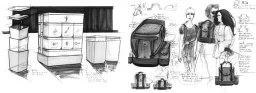
Initially, there were questionnaires distributed online during the month of May 2016, via the Googledocs platform, to allow identifying the possible needs of people. Then, were developed possible solutions through sketches. Next, from the 10 final concepts, was chose the most relevant one (Fig. 1). The choice of the final concept was made by 36 individuals.
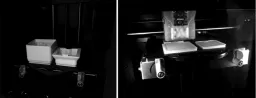
Once the final concept was chosen, were defined every technical and aesthetic aspect of the product. In order to define every technical aspect in detail, it was necessary to develop virtual models, 3D prints and prototypes. The volumetric studies (3D prints and prototypes), were mainly used as first attempts to turn the idea into early physical representations, in order to test them. The various parts were initially designed in Solidworks and then saved as an STL file format, to allow transferring the designs from the CAD (computer-aided design) software to the rapid 3D prototyping machine in order to physically produce the parts (Fig. 2). The prototype of the bag was made by the sewing machine.
Figure 1. From left to right: Container sketch and backpack sketch (final concept).
Figure 2. 3D prints of the parts of one of the containers.
To validate the prototype, were carried out usability tests in mid-October 2016, which involved 98 individuals from the district of Aveiro, Portugal, of both genders, with ages ranging from 18 to 65. The age group was chosen considering the active population on the labour market.
It was possible to divide the participants into two groups: those who care about having healthy eating habits, comprising 39 individuals, and the group of those who do not care about eating balanced meals, comprising 59 individuals.
The usability tests were based on the collection and analysis of information for a qualitative and quantitative assessment of the use of the prototype and on an analysis of the emotions experienced according to desmet’s premo measuring tool. In order to handle the obtained data as a statistical analysis, was used the Statistical Package for the Social Sciences software (SPSS) and the Excel spreadsheet.
4 PRODUCT DESCRIPTION
Product is a bag that can also work as a backpack, which has food containers, stoppers and straps to fasten the containers’ lids inside (Figs 3, 4).
In order to keep the food at the appropriate temperature, there is a hole that allows using hot water or water at room temperature for freezing (the container should be placed in the freezer for the water to freeze), according to the type of food that is placed in each container. The final product should have various containers, each of which is adjusted to a specific food group. The chosen food groups were suggested by the respondents, and are the following: whole grains, vegetables, legumes, fish, salad, soup, seeds, fruit and natural beverage. The sizes of the various containers were defined based on opinions provided by nutritionists.
The container presented in this study is the one designed for the vegetable group; it is made from ABS (Acrylonitrile butadiene styrene), because it is still a prototype, but we should note that the final product should be ceramic.
The backpack is made from “burel” fabric, as this 100% natural, resistant and flexible fabric is a material with a high level of impermeability; the structure is made from cork sheets, an impact-resistant material that allows protecting the containers. The colours chosen for the bag were brown and gray, as most of the possible users of the product mentioned them in the questionnaires when they were asked about their favourite colours.
The container straps which allow holding the containers are also made from cork, sealing...