eBook - ePub
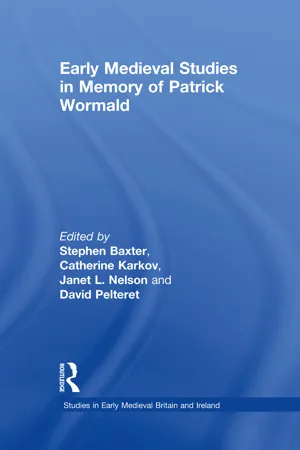
Early Medieval Studies in Memory of Patrick Wormald
- 602 pages
- English
- ePUB (mobile friendly)
- Available on iOS & Android
eBook - ePub
Early Medieval Studies in Memory of Patrick Wormald
About this book
Patrick Wormald was a brilliant interpreter of the Early Middle Ages, whose teaching, writings and generous friendship inspired a generation of historians and students of politics, law, language, literature and religion to focus their attention upon the world of the Anglo-Saxons and the Franks. Leading British, American and continental scholars - his colleagues, friends and pupils - here bear witness to his seminal influence by presenting a collection of studies devoted to the key themes that dominated his work: kingship; law and society; ethnic, religious, national and linguistic identities; the power of images, pictorial or poetic, in shaping political and religious institutions. Closely mirroring the interests of their honorand, the collection not only underlines Patrick Wormald's enormous contribution to the field of Anglo-Saxon studies, but graphically demonstrates his belief that early medieval England and Anglo-Saxon law could only be understood against a background of research into contemporary developments in the nearby Welsh, Scottish, Irish and Frankish kingdoms. He would have been well pleased, therefore, that this volume should make such significant advances in our understanding of the world of Bede, of the dynasty of King Alfred, and also of the workings of English law between the seventh and the twelfth century. Moreover he would have been particularly delighted at the rich comparisons and contrasts with Celtic societies offered here and with the series of fundamental reassessments of aspects of Carolingian Francia. Above all these studies present fundamental reinterpretations, not only of published written sources and their underlying manuscript evidence, but also of the development of some of the dominant ideas of that era. In both their scope and the quality of the scholarship, the collection stands as a fitting tribute to the work and life of Patrick Wormald and his lasting contribution to early medieval studies.
English Politics and Law (Ninth–Twelfth Centuries)
Chapter 20
The Fonthill Letter, Ealdorman Ordlaf and Anglo-Saxon law in practice
Nicholas P. Brooks
The remarkable document that is the subject of this paper has long been familiar both to students of Old English and to Anglo-Saxon historians. Thus it was included in nineteenth-century collections of documents such as Benjamin Thorpe's Diplomatarium of 1865 and John Earle's Handbook of 1888 and it found a deserved place for Cambridge students in Wyatt's oft reissued Anglo-Saxon Reader of 1919.1 Historians with little or no command of Old English were helped to appreciate its importance by the excellent translations, first in the edition of Florence Harmer in 1914 and then in 1955 in Dorothy Whitelock's first volume of English Historical Documents.2 It may have somewhat fallen from the attention of budding English philologists at Oxford, since it found no place in Sweet's Anglo-Saxon Reader of 1876 or in its numerous re-editions through to the 1970s. But happily it has been reinstated to the canon of learning texts in Bruce Mitchell's Invitation to Anglo-Saxon England of 1995 and Richard Marsden's Cambridge Old English Reader of 2004.3
I provide below a new edition and parallel translation of the so-called 'Fonthill Letter' drawn from the forthcoming edition of the Charters of Christ Church Canterbury which Dr Susan Kelly and I are editing for the British Academy series 'Anglo-Saxon Charters'. The document will be numbered no. 104 in our edition, which is scheduled for publication in three volumes in 2010.4
Letter to King Edward the Elder recounting a dispute over an estate at Fonthill, Wiltshire [A.D. 899x 24]
MS Canterbury, Dean & Chapter Library, Chart. Ant. C. 1282 (Red Book, no.12): original, s.xin, 173/159 x 380 mm.
Endorsements: (1) in a contemporary hand: see (b). (2) in a hand of s. xii: Inutile
Principal Editions: BCS 591; Harmer, SEHD, no. 18
Listed: S 1445; H.P.R. Finberg, Early Charters of Wessex, Studies in Early English History, 3 (Leicester, 1964), no. 227; P. Wormald, 'A Handlist of Anglo-Saxon Lawsuits', ASE, 17 (1988), 247–81, nos. 23–6
Note on editing: The manuscript of this complex document has no punctuation at all and uses no capital letters. In order to make the text comprehensible full stops, question marks and capitals have therefore been inserted where appropriate; and the lengthy text has been divided into convenient paragraphs. The practice of earlier editors of inserting commas where some Anglo-Saxon scribes might have used punctus has not been followed; and it should be observed that a different editor might well divide the text into more sentences. Supplied readings where the manuscript is damaged are italicized and placed within square brackets.
| + Leof ic ðe cyðe hu hit ƿæs ymb ðæt lond æt Funtial ða fif hida ðe Æðelm Higa ymb spycð. Ða Helmstan ða undæde gedyde ðæt he Æðęredes belt for'stæl'a ða ongon Higa him specan sona on mid oðran onspecendan ]ƿolde him oðflitan ðæt lond. Ða sohte he me ] bæd me ðæt ic him ƿære forespeca forðon ic his hæfde ær onfongen æt biscopes honda ær he ða undæde 'gedyde'a.Ða spæc ic him fore ] ðingade him to Ælfrede cinge. Ða God forgelde his saule ða lyfde he ðæt he moste beon ryhtes ƿyrðe for mire forspæce ] ryhtrace ƿið Æðelm ymb ðæt lond. Ða het he hie seman. Ða ƿæs ic ðara monna sum ðe ðærto genemned ƿæran ] ƿihtbord ] <Ælfric>b ƿæs ða hrælðen ]Byrhthelm ]ƿulfhun ðes blaca æt Sumortune ] Strica ] Ubba ] ma monna ðonne ic nu genemnan mæge. | Sir. I will relate to you how it was concerning the estate at Fonthill, the five hides which Æthelm Higa is claiming. When Helmstan committed the offence of stealing Æthelred's belt, Higa immediately began to bring a charge against him, along with other claimants, and wished to gain the land from him by legal process. Then he [Helmstan] sought me and begged me to be his advocate, because I had previously received him from the bishop's hand [i.e. stood sponsor for him at confirmation] before he had committed that offence. Then I spoke on his behalf and interceded for him with King Alfred. Then – may God reward his soul – he [the king] granted that he [Helmstan] should be allowed to establish right in relation to Æthelm concerning that land, because of my advocacy and correct account. Then he ordered them to be brought to an |
| agreement. Then was I one of those who were nominated thereto, and [so were] Wihtbrord and Ælfric, the wardrobe-thegn, and Byrhthelm and Wulfhun the Black of Somerton, and Strica and Ubba and more men than I am now able to name. | |
| Ða reahte heora aegðer his spell ða ðuhte us eallan ðæt Helmstan moste gan forð mid ðon bocon ] geagnigean him ðæt lond ðæt he hit hæfde sƿa Æðeldryð hit Osulfe on æht gesealde ƿið gemedan feo ] heo cƿæð to Osulfe ðæt heo hit ahte him ƿel to syllanne forðon hit ƿæs hire morgengifu ða heo æ[re]st to Aðulfec com. ] Helmstan ðis eal on ðon aðe befeng. ] Ælfred cing ða Osulfe his hondsetene sealde ða he ðæt lond æt Æðeldryðe bohte ðæt hit sƿa stondan moste ] Eadweard his ] Æðelnað his ] Deormod his ] ælces ðara monna ðe mon ða habban ƿolde. Ða ƿe hie æt Ƿeardoran nu semdan ða bær mon ða boc forð ] rædde hie. Ða stod seo hondseten eal ðæron. Ða ðuhte us eallan ðe æt ðære some ƿæran ðæt Helmstan d ƿære aðe ðæs ðe near. | Then each of them related his version; then it seemed to us all that Helmstan might proceed with the books [i.e. land-charters] and state his claim for the estate: [namely] that he had it just as Ætheldryth had given it into Oswulf's ownership for a fair price; and that she had declared to Oswulf that she possessed it with the full right to give [it away], since it was her morning-gift when she first came to Athulf. And Helmstan included all this in his oath. And King Alfred had given his 'hand-setting' [i.e. subscription] for Oswulf, when he had bought the estate from Ætheldryth, in order that it might so stand, and Edward gave his and Æthelnoth his and Deormod his, and [so did] each of the men whom one then wanted to have. When we were reconciling them at Wardour, the book [charter] was brought forth and read: then all the subscriptions were found thereon. Then it seemed to all of us who were at that settlement that Helmstan was in consequence nearer to the oath. |
| Ða næs Æðelm na fullice geðafa ær ƿe eodan in to cinge ] sædan eall hu ƿe hit reahtan ] be hƿy ƿe hit reahtan. ] Æðelm stod self ðærinne mid. ] cing stod ðƿoh 'his'a honda æt Ƿeardoran innan ðon bure. Ða he ðæt gedon hæfde ða ascade he Æðelm hƿy hit him ryht ne ðuhte ðæt ƿe him gereaht hæfdan cƿæð ðæt he nan ryhtre geðencan ne meahte ðonne he ðone að agifan | Then Æthelm would not agree fully before we went in to the king and told exactly how we had adjudged it and why we had adjudged it; and Æthelm himself stood there with us. And the king stood [and] washed his hands in the chamber at Wardour. When he had finished that, he asked Æthelm why what we had resolved for him did not seem right to him, saying that he could |
| moste gif he meahte. Ða cƿæð ic ðæt he ƿolde cunnigan ] bæd ðone cing ðæt he hit andagade. ] he ða sƿa dyde. ] he gelædde ða to ðon andagan ðone að be fulla[n. ]]e bæd me ðæt ic him fultemade ] cƿæð ðæt him ƿære leofre ðæt he [ðæt land me se]aldee ðonne se að forburste oððe hit æfr[e Higan sie gelyfe]de.f Ða cƿæð ic ðæt ic him ƿolde fylstan to ryhte ] næfre to nanan ƿo on ða gerada ðe he his me uðe. ] he me ðæt on ƿedde gesealde. | think of nothing more right than that he [Helmstan] must produce the oath if he could. Then I declared that he wished to attempt it and requested the king to fix a day for it, and he then did so. And on the appointed day he performed the oath in full. He [Helmstan] begged me that I should support him and said that he would rather give [the land to me] than that the oath should fail or it ever [be allowed to Higa]. Then I declared that I would help him to [his] right, but never to any wrong, on condition that he granted it [the land] to me; and he gave me that pledge. |
| ] ƿe ridan ða to ðon andagan. ic ] Ƿihtbord rad mid me ] Byrhthelm rad ðider mid Æðelme. ] ƿe gehyrdan ealle ðæt he ðone að be fulan ageaf. Ða ƿe cwædan ealle ðæt hit ƿære geendodu spæc ða se dom ƿæs gefylled. ] leof hƿonne bið engu spæc geendedu gifmon ne mæg noƿðer ne mid feo ne mid aða geendigan? Oððe gif mon ælcne dom wile onƿendan ðe Ælfred cing gesette hƿonne habbe ƿe ðonne gemotad? ] he me ða boc ða ageaf sƿa he me on ðon ƿedde ær geseald hæfde sona sƿa se að agifen ƿas. ] ic him gehet ðæt he moste ðes londes brucan ða hƿile ðe he lifde gif heg hine ƿolde butan bysmore gehealdan. | And then we ... |
Table of contents
- Cover Page
- Half Title Page
- Frontispiece
- Title Page
- Copyright Page
- Table of Contents
- Foreword
- Preface
- Abbreviations
- List of Illustrations
- Patrick Wormald
- Studies: Celtic and Anglo-Saxon Foundations
- Gregory and Bede
- Carolingian Authority and Learning
- English Politics And Law (Ninth–Twelfth Centuries)
- Church. Cult And Memory in England
- General Index
- Index of Anglo-Saxon Charters
- Index of Manuscripts
Trusted by 375,005 students
Access to over 1.5 million titles for a fair monthly price.
Study more efficiently using our study tools.
Frequently asked questions
Yes, you can cancel anytime from the Subscription tab in your account settings on the Perlego website. Your subscription will stay active until the end of your current billing period. Learn how to cancel your subscription
No, books cannot be downloaded as external files, such as PDFs, for use outside of Perlego. However, you can download books within the Perlego app for offline reading on mobile or tablet. Learn how to download books offline
Perlego offers two plans: Essential and Complete
- Essential is ideal for learners and professionals who enjoy exploring a wide range of subjects. Access the Essential Library with 800,000+ trusted titles and best-sellers across business, personal growth, and the humanities. Includes unlimited reading time and Standard Read Aloud voice.
- Complete: Perfect for advanced learners and researchers needing full, unrestricted access. Unlock 1.5M+ books across hundreds of subjects, including academic and specialized titles. The Complete Plan also includes advanced features like Premium Read Aloud and Research Assistant.
We are an online textbook subscription service, where you can get access to an entire online library for less than the price of a single book per month. With over 1.5 million books across 990+ topics, we’ve got you covered! Learn about our mission
Look out for the read-aloud symbol on your next book to see if you can listen to it. The read-aloud tool reads text aloud for you, highlighting the text as it is being read. You can pause it, speed it up and slow it down. Learn more about Read Aloud
Yes! You can use the Perlego app on both iOS and Android devices to read anytime, anywhere — even offline. Perfect for commutes or when you’re on the go.
Please note we cannot support devices running on iOS 13 and Android 7 or earlier. Learn more about using the app
Please note we cannot support devices running on iOS 13 and Android 7 or earlier. Learn more about using the app
Yes, you can access Early Medieval Studies in Memory of Patrick Wormald by Stephen Baxter, Catherine Karkov, Janet L. Nelson, David Pelteret, Stephen Baxter,Catherine Karkov,Janet L. Nelson,David Pelteret in PDF and/or ePUB format, as well as other popular books in History & World History. We have over 1.5 million books available in our catalogue for you to explore.